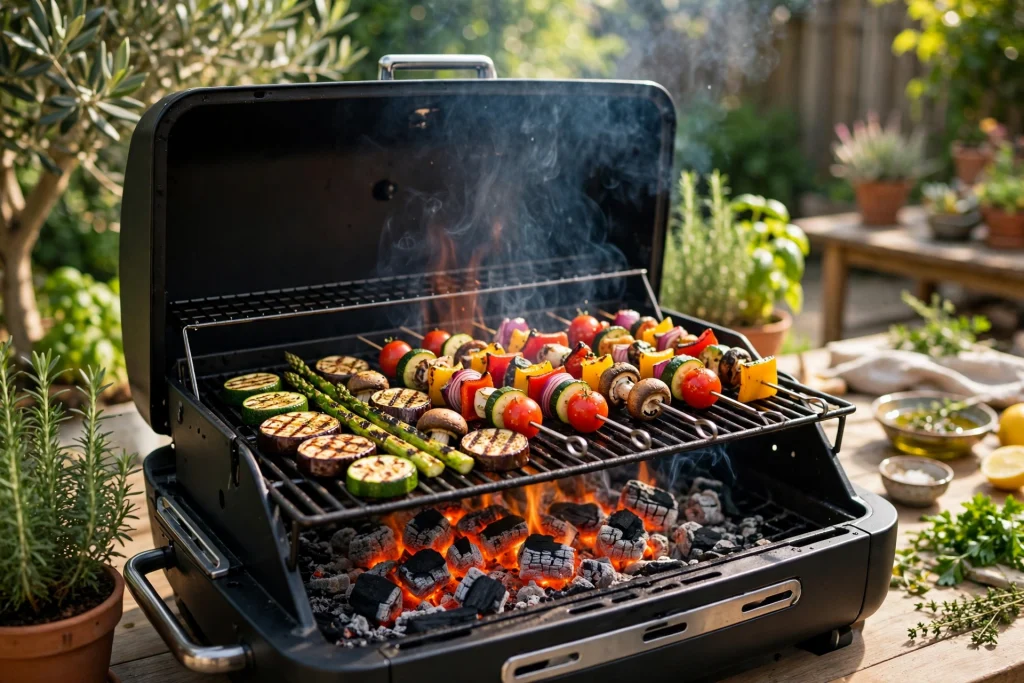

Asking for the hottest grill is really asking two questions: which type of grill can reach the highest temperature, and how hot do you actually need it to be? The answer to the first is clear: a charcoal kamado or a lump-charcoal grill can reach 700°F to 900°F, hotter than most gas grills, which usually top out at 500°F to 700°F. The answer to the second is more useful: for a proper steak sear you need about 500°F to 700°F, for burgers about 450°F to 500°F, and for pizza, 700°F or more.
This guide compares the maximum temperatures of charcoal, gas, pellet, electric and infrared grills, explains why a grill’s advertised maximum is not the whole story, and shows you how to get your own grill hotter, how to measure the heat, and how to use high heat without burning your food or yourself.
How Hot Do Different Grills Get?
Maximum temperature depends on fuel, airflow and insulation, not just on the brand name. A thin, leaky charcoal grill will never get as hot as a thick ceramic kamado, even with the same charcoal. The table below gives the realistic maximums you can expect from each type when it is clean, preheated and used properly.
| Grill type | Typical maximum | Best for | Main limit |
|---|---|---|---|
| Charcoal kamado (ceramic) | 750°F to 900°F | Searing steak, pizza, high-heat cooking | Expensive, heavy, slow to cool |
| Lump-charcoal kettle grill | 700°F to 800°F | Searing, direct grilling | Heat falls as charcoal burns down |
| Briquette charcoal grill | 500°F to 700°F | Steady, even heat | Briquettes burn cooler than lump charcoal |
| Infrared gas grill | 700°F to 900°F | Fast searing | Can burn food quickly, pricey |
| Standard gas grill | 500°F to 700°F | Everyday grilling, burgers, chicken | Burner power and lid design limit heat |
| Pellet grill | 450°F to 500°F | Smoking, low-and-slow cooking | Not designed for high-heat searing |
| Electric grill | 400°F to 500°F | Balconies and flats where gas is banned | Low power, slow recovery |
Two points stand out. First, charcoal is the heat king: lump charcoal burns hotter than briquettes because it is pure carbonised wood with no binders, and a kamado’s thick ceramic walls hold that heat in instead of letting it escape. Second, a pellet grill, which many people buy for smoking, is one of the coolest grills on the list, so it is a poor choice if searing is your main goal.
What Temperature Do You Actually Need?
Hotter is not always better. The Maillard reaction, the browning that gives grilled meat its flavour, starts at about 300°F, and a good sear happens at 500°F to 700°F. Above 800°F, the outside of a steak can burn before the inside is cooked, and thin foods such as fish or vegetables will char in seconds.
| Food | Best grill temperature | Why |
|---|---|---|
| Steak (searing) | 500°F to 700°F | Fast browning, juicy centre |
| Burgers | 450°F to 500°F | Even cooking, good crust |
| Chicken pieces | 375°F to 450°F | Cooked through without burning the skin |
| Fish fillets | 400°F to 450°F | Delicate flesh, quick cooking |
| Vegetables and halloumi | 400°F to 500°F | Char marks without drying out |
| Pizza | 700°F to 900°F | Crisp base in 2 to 3 minutes |
| Low-and-slow barbecue | 225°F to 275°F | Tender meat, smoke flavour |
A worked example makes the point. Take a 1-inch ribeye steak. At 700°F, it needs about 90 seconds per side for a medium-rare sear, then a few minutes resting away from the heat. At 500°F, the same steak needs about 2 to 3 minutes per side, and the crust will be lighter. At 400°F, it will take 4 to 5 minutes per side and will be more grey than brown. The hotter grill does not cook the steak faster in total, it just browns the outside faster, which is exactly what a sear is for.
How to Get Your Grill Hotter
- Use lump charcoal, not briquettes: lump charcoal burns hotter and lights faster, and it leaves less ash to block airflow.
- Open the vents: fire needs oxygen. Open the bottom and top vents fully for maximum heat, and close them down to cool the grill.
- Preheat with the lid on: give a gas grill 10 to 15 minutes and a charcoal grill 20 to 30 minutes to reach full temperature.
- Clean the grates: a dirty grate blocks heat and sticks food. Brush it hot, then oil it lightly before cooking.
- Do not overcrowd the grate: food releases moisture, which cools the surface. Cook in batches if you need a good sear.
- Use a chimney starter: it lights charcoal evenly and gets it to cooking temperature in about 15 minutes.
How to Measure Grill Temperature
The lid thermometer on most grills is unreliable, because it measures the air at the top of the lid, not the heat at the grate. For a real reading, use an infrared thermometer pointed at the grate, or a probe thermometer clipped to the grate. As a rough guide, hold your hand about 6 inches above the grate: if you can hold it there for 2 to 3 seconds, the grill is at about 500°F to 600°F; 4 to 5 seconds means about 400°F; and 6 to 7 seconds means about 300°F. Use this hand test only for a quick check, and never touch the grate.
Choosing the Hottest Grill for You
Buy for the cooking you actually do, not for the highest number on the box. If you sear steaks and make pizza most weekends, a kamado or a lump-charcoal kettle is the best choice, and it will also smoke low and slow when you close the vents. If you grill burgers and chicken on weeknights, a good gas grill at 500°F to 700°F is more convenient and still hot enough. If you mainly smoke brisket and ribs, a pellet grill is the right tool, even though it is not the hottest. And if you live in a flat with a balcony, check the rules first: many buildings ban charcoal and gas, leaving electric as the only option.
High heat is also about what you cook on it. A thick cut such as tri-tip takes a hard sear beautifully, so read our guide to tri-tip: what it is, where the cut comes from, and how to cook it before you buy a whole roast for the grill. Halloumi is another high-heat favourite: it holds its shape on a hot grate, as explained in what is in halloumi cheese. For the opposite end of the scale, low-and-slow cooking, see our pork shoulder crock-pot recipe, which shows how the same cut can be cooked gently instead of seared.
Safety at High Heat
Never use a grill indoors, in a garage, or under a low roof, because charcoal produces carbon monoxide and gas grills produce heat and fumes that can build up quickly. Keep the grill at least 10 feet from your house, deck railings and overhanging branches, keep children and pets away, and keep a spray bottle of water and a fire extinguisher nearby. Let charcoal cool completely before you dispose of the ash, and never leave a hot grill unattended.
Frequently Asked Questions
What is the hottest type of grill?
A charcoal kamado or an infrared gas grill, both of which can reach 750°F to 900°F. A lump-charcoal kettle grill is close behind at 700°F to 800°F.
How hot does a gas grill get?
Most standard gas grills reach 500°F to 700°F with the lid closed and all burners on high. Infrared gas grills can reach 700°F to 900°F.
Is 700°F too hot for grilling?
Not for searing a thick steak or cooking pizza, but it is too hot for chicken, fish and vegetables, which will burn on the outside before they cook inside. Use high heat for a short sear, then move food to a cooler part of the grill to finish.
Do pellet grills get hot enough to sear?
Usually not. Most pellet grills top out at 450°F to 500°F, which is enough for burgers but not for a hard steak sear. Some pellet grills have a sear zone or a cast-iron plate that helps, but a charcoal or infrared grill is better for searing.
The Bottom Line
The hottest grill is a charcoal kamado or an infrared gas grill, at 750°F to 900°F, but the best grill for you is the one that reaches the temperature your food needs. For most people, that means 500°F to 700°F for searing, 450°F to 500°F for everyday grilling, and 225°F to 275°F for low-and-slow barbecue. Choose the fuel and the design that match your cooking, preheat properly, and measure the heat at the grate, not on the lid.