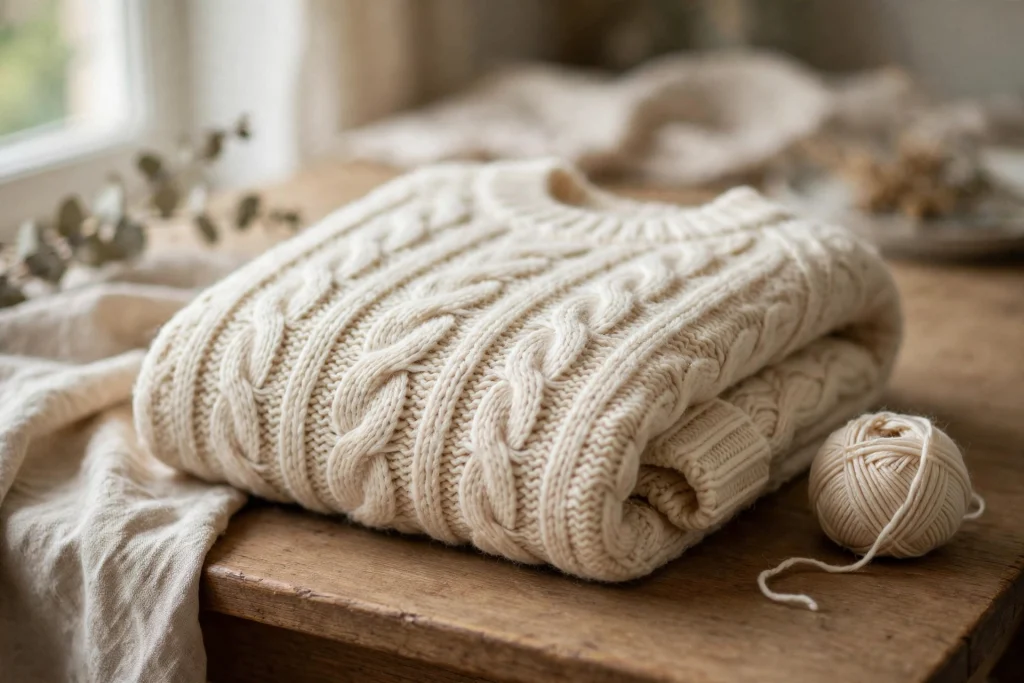

An alpaca jumper is a sweater knitted from alpaca fibre, the soft, hollow hair of the alpaca, a camelid farmed in the Andes of Peru, Bolivia and Chile. It looks like an ordinary wool jumper, but it behaves very differently: it is lighter than sheep’s wool, warmer for its weight, and it contains no lanolin, the oily substance in sheep’s wool that makes many people itch. That combination explains why alpaca jumpers have moved from a niche, craft-market buy to a mainstream winter staple, with prices now ranging from about $45 for a basic blended jumper to more than $255 for a 100% baby alpaca piece.
In this guide you will learn what an alpaca jumper really is, how warm it is compared with wool and cashmere, how to spot a genuine one, what you should expect to pay, and how to wash and store it so it lasts for years rather than one season.
What Is an Alpaca Jumper?
A jumper is the British name for a sweater, so an alpaca jumper is simply a sweater made wholly or partly from alpaca fibre. The fibre comes from two breeds: huacaya alpacas, whose dense, crimped fleece makes soft, springy yarn, and suri alpacas, whose long, silky locks make a smoother, drapier yarn. Most jumpers on sale are huacaya, or a blend of huacaya with wool, acrylic or a small amount of nylon for shape.
Alpaca fibre is graded by diameter, measured in microns. The finer the fibre, the softer it feels against the skin. Baby alpaca is not fibre from a baby animal; it is the finest grade, usually 19 to 22.5 microns, taken from the first shearing or from the softest part of the fleece. Royal alpaca is finer still, at about 18 microns or less, and it is rare and expensive. A jumper labelled simply “alpaca” can be any grade, and it can also be a blend, so the label, not the product name, is what tells you what you are buying.
Why Is Alpaca So Warm?
Alpaca fibre is hollow. Each hair has a hollow core that traps air, and trapped air is an excellent insulator. That is the main reason alpaca is often described as up to seven times warmer than sheep’s wool by weight, a claim repeated by many specialist sellers. Treat that figure as a marketing shorthand rather than a laboratory measurement: it is not a standardised test result, and warmth also depends on how thickly the jumper is knitted, how it fits, and what you wear under it. What is well established is that alpaca gives a lot of warmth for very little weight, so a fine alpaca jumper can feel warm without feeling bulky.
Three other properties matter in everyday wear. First, alpaca has no lanolin, so it is naturally hypoallergenic for most people who react to sheep’s wool, although a small number of people are sensitive to any animal fibre. Second, the fibre is smooth, with fewer scales than sheep’s wool, which is why good alpaca feels silky rather than scratchy and pills less than cheap wool. Third, alpaca is naturally water-resistant and wicks moisture, so it stays comfortable when you move between a cold street and a heated room.
Alpaca vs Wool vs Cashmere
No fibre wins on every measure. The table below compares the three fibres on the points that matter most when you are choosing a jumper.
| Feature | Alpaca | Sheep’s wool (merino) | Cashmere |
|---|---|---|---|
| Warmth for its weight | Very high; hollow fibre traps air | High; crimp traps air | Very high; fine fibres trap air |
| Softness | Very soft, silky; baby alpaca is softest | Soft in fine merino; coarser wool can itch | Extremely soft, but delicate |
| Itch factor | Low; no lanolin | Medium; lanolin and coarser fibres can irritate | Very low |
| Durability and pilling | Good; stronger than cashmere, pills less than cheap wool | Good; merino pills in high-friction areas | Poor; pills and wears thin quickly |
| Water and odour | Naturally water-resistant, low odour | Water-resistant, can hold odour when damp | Absorbs moisture, needs careful care |
| Typical price for a jumper | $45 to $255+, depending on grade and blend | $50 to $200 for good merino | $100 to $400+ for good quality |
| Best for | Cold, dry winters; sensitive skin; everyday warmth | Outdoor layers; hard-wearing everyday jumpers | Luxury, light layers; gentle wear |
If you want one jumper to wear most days in winter, alpaca is usually the practical choice: it is warmer than a comparable merino jumper, tougher than cashmere, and it does not need the delicate handling cashmere does. If you want the softest possible layer for occasional wear, cashmere still wins on feel.
Types of Alpaca Jumper
- 100% baby alpaca: the softest and warmest option, usually fine-gauge and light. Expect to pay $120 to $300 or more. Best for a dressier jumper you will wear often.
- 100% alpaca (standard grade): warm and soft, but slightly heavier and less silky than baby alpaca. A good mid-price choice at $70 to $180.
- Alpaca blend (alpaca and wool): adds structure and lowers the price, often $45 to $100. Check the percentage: a 70% alpaca blend behaves like alpaca, while a 20% blend is mostly wool.
- Alpaca and acrylic blend: cheaper and machine-washable in some cases, but it loses much of alpaca’s breathability and can pill badly. Buy it only if the price is low and you accept the trade-off.
- Chunky knit: thick, loosely knitted jumpers for very cold weather and a relaxed look. Warm, but bulky under a coat.
- Fine-gauge knit: thin, smooth jumpers that layer well under a jacket or coat. The best choice if you want warmth without bulk.
How to Choose an Alpaca Jumper
Start with the label, then the feel, then the fit. A good jumper should state the fibre content in percentages, the grade if it claims baby or royal alpaca, and the country where it was made. Peru is the largest producer, and many of the best-known specialist brands, including PAKA, BellePaga and Gamboa Fashion, source their fibre there.
| Price band | What you usually get | Examples from current listings |
|---|---|---|
| Budget: $45 to $70 | Blended alpaca, often with wool or acrylic; simple crew-neck styles | Basic alpaca-blend jumpers from Gamboa Fashion and similar direct sellers |
| Mid-range: $70 to $180 | Higher alpaca content, better knitting, more colours and fits | Mid-range styles from BellePaga, Everlane and H&M’s premium lines |
| Premium: $180 to $255+ | 100% baby alpaca, fine gauge, hand-finished details | PAKA’s classic alpaca sweater at about $149 to $180, Percival and similar labels above $255 |
Use this five-point check before you buy. First, read the label and look for at least 50% alpaca if you want the fibre’s warmth and softness to be noticeable. Second, hold the jumper to your neck or inner wrist: baby alpaca should feel smooth, not prickly. Third, check the seams and ribbing; neat, even stitching and firm cuffs are signs of a jumper that will hold its shape. Fourth, try your normal size, but size up if you plan to layer it over a shirt, and size down if it is a fine-gauge style meant to sit close to the body. Fifth, look at the return policy, because alpaca softens slightly with wear and you need a few wears to judge it fairly.
How to Spot a Fake Alpaca Jumper
“Alpaca style” and “alpaca feel” are warning signs: they usually mean the jumper contains no alpaca at all. A genuine jumper will list alpaca in the fibre composition, often with a percentage. Very cheap jumpers claiming 100% baby alpaca are also suspect, because baby alpaca fibre is scarce and costly. Acrylic imitations feel slippery and plasticky, do not breathe, and often pill in a hard, beaded way that alpaca does not. If you can, do a simple check: alpaca fibre burns slowly and smells like burnt hair, while acrylic melts and smells chemical, although you should only test a loose thread, not the garment itself.
How to Wash and Care for an Alpaca Jumper
- Wash rarely: alpaca resists odour, so air it out after wearing instead of washing it every time. Most owners wash a jumper only a few times a season.
- Hand wash cold: use cool water and a gentle wool wash, soak for 10 to 15 minutes, and do not rub, twist or wring the jumper.
- Dry flat: roll it in a towel to remove water, then lay it flat on a dry towel away from direct heat. Never tumble dry it and never hang it wet, or it will stretch.
- Remove pills gently: use a fabric comb or a sweater stone, working in one direction. Do not pull pills off by hand, as that can damage the yarn.
- Store against moths: store clean jumpers in a sealed bag or box with cedar blocks or lavender sachets. Moths are attracted to dirty wool, so always wash before storing for summer.
How to Style an Alpaca Jumper
A fine-gauge alpaca jumper is one of the easiest pieces to build a winter wardrobe around. Wear a neutral cream, grey or camel crew-neck over a shirt for a smart look, or with jeans and boots for a relaxed weekend outfit. A chunky knit works best as the outer layer, with a coat on top only in very cold weather. Because alpaca comes in natural, undyed shades as well as dyed colours, it fits naturally into a women’s clothing capsule, where a few versatile pieces are mixed and matched. For layering, the same rules that apply to a button-up vs button-down shirt apply here: a crisp collar under a crew-neck adds structure, while a soft, open collar keeps the look casual. If you want the jumper to work for smart-casual occasions, read our guide to what dressy casual means and choose a fine-gauge style in a solid, muted colour.
Frequently Asked Questions
Are alpaca jumpers itchy?
Good alpaca, especially baby alpaca, is not itchy for most people, because it has no lanolin and its fibres are smooth. Coarse, low-grade alpaca and blends with scratchy wool can still irritate sensitive skin, so try the jumper against your neck before buying.
Are alpaca jumpers warmer than wool jumpers?
Yes, for the same weight. Alpaca’s hollow fibres trap more air than sheep’s wool, so a light alpaca jumper can be as warm as a much heavier wool one. The difference is most noticeable in fine-gauge jumpers, where alpaca gives warmth without bulk.
Can you machine wash an alpaca jumper?
Most makers recommend hand washing in cold water and drying flat. Some blends are labelled machine-washable on a cold, gentle cycle, but follow the care label on your own jumper, because a hot wash can shrink alpaca badly.
How long does an alpaca jumper last?
With gentle washing, flat drying and proper storage, a good alpaca jumper can last many years. Alpaca fibre is stronger than cashmere and resists pilling better than cheap wool, so the main risks are moths, stretching when wet, and shrinking in hot water.
Is alpaca ethical and sustainable?
Alpacas are shorn once a year without harm, they graze lightly on Andean pasture, and their fibre is biodegradable. Look for brands that name their Peruvian or Bolivian cooperatives and pay fair prices to herders, and avoid very cheap jumpers where the supply chain is not disclosed.
The Bottom Line
An alpaca jumper is worth the premium if you want a warm, light, low-itch sweater that lasts. Choose baby alpaca or a high-percentage blend, check the label for the real fibre content, buy a fine-gauge style if you want to layer it, and wash it cold and dry it flat. Do that, and a single good alpaca jumper can replace two or three ordinary wool jumpers in your winter wardrobe.