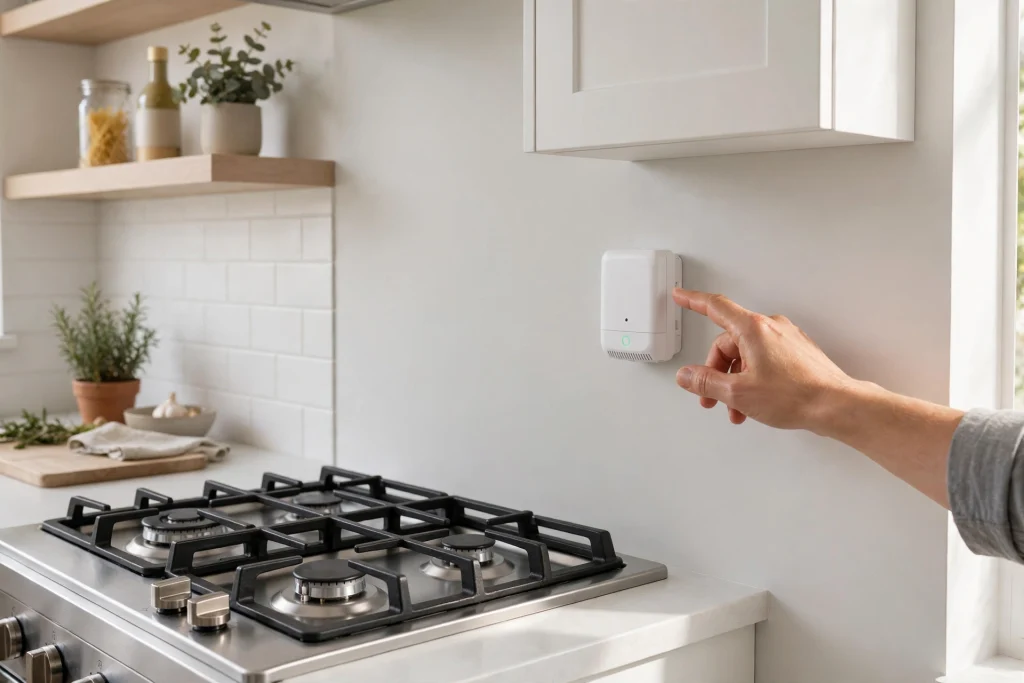

A natural gas detection sensor is a small device that watches the air in your home for leaking natural gas and sounds an alarm before the gas can build up to a dangerous level. Natural gas itself is mostly methane and has no smell, so suppliers add a chemical called mercaptan that gives it a rotten-egg odour. Even so, a slow leak behind a cooker or in a basement can go unnoticed, especially while you are asleep. A sensor gives you an electronic nose that never sleeps.
The risk is real. The National Fire Protection Association (NFPA) reports that, in the United States, an average of 68,800 home structure fires a year between 2017 and 2021 involved natural gas, causing about 560 injuries, 125 deaths and $1.6 billion in property damage. Most of those fires did not start with a dramatic explosion; they started with a leak that found a spark. This guide explains how a natural gas detection sensor works, which type to buy, where to put it, and exactly what to do if it alarms.
What Is a Natural Gas Detection Sensor?
A natural gas detection sensor, also called a gas leak detector or combustible gas detector, measures the concentration of methane in the air and triggers an alarm when it reaches a set threshold. Most home sensors alarm well before the gas reaches its lower explosive limit (LEL), the lowest concentration at which it can ignite. For methane, the LEL is 5% gas in air, or 50,000 parts per million (ppm). A typical home sensor alarms at 10% to 20% of the LEL, which is 0.5% to 1% gas in air, giving you time to leave and call for help.
Do not confuse a gas sensor with a carbon monoxide (CO) detector. A CO detector warns you about a poisonous gas produced by incomplete burning, while a gas sensor warns you about unburned fuel gas that can catch fire or explode. Many homes need both, and some devices combine the two, but a CO alarm on its own will not detect a methane leak.
How a Natural Gas Detection Sensor Works
Home sensors use one of four main sensing technologies. Each has strengths and weaknesses, and the best choice depends on whether you want a cheap plug-in alarm, a smart home device, or a long-life professional unit.
| Sensor type | How it works | Strengths | Weaknesses | Typical use |
|---|---|---|---|---|
| Catalytic bead | A heated bead burns tiny amounts of gas; the heat change is measured | Fast, reliable, widely used | Needs oxygen, can be poisoned by silicone fumes | Fixed home and industrial detectors |
| Metal-oxide semiconductor (MOS) | Gas changes the electrical resistance of a heated metal-oxide film | Cheap, small, low power | Can react to alcohol and cleaning fumes, causing false alarms | Budget plug-in alarms |
| Infrared (NDIR) | Measures how much infrared light methane absorbs | Very accurate, long life, few false alarms | More expensive | Premium and smart detectors |
| Electrochemical | Gas reacts in a chemical cell and produces a current | Accurate at low concentrations | Shorter life, mainly for toxic gases | Combined gas and CO units |
In practice, most plug-in home sensors use a semiconductor or catalytic bead element, while higher-end smart sensors, such as those from DeNova Detect and GasKnight, use more stable sensing and add Wi-Fi alerts, app notifications and, in some models, an automatic gas shut-off valve. When you compare models, look for certification to UL 1484 in the United States or EN 50194 in Europe, a stated alarm level in %LEL, and a sensor life of at least five years.
Natural Gas vs Propane: Placement Is Opposite
This is the single most important placement rule, and it is also the most commonly misunderstood. Methane, the main part of natural gas, is lighter than air, so a leak rises and collects near the ceiling. Propane (LPG) is heavier than air, so a leak sinks and collects near the floor. A sensor made for natural gas must go high on the wall; a sensor made for propane must go low. If you use the wrong type, or put a natural gas sensor at floor level, it may not alarm until the room is already full of gas.
| Gas | Heavier or lighter than air? | Where the sensor goes | Typical home use |
|---|---|---|---|
| Natural gas (methane) | Lighter | High on the wall, 12 inches (30 cm) below the ceiling, or on the ceiling | Mains gas cooker, boiler, furnace |
| Propane (LPG) | Heavier | Low on the wall, 6 to 12 inches above the floor | LPG cooker, caravan, off-grid heating |
Some sensors are sold as dual gas detectors and can detect both, but check the instructions: a dual sensor still needs to be placed at the height for the gas you actually use, and some models need a switch or a different mode for propane.
Where to Put a Natural Gas Detection Sensor
Put a sensor in every room that has a gas appliance, and in the room where the gas meter or boiler sits. For most homes that means the kitchen and the boiler room or basement, plus a sensor near a gas furnace or water heater if it is in a separate room. Place the sensor 1 to 3 metres (3 to 10 feet) from the appliance, high on the wall, so it can detect a leak without being triggered by normal cooking fumes. Do not put it directly above a cooker, in a steamy bathroom, or in a draughty window, and do not hide it behind curtains or furniture.
- Kitchen: high on the wall near the cooker, but not directly above the hob.
- Boiler room or basement: high on the wall near the boiler, where a slow leak would collect first.
- Utility room: near a gas water heater or tumble dryer, if one is gas-powered.
- Bedrooms: only if a gas appliance is in the room; a sensor in the hallway outside bedrooms is more useful than one in a bedroom with no appliance.
- Avoid: bathrooms, very humid rooms, and places where cleaning sprays or aerosols are used often, because they can cause false alarms.
How Much Does a Natural Gas Detection Sensor Cost?
| Type | Typical price | What you get |
|---|---|---|
| Basic plug-in alarm | $20 to $50 | Audible alarm, plug-in power, semiconductor sensor |
| Mid-range detector | $50 to $100 | Digital display, test button, longer sensor life |
| Smart detector | $80 to $150 | Wi-Fi and app alerts, sometimes a shut-off valve, e.g. DeNova Detect and GasKnight |
| Combined gas and CO detector | $60 to $130 | One device for two risks, but check both alarm levels |
| Professional fixed system | $200+ | Multiple sensors, panel, automatic shut-off, for large homes |
For a typical home, two mid-range plug-in sensors, one in the kitchen and one in the boiler room, are a sensible minimum, costing about $40 to $100 in total. A smart sensor is worth the extra cost if you travel often or have a holiday home, because it can alert your phone while you are away. Installing a sensor is a simple DIY job for a plug-in model: choose the spot, plug it in, test it, and you are done. If you are doing wider work, see our guide to essential tools for DIY, and if you are planning a bigger project, read our home renovation guide before you move gas appliances or change a kitchen layout. For heating, a gas boiler is not the only option: an electric fireplace with mantel can heat a room without any gas at all, which removes the leak risk from that room entirely.
What to Do If the Sensor Alarms
Take every alarm seriously, even if you cannot smell gas. Do not switch lights or appliances on or off, do not use a phone or a light switch inside the house, and do not light a match or a cigarette, because a spark can ignite gas. Leave the house at once, taking everyone and any pets with you, and call the gas emergency service or 911 from outside, from a neighbour’s phone if needed. Do not re-enter the house until a professional says it is safe. If the alarm stops after you ventilate the room, still treat it as a real event and have the appliance and pipework checked, because a sensor that alarms once and is then ignored is worse than no sensor at all.
False Alarms, Testing and Maintenance
False alarms are the most common complaint about gas sensors, and most are avoidable. Alcohol, hairspray, deodorant, cleaning sprays, paint fumes and strong cooking smells can trigger a semiconductor sensor, especially if the sensor is too close to the source. Keep aerosols away from the sensor, ventilate the kitchen while cooking, and choose an infrared or catalytic sensor if false alarms keep happening.
- Test monthly: press the test button and check that the alarm sounds. If it does not, replace the unit.
- Replace on schedule: most home sensors last 5 to 10 years. Write the expiry date on the unit and replace it when it is due, even if it still seems to work.
- Keep it clean: dust the sensor gently with a dry cloth. Do not spray cleaner directly on it.
- Check the battery: battery models need a fresh battery at least once a year, and a low-battery chirp should never be ignored.
- Calibrate if required: some professional sensors need calibration every year or two; home plug-in sensors usually do not, but follow the maker’s instructions.
Frequently Asked Questions
Will a carbon monoxide detector detect a natural gas leak?
No. A CO detector measures carbon monoxide, a different gas produced by incomplete burning. A natural gas leak is unburned methane, so you need a combustible gas sensor, or a combined gas and CO detector that is certified for both.
Where should a natural gas sensor be placed?
High on the wall, about 12 inches below the ceiling, in the room with the gas appliance, 1 to 3 metres from the appliance. Methane rises, so a low sensor will alarm too late. For propane, the opposite applies: place the sensor low, near the floor.
How long do natural gas sensors last?
Most home sensors last 5 to 10 years, depending on the sensor type and the maker. Infrared sensors tend to last longest, while semiconductor sensors are usually at the shorter end of that range. Check the expiry date printed on the unit.
Can I install a natural gas sensor myself?
Yes, for a plug-in or battery model: choose the right height, plug it in, and test it. You do not need to touch any gas pipework. If the sensor needs to be wired in, or if it controls an automatic shut-off valve, use a qualified gas engineer.
The Bottom Line
A natural gas detection sensor is a cheap, simple way to turn an invisible, odourless risk into a loud, clear warning. Buy a certified sensor, place it high on the wall near each gas appliance, test it monthly, and replace it when it expires. And if it ever alarms, leave the house and call for help from outside: that is exactly what it is there for.