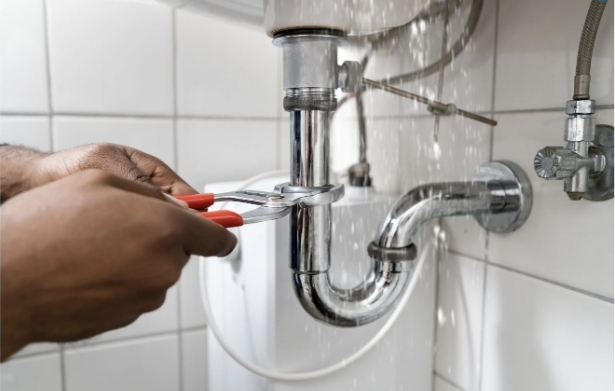

If your tap water tastes of chlorine, leaves spots on glasses, or just does not taste quite right, an under sink water filter can fix it at the source. Unlike a pitcher filter that you refill by hand, or a faucet attachment that gets in the way, an under sink system hides under your kitchen sink and delivers filtered water straight from a dedicated tap, every time you turn it on.
Under sink water filters are one of the most popular home water treatments, and for good reason: they remove a wide range of contaminants, they do not take up counter space, and they cost far less over time than buying bottled water. In this guide, you will learn how under sink water filters work, the main types and what each removes, how much they cost, how to install one, and how to choose the right system for your water.
What Is an Under Sink Water Filter and How Does It Work?
An under sink water filter is a filtration system installed on the cold water line beneath your kitchen sink. Water flows from your home’s supply through one or more filter cartridges, and then up to a small dedicated faucet mounted on your sink or countertop. The filtered water is separate from your regular tap, so you use it for drinking and cooking while the main tap stays as it is.
Most systems use a combination of filters. A sediment pre-filter catches sand, rust, and grit. A carbon filter then absorbs chlorine, bad tastes, and odors, and traps many chemicals and organic compounds. More advanced systems add a reverse osmosis membrane, which forces water through a very fine barrier that removes dissolved solids, lead, fluoride, nitrates, and other tiny contaminants. How much a system removes depends on its design and certifications, so check for NSF or ANSI certification rather than trusting marketing claims.
Types of Under Sink Water Filters
There are four main types of under sink systems. The right one depends on what is in your water, how much you want to spend, and how much maintenance you are willing to do.
| Type | What it removes | Best for | Typical cost |
|---|---|---|---|
| Single-stage carbon filter | Chlorine, taste, odor, sediment | Better-tasting city water | $50 to $150 |
| Multi-stage carbon filter | Chlorine, lead, chemicals, sediment | City water with lead or chemical concerns | $150 to $350 |
| Reverse osmosis (RO) | Lead, fluoride, nitrates, dissolved solids | The most thorough filtration | $200 to $500 |
| UV + carbon combination | Chlorine, chemicals, bacteria, viruses | Well water | $300 to $600 |
A carbon filter is the simplest and cheapest option, and it is enough for most homes on a municipal supply where the main complaints are taste and chlorine. A multi-stage carbon system adds extra cartridges, often including a lead-reducing filter, and is a good middle ground.
Reverse osmosis is the most thorough option. A typical RO system has three to five stages and removes up to 99 percent of dissolved solids, including lead, arsenic, fluoride, and nitrates. The trade-offs are a slower flow rate, some wastewater, and a storage tank that takes up space under the sink. UV systems use ultraviolet light to kill bacteria and viruses and are almost always paired with carbon filtration. They make sense mainly for well water; for ordinary city water, which is already disinfected, UV is usually unnecessary.
How to Choose the Right Under Sink Water Filter
Choosing a system starts with knowing what is in your water. If you are on a municipal supply, your water company must publish an annual water quality report, often called a Consumer Confidence Report, which lists the contaminants found in your water. If you are on a well, get your water tested by a certified lab before buying anything.
Once you know what needs removing, match the system to the problem. Chlorine taste and odor? A carbon filter is enough. Lead? Look for a system certified to NSF/ANSI 53 for lead reduction. High dissolved solids, or a salty or metallic taste? Reverse osmosis is the answer. Hard water? Note that a filter is not a water softener: filters do not remove calcium and magnesium, so if scale is your problem, you need a softener instead. Also check certifications, measure the space under your sink, and check your water pressure, because RO systems need at least 40 psi to work well. When planning the space, it also helps to think about designing a functional kitchen so the filter, tank, and faucet fit neatly alongside everything else under the sink.
How Much Do Under Sink Water Filters Cost?
The total cost has two parts: the system itself, and the replacement filters over its life. A basic carbon unit costs about $50 to $150, a multi-stage carbon system $150 to $350, a reverse osmosis system $200 to $500, and a UV combination system $300 to $600. Professional installation adds $100 to $300 if you do not install it yourself. Annual filter costs run about $30 to $180 depending on the system. Even at the higher end, filtered water from an under sink system usually costs a few cents per gallon, far cheaper than bottled water. A household that buys two cases of bottled water a week can often recover the cost of a mid-range system within a year.
How to Install an Under Sink Water Filter
Most under sink filters are designed for DIY installation and take one to two hours with basic tools. If your sink has no spare hole for the faucet, or your plumbing is unusual, hire a plumber.
- Turn off the water and clear the space. Shut off the cold water supply valve, open the faucet to release pressure, and clear out everything stored underneath.
- Mount the filter unit. Screw the mounting bracket to the cabinet wall, leaving enough room below the cartridges to unscrew them later.
- Connect the water supply. Use the included saddle valve or T-fitting to tap into the cold water line, then run the tubing to the filter inlet.
- Install the faucet. Mount the dedicated faucet in a spare sink hole, or drill a hole if there is none, then connect the tubing from the filter outlet.
- Flush and check for leaks. Turn the water back on slowly, flush the system for 5 to 10 minutes to clear carbon dust, and check every connection for drips.
Before you start, check for existing plumbing problems. If you notice dampness, corrosion, or a musty smell under the sink, learn how to find and fix a water leak before it causes serious damage, because a slow leak will only get worse once new fittings are added. If you are planning a bigger update, a kitchen remodeling project is the ideal time to add a filtration system, since the sink area is already being worked on.
Maintenance: When to Change the Filters
A filter only works if you change its cartridges on schedule. An old carbon filter can become a breeding ground for bacteria, and a clogged sediment filter slows the flow to a trickle. Most manufacturers recommend changing carbon and sediment cartridges every 6 to 12 months, and an RO membrane every 2 to 3 years. UV lamps need replacing about once a year, even if they still glow, because their output fades over time.
Watch for signs that a change is due early: slower water flow, a return of chlorine taste or odor, or cloudy water. To change a cartridge, turn off the water, release the pressure, swap the cartridge, check the O-ring for cracks, and flush the system for a few minutes before drinking from it.
Common Mistakes to Avoid
The most common mistake is buying a system without testing your water first, and ending up with a filter that does not remove the contaminant you actually have. The second is ignoring certifications and trusting marketing claims instead. The third is installing the filter on the hot water line, which damages carbon filters, so always connect to the cold line only. Also avoid mounting the unit where cartridges cannot be removed, skipping the flush step, and forgetting filter changes for years. A neglected filter is worse than no filter at all, because it can harbor bacteria and restrict flow.
Frequently Asked Questions
Do under sink water filters remove fluoride?
Standard carbon filters do not remove fluoride. Only reverse osmosis systems, and some specialized filters, remove fluoride effectively. If fluoride removal is your goal, choose an RO system certified to NSF/ANSI 58.
Is under sink or countertop filtration better?
Under sink systems are better for most homes: they are hidden, they do not take up counter space, and they usually have larger cartridges that last longer. Countertop filters are easier to install and a good choice for renters who cannot modify plumbing.
Can I install an under sink water filter myself?
Yes, most systems are designed for DIY installation with basic tools and take one to two hours. You will need to connect to the cold water line and mount a faucet, which may require drilling a hole. If you are not comfortable with plumbing, a plumber can usually install one for $100 to $300.
Under sink water filters are a practical, long-lasting upgrade for any kitchen. Start by testing your water or reading your water quality report, choose a certified system that targets the contaminants you actually have, and install it on the cold water line. Keep up with filter changes, and you will have clean, great-tasting water on tap for years, at a fraction of the cost of bottled water.