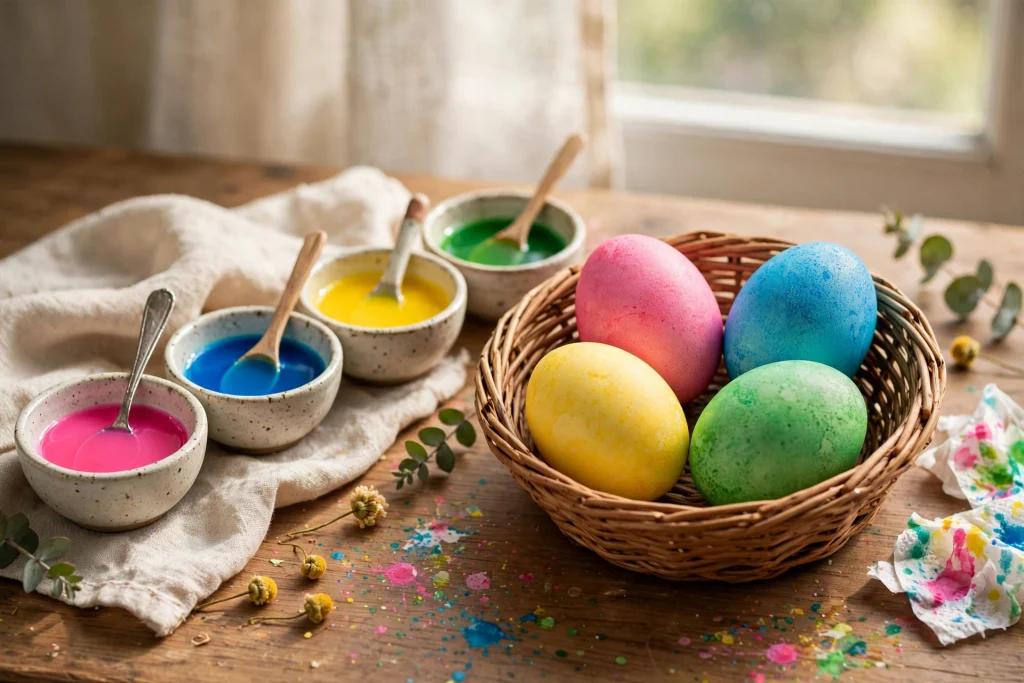

Colouring eggs with food colouring is one of the simplest and most satisfying kitchen projects, whether you are decorating Easter eggs with children or preparing eggs for a celebration. All you need is food colouring, some vinegar, and a few hard-boiled eggs. The results can be surprisingly beautiful, from soft pastels to deep, jewel-like shades.
In this guide, you will learn how egg food colouring works, what you need, the step-by-step method for bright, even colour, a mixing chart for custom shades, natural alternatives to shop-bought dyes, and how to store coloured eggs safely. It works with liquid, gel, and natural food colouring, and the same principles apply whether you are dyeing one egg or three dozen.
What Is Egg Food Colouring?
Egg food colouring means using food colouring to dye the shells of hard-boiled eggs. The dye soaks into the porous shell and stains it, while the egg inside stays white and safe to eat, provided you use food-grade colouring and follow basic food safety rules. It is different from colouring food with egg, such as using yolk to give pasta a golden tint, although the two ideas are related.
Most people use liquid food colouring from the supermarket, which is cheap, widely available, and comes in the classic red, yellow, green, and blue. Gel food colouring is more concentrated and gives deeper, more vivid colours, while natural dyes made from foods such as beetroot, turmeric, and red cabbage give softer, earthier shades. All three work on eggshells, and the method is almost the same for each.
What You Need to Colour Eggs
Before you start, gather everything so the dyeing goes smoothly. You will need hard-boiled eggs that have cooled completely, food colouring in the shades you want, white vinegar, and hot water. You will also need a mug or small bowl for each colour, a spoon or tongs for lifting the eggs, and paper towels or an egg carton to dry them on. Wear an apron, because food colouring stains fabric, and cover your work surface with newspaper. White eggs give the truest colours; brown eggs give deeper, more muted shades.
How to Colour Eggs with Food Colouring
The classic method uses vinegar and hot water. The vinegar helps the dye bond to the shell, and the hot water helps it dissolve and spread evenly. Follow these steps:
- Hard-boil the eggs. Place eggs in a pan, cover with cold water, bring to a boil, then turn off the heat and leave them covered for 10 to 12 minutes. Cool them in cold water and dry them completely.
- Mix the dye. For each colour, combine about 120 ml (half a cup) of hot water, 1 tablespoon of white vinegar, and 10 to 20 drops of food colouring in a mug. More drops mean a deeper colour.
- Dip the egg. Lower an egg into the dye with a spoon and leave it for 5 minutes for a light colour, or up to 15 minutes for a deep colour. Turn it gently once or twice so the colour is even.
- Lift and dry. Lift the egg out, let the excess dye drip off, and place it on paper towels or in an egg carton to dry. Do not rub the egg while it is wet, or the colour may smudge.
- Repeat for more colours. Dip the same egg into a second colour for layered effects, or dye more eggs. Once dry, rub a tiny drop of cooking oil on the shell for a glossy finish.
If you are using gel food colouring, use less: a pea-sized amount in the same vinegar and water base is enough, because gel is much more concentrated than liquid. For a fun effect, try baked eggs with cheese, spinach, and tomatoes for breakfast the next morning, using any plain hard-boiled eggs you have left over.
Egg Food Colouring Chart: How to Mix Colours
You do not need a dye for every colour. With the four basic colours, red, yellow, green, and blue, you can mix almost any shade. The chart below uses drops of liquid food colouring in half a cup of water with a tablespoon of vinegar.
| Colour you want | Red | Yellow | Green | Blue |
|---|---|---|---|---|
| Pink | 10 drops | 0 | 0 | 0 |
| Orange | 8 drops | 12 drops | 0 | 0 |
| Bright yellow | 0 | 15 drops | 0 | 0 |
| Green | 0 | 8 drops | 0 | 8 drops |
| Teal | 0 | 0 | 10 drops | 10 drops |
| Purple | 10 drops | 0 | 0 | 10 drops |
| Lavender | 5 drops | 0 | 0 | 5 drops |
| Deep blue | 0 | 0 | 0 | 20 drops |
For pastel shades, use half the number of drops and soak the egg for only 3 to 5 minutes. For deep colour, use the full amount and soak for 10 to 15 minutes. Remember that the colour looks darker when the egg is wet and lightens slightly as it dries, so leave eggs in the dye a little longer than you think you need.
Natural Food Colouring for Eggs
If you prefer to avoid shop-bought dyes, you can colour eggs with foods from your kitchen. Natural dyes give softer, more muted colours, and they take longer, but they are fun to make. Simmer the ingredient in water with a tablespoon of vinegar for 20 to 30 minutes, strain it, and let the liquid cool before dipping the eggs.
Beetroot gives pink and red, turmeric gives a bright golden yellow, and red cabbage gives blue, which turns purple or green depending on how much vinegar you add. Strong brewed coffee gives warm brown, and onion skins give orange and rusty brown. Soak the eggs in natural dye for at least 30 minutes, or overnight in the fridge for the deepest colour. Natural dyes stain hands and clothes just like shop-bought ones, so wear gloves and an apron.
Tips for Bright, Even Colour
The best results come from preparation. Make sure the shells are clean and completely dry before dyeing, because grease or moisture stops the dye from sticking. White vinegar is important: without it, the colour will be pale and patchy. Use hot water, not boiling water, so the eggs do not crack.
Do not overcrowd the dye bowl: one egg at a time gives the most even colour. If the dye starts to look weak after several eggs, add a few more drops of colouring and a splash of vinegar. For two-tone eggs, dip half the egg in one colour, let it dry, then dip the other half in a second colour. For patterns, wrap a rubber band around the egg before dyeing, or draw on the shell with a white crayon first: the wax resists the dye and leaves a white design.
Common Mistakes to Avoid
The most common mistake is skipping the vinegar, which is the ingredient that makes the dye stick to the shell. Without it, the colour washes off in patches. The second is dyeing warm eggs: if the eggs are still warm, the shells can crack, and the colour goes on unevenly. Always let them cool completely first.
Other mistakes include using cold water, which gives pale colour, and leaving eggs in the dye for too long, which can make the shells chalky. Do not use non-food-grade dyes, paints, or markers on eggs you plan to eat. And do not leave coloured eggs out at room temperature for more than two hours. If you are planning a bigger baking project, knowing how to vet a bakery food service partner is useful when you need large quantities of eggs or baked goods for an event.
How Long Do Coloured Eggs Last?
Coloured hard-boiled eggs last as long as plain hard-boiled eggs: up to one week in the fridge, in their shells. Keep them refrigerated, and do not eat eggs that have been out of the fridge for more than two hours, or eggs with cracked shells that were left at room temperature.
If you are using the eggs only for decoration, blow out the contents first and dye the empty shells; they keep indefinitely if stored carefully, and you can use the egg inside for cooking, such as baking a potato in the oven alongside a frittata.
Frequently Asked Questions
Can you use food colouring to colour eggs?
Yes. Liquid or gel food colouring mixed with hot water and white vinegar dyes eggshells brightly and safely. Use 10 to 20 drops of colouring per half cup of water with a tablespoon of vinegar, and soak the eggs for 5 to 15 minutes.
How long do you leave eggs in food colouring?
For liquid food colouring, 5 minutes gives a light colour and 10 to 15 minutes gives a deep colour. Natural dyes take longer: at least 30 minutes, or overnight in the fridge for the deepest shades. Check the colour every few minutes, since it lightens slightly as the egg dries.
Is it safe to eat eggs coloured with food colouring?
Yes, as long as you use food-grade colouring and food safety rules. Use clean hands and equipment, keep the eggs refrigerated, and do not eat eggs that have been out of the fridge for more than two hours. Do not eat eggs coloured with paint, markers, or non-food dyes.
Egg food colouring is simple, cheap, and fun, and it works with liquid, gel, or natural dyes. Mix hot water, vinegar, and food colouring, dip cooled hard-boiled eggs for 5 to 15 minutes, and dry them without rubbing. Experiment with the mixing chart to create your own shades, keep the eggs refrigerated, and enjoy the results.