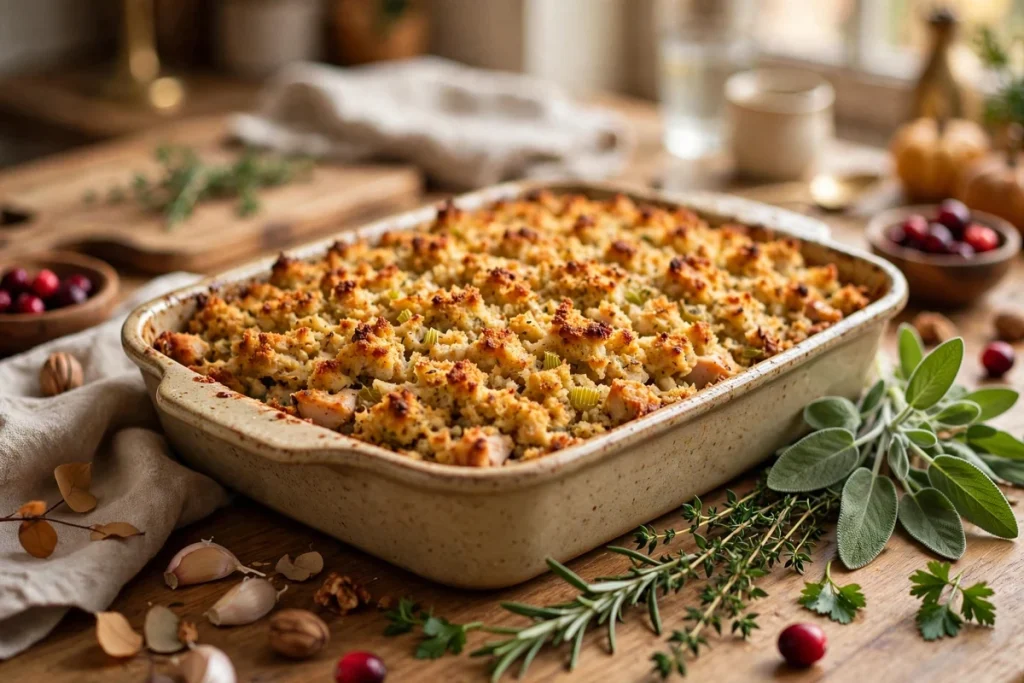

This turkey stuffing recipe is the classic herb stuffing many families return to every year: buttery, savory, crisp on top, and soft and moist underneath. It is made with dried bread cubes, onion, celery, fresh sage, thyme, and parsley, plus rich turkey or chicken broth and eggs to bind it together. It tastes like the center of a holiday table, and it is simple enough to make on a busy cooking day because most of the work can be done ahead.
The key to great stuffing is balance. You want enough butter and broth to keep it moist, but not so much liquid that it turns soggy. You want the bread to hold its shape, the vegetables to be tender, and the herbs to be clear without overpowering the roast turkey beside it. This recipe gets that balance right, and it explains the safer way to cook stuffing so the whole meal is both delicious and safe to eat.
Why This Turkey Stuffing Recipe Works
Good stuffing starts with dry bread. Fresh, soft bread absorbs broth too quickly and can collapse into a paste. Bread that has been dried in the oven keeps its structure, soaks up flavor slowly, and gives you distinct, tender cubes with a golden crust. If you buy pre-cut stuffing cubes, they work well too, but check that they are plain or lightly seasoned so you can control the salt and herbs yourself.
Butter, onion, and celery form the savory base. Cooking them together until the onion is soft and translucent builds a deep, rounded flavor that plain broth cannot provide on its own. Fresh herbs make the biggest difference here. Dried herbs are acceptable in a pinch, but fresh sage and thyme give the classic roast-turkey flavor that most people remember from holiday meals.
This recipe is also flexible. It works as a side dish for a whole roast turkey, for turkey breast, or even on its own for a smaller gathering. The method below bakes it separately in a casserole dish, which is the safest and most reliable way to get a crisp top and an evenly cooked center.
Ingredients
This recipe serves 10 to 12 people as a side dish. It fills a 9 by 13 inch baking dish generously.
- 1 loaf (about 1 pound) day-old white bread or country bread, cut into 3/4 inch cubes (about 12 cups)
- 1/2 cup (1 stick) unsalted butter, plus extra for greasing the dish
- 2 medium yellow onions, finely diced (about 2 cups)
- 4 celery stalks, finely diced (about 2 cups)
- 4 garlic cloves, minced
- 2 tablespoons chopped fresh sage
- 2 tablespoons chopped fresh thyme leaves
- 1/4 cup chopped fresh flat-leaf parsley
- 1 teaspoon kosher salt, plus more to taste
- 1/2 teaspoon freshly ground black pepper
- 1/4 teaspoon ground nutmeg (optional, for warmth)
- 3 to 3 1/2 cups low-sodium turkey broth or chicken broth, warmed
- 2 large eggs, lightly beaten
- 1/2 cup toasted pecans or walnuts, chopped (optional)
If you are cooking for a smaller group, halve the recipe and bake it in an 8 by 8 inch dish. If you like a richer stuffing, add 1/2 pound of cooked, crumbled sausage, browned and drained, or 1 cup of diced cooked mushrooms. Keep the total amount of added ingredients modest so the bread and herbs stay the stars of the dish.
How to Make Turkey Stuffing: Step by Step
Preparation time is about 25 minutes, plus 20 minutes to dry the bread if it is not already dry. Baking time is 45 to 55 minutes. Plan for about 1 hour and 20 minutes in total.
- Dry the bread. Heat the oven to 300 degrees Fahrenheit (150 degrees Celsius). Spread the bread cubes in a single layer on two large baking sheets and bake for 15 to 20 minutes, stirring once, until dry and lightly crisp but not browned. If your bread is already stale, you can skip this step. Cool completely.
- Cook the vegetables. Melt the butter in a large skillet over medium heat. Add the onion and celery with a pinch of salt and cook for 10 to 12 minutes, stirring often, until soft and translucent. Add the garlic, sage, and thyme and cook for 1 minute more, until fragrant. Stir in the parsley and remove from the heat.
- Combine. Put the dried bread cubes in a very large bowl. Pour the warm butter and vegetable mixture over the top and toss gently so the cubes are evenly coated. Season with salt, pepper, and nutmeg.
- Add the liquid and eggs. Whisk the eggs into 3 cups of warm broth. Pour the mixture over the bread a little at a time, tossing gently after each addition. The bread should be moist all the way through but not swimming in liquid. Add up to 1/2 cup more broth if the cubes still look dry, especially if you are using very dry bread.
- Rest briefly. Let the mixture sit for 10 minutes so the bread can absorb the liquid evenly. If it looks dry after resting, add a splash more broth. Taste and adjust the salt.
- Bake. Heat the oven to 375 degrees Fahrenheit (190 degrees Celsius). Butter a 9 by 13 inch baking dish, spoon in the stuffing, and spread it evenly without packing it down hard. Dot the top with a few small pieces of butter if you like a richer crust. Cover tightly with foil and bake for 30 minutes.
- Crisp the top. Remove the foil and bake for 15 to 25 minutes more, until the top is golden and crisp and the center is hot. If the top browns too quickly, cover it loosely with foil again. Let the stuffing rest for 10 minutes before serving so it holds together when scooped.
Food Safety: Cook Stuffing to 165°F (74°C)
Food safety matters most with stuffing, because bread, broth, and eggs can support bacteria if they stay too long at warm, unsafe temperatures. The stuffing must reach 165°F (74°C) internal temperature. Use a food thermometer and check the center of the dish, not just the edges, because the center is the last part to heat through.
The safer recommended method is baking the stuffing separately in a casserole dish. This is the method used in this recipe. It heats evenly, it is easy to check with a thermometer, and it does not depend on the turkey finishing at the same time. It also gives you a crisp top that is hard to get inside a bird.
If you do choose to stuff the turkey, pack the stuffing loosely, never tightly, so heat can reach the center. Stuff the bird just before roasting, not the night before, and check the stuffing’s own temperature with a food thermometer. The stuffing inside the bird must also reach 165°F (74°C), even if the turkey meat itself is already done. If the turkey is ready but the stuffing is not, remove the stuffing to a baking dish and continue baking it until it reaches 165°F. Do not leave cooked stuffing at room temperature for more than 2 hours, and refrigerate leftovers promptly in shallow containers.
Variations to Try
Once you know the base recipe, it is easy to make it your own. Keep the bread, butter, onion, celery, broth, and egg ratio the same, then change one or two extras at a time.
- Sausage and apple: Add 1/2 pound of browned sausage and 1 diced apple, cooked with the onion and celery until just soft. The apple adds a gentle sweetness that pairs well with roast turkey.
- Mushroom and herb: Add 8 ounces of sliced mushrooms, cooked until golden, plus extra thyme and a little rosemary. This version is earthy and works well for a vegetarian table if you use vegetable broth.
- Cranberry and pecan: Stir in 3/4 cup of dried cranberries and 1/2 cup of toasted pecans. The tart cranberries cut through rich gravy and give the stuffing a festive look.
- Cornbread stuffing: Replace half the white bread with crumbled, day-old cornbread. It will be a little more crumbly and slightly sweet, so add broth gradually and stop when it is moist but not wet.
- Gluten-free: Use a sturdy gluten-free bread, dried the same way, and check that your broth is gluten-free. Gluten-free bread can absorb liquid faster, so add the broth in smaller amounts.
Serving Ideas for a Holiday Table
Stuffing is at its best beside roast turkey and gravy, but it also works with mashed potatoes, green beans, roasted carrots, and cranberry sauce. For a relaxed gathering, start with appetizers and hors d’oeuvres while the turkey rests, then serve the stuffing in its baking dish so guests can scoop the crisp top pieces they like best. If you are planning a larger roast dinner and want another slow-cooked main dish for a different occasion, a pork shoulder crock pot recipe uses the same low-and-slow, crowd-friendly approach and frees up oven space.
For a balanced plate, aim for a generous scoop of stuffing, a slice of turkey, one or two vegetables, and a spoonful of gravy. The stuffing is rich, so it does not need a heavy sauce on top. Leftover stuffing is also excellent the next day, warmed and served with sliced turkey, or pressed into a skillet and crisped for a next-day lunch.
Make-Ahead and Storage Tips
Stuffing is one of the best make-ahead holiday dishes, but it needs to be handled carefully. You can dry the bread up to 3 days ahead and store it in an airtight container at room temperature. You can cook the onion, celery, and herbs up to 2 days ahead, cool them completely, and refrigerate them in a covered container.
For the best texture and safety, assemble the stuffing on the day you plan to bake it. Mix the bread, vegetables, broth, and eggs, cover, and refrigerate for up to 24 hours, then bake from chilled, adding 10 to 15 minutes to the covered baking time and checking that the center reaches 165°F (74°C). Do not assemble stuffing and leave it uncooked at room temperature, and do not store raw stuffing inside a raw turkey overnight.
Store baked leftovers in shallow, covered containers in the refrigerator and eat them within 3 to 4 days. To reheat, sprinkle with a little broth, cover with foil, and warm in a 350 degrees Fahrenheit (175 degrees Celsius) oven until steaming hot, then uncover for a few minutes to crisp the top again. For longer storage, freeze baked stuffing in portions for up to 1 month, thaw overnight in the refrigerator, and reheat until it reaches 165°F (74°C) in the center.
Frequently Asked Questions
What temperature should turkey stuffing reach?
Stuffing must reach 165°F (74°C) in the center. Check it with a food thermometer, whether it was baked separately or inside the turkey.
Is it safer to bake stuffing separately or inside the turkey?
Baking it separately in a casserole dish is safer and more reliable. It heats evenly, is easy to test, and gives a crisp top without depending on the turkey’s cooking time.
Can I make turkey stuffing ahead of time?
Yes. Dry the bread up to 3 days ahead and cook the vegetables up to 2 days ahead. Assemble on baking day, or assemble up to 24 hours ahead, refrigerate, and bake until the center reaches 165°F (74°C).
Why is my stuffing soggy?
It usually has too much broth or the bread was too fresh. Use dried bread, add broth gradually, and bake uncovered at the end so the top can crisp.
How long do stuffing leftovers keep?
Refrigerate leftovers promptly in shallow containers and eat them within 3 to 4 days. Reheat until steaming hot, with the center reaching 165°F (74°C).