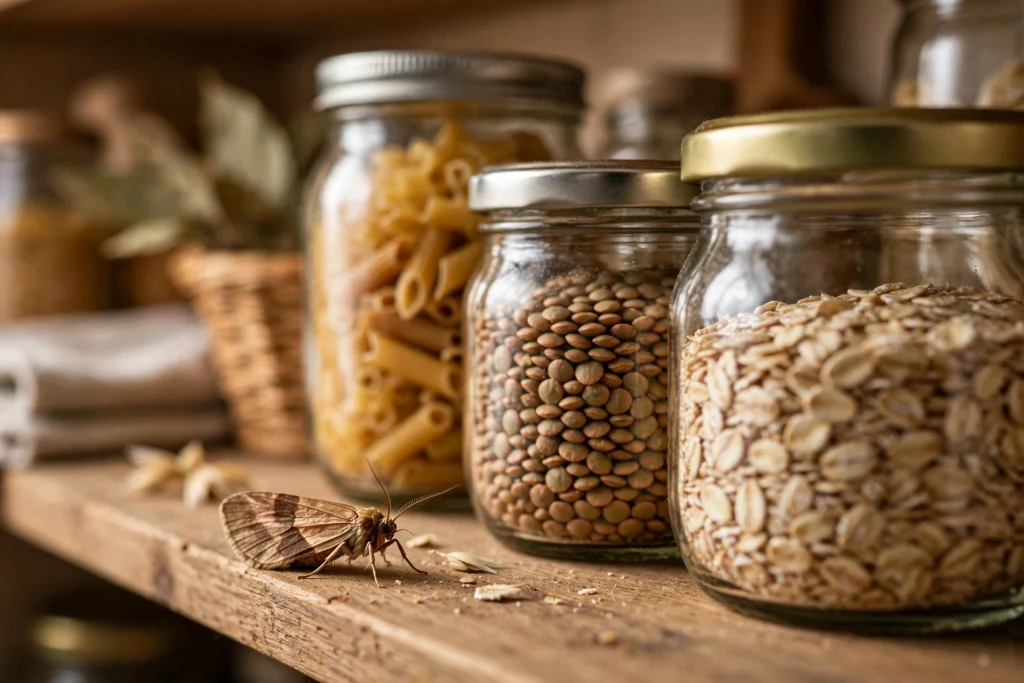

A pantry moth is a small moth whose larvae feed on dry food in your kitchen cupboards. The most common species is the Indian meal moth (Plodia interpunctella), a grey-brown moth with a distinctive coppery band on its wings, about 16 to 20 mm across. The adult moth does not eat your food; its caterpillars do. A single female can lay 100 to 400 eggs, so a few moths fluttering around the kitchen at dusk can become a full infestation in a matter of weeks.
Pantry moths do not bite, sting or spread disease, but they do contaminate food with webbing, droppings and dead larvae, and the food they have touched should be thrown away. This guide explains how to identify a pantry moth, how to tell it apart from a clothes moth, how to get rid of it step by step without spraying insecticide near food, and how to keep it from coming back.
How to Identify a Pantry Moth
Look for the moth itself first. An Indian meal moth has two-tone forewings: the inner half is grey-white and the outer half is reddish-brown or coppery, with a dark band between them. It flies in a zigzag pattern, usually at dusk, and it rests on ceilings and walls near the kitchen. Clothes moths, by contrast, are uniformly pale gold and stay near wardrobes, not food.
| Sign | What it looks like | Where to look |
|---|---|---|
| Adult moths | Small, two-tone grey and coppery wings, 16 to 20 mm wingspan | Flying at dusk, resting on ceilings near the pantry |
| Larvae | Whitish-pink caterpillars, about 12 mm long, with a brown head | Inside flour, rice, cereal and pasta packets |
| Webbing | Fine silk threads, like cobwebs, in food and in shelf corners | Inside packets, in the corners of shelves and jars |
| Frass and damage | Tiny droppings, clumped food, small holes in packaging | In dry food, on shelf surfaces |
If you find webbing or larvae in one packet, assume the infestation is wider than that packet. Larvae can chew through paper, thin plastic and cardboard, and they can crawl into unopened packets, so check every dry food item in the cupboard, including pet food, birdseed, chocolate and spices.
The Pantry Moth Life Cycle
Understanding the life cycle explains why pantry moths are hard to get rid of and why a single clean-up is rarely enough. Eggs hatch in 2 to 14 days, depending on temperature. The larvae then feed for 2 to 6 weeks, growing through several stages and spinning silk webbing as they go. They pupate in a cocoon, often in a shelf corner or on a ceiling, and emerge as adult moths that live for only 1 to 2 weeks, just long enough to mate and lay the next batch of eggs. The whole cycle can take as little as 28 days in a warm kitchen, or up to 300 days in a cool one, so eggs and pupae can survive a clean-up that kills only the adults you can see.
| Stage | How long it lasts | What it does |
|---|---|---|
| Egg | 2 to 14 days | Laid on or near dry food, 100 to 400 per female |
| Larva (caterpillar) | 2 to 6 weeks | Feeds on food, spins webbing, causes the damage |
| Pupa (cocoon) | 1 to 4 weeks | Hides in shelf corners, ceilings and jar lids |
| Adult moth | 1 to 2 weeks | Mates and lays eggs; does not feed |
What Do Pantry Moths Eat?
Pantry moth larvae eat almost any dry, starchy food: flour, rice, pasta, breakfast cereal, oats, nuts, dried fruit, chocolate, spices, dried beans, pet food and birdseed. They prefer food that has been open for a while, but they will also infest sealed packets if the packaging is thin enough to chew through. Whole, unopened tins and thick glass jars are safe; paper bags, cardboard boxes and thin plastic bags are not.
How to Get Rid of Pantry Moths, Step by Step
Getting rid of pantry moths takes a thorough clean, not a spray. Insecticide should not be used in a pantry or near food, and a spray that kills the moths you can see will not kill the eggs and pupae hidden in shelf corners. Work through the steps below in order, and expect the process to take two to six weeks, because new moths can still emerge from pupae after the first clean.
- Step 1: Throw away infested food. Check every packet of dry food. Throw away anything with webbing, larvae or live moths, in a sealed bag, straight into an outside bin. Do not put it in the kitchen bin.
- Step 2: Save food that may be at risk. Food that looks clean but was near infested food can be saved by freezing it for 72 hours at -18°C, or heating it to 60°C (140°F) for 30 minutes, which kills eggs and larvae.
- Step 3: Empty and vacuum the pantry. Take everything out, vacuum every shelf, corner, hinge and crack, and throw the vacuum bag away outside.
- Step 4: Wash the shelves. Wash shelves, walls and jar lids with hot, soapy water, then wipe them with white vinegar. Pay attention to corners and the underside of shelves, where pupae hide.
- Step 5: Set pheromone traps. A pheromone trap, such as those from Dr Killigan’s or MothPrevention, attracts and catches male moths, which stops them mating and lets you see whether moths are still present. Put one trap in the pantry and one in the kitchen, and replace it every few months.
- Step 6: Restock in airtight containers. Put all dry food into glass jars or thick, airtight plastic containers with tight lids. Label them with the date you bought them.
How to Prevent Pantry Moths Coming Back
- Buy small amounts: buy dry food in quantities you will use within a few weeks, and use the oldest food first.
- Store food in glass or metal: airtight glass jars and metal tins are the best defence, because larvae cannot chew through them.
- Check new groceries: inspect packets for webbing or holes before you put them in the pantry, especially flour, rice and pet food.
- Keep the pantry clean and dry: wipe up spills at once, keep the pantry cool and dry, and clean the shelves every few months.
- Use bay leaves with care: bay leaves and cedar are often suggested as repellents, but they do not kill moths or larvae. They may help a little in a clean pantry, but they are not a substitute for airtight storage.
Prevention is mostly about storage and organisation. Airtight storage is the single best step, so see our guide to can storage racks: 9 ways to organise cans in your pantry and cabinets for practical ways to keep a pantry tidy and sealed. A well-designed pantry also helps: read how to design a functional kitchen before you reorganise, and use our decluttering checklist to clear out old food and clutter that gives moths places to hide.
Frequently Asked Questions
Are pantry moths harmful to humans?
No, pantry moths do not bite, sting or spread disease. They contaminate food with webbing, droppings and larvae, so infested food should be thrown away, but eating a small amount by accident is unlikely to make a healthy adult ill. People with allergies may react to moth debris, so clean thoroughly.
How long does it take to get rid of pantry moths?
Usually two to six weeks. Adults die quickly, but eggs and pupae can survive the first clean and hatch later, so keep pheromone traps in place and check the pantry weekly until no moths have been caught for at least two weeks.
Do pantry moth traps work?
Yes, as a monitor and as part of control. Pheromone traps catch male moths, which reduces mating, and they show you whether moths are still present. Traps alone will not clear an infestation: you still need to throw away infested food, clean the pantry and store food in airtight containers.
Can pantry moths eat through plastic?
Larvae can chew through paper, cardboard and thin plastic bags, but they cannot chew through thick glass, metal or hard, airtight plastic containers with tight lids. That is why transferring dry food to glass jars is the most effective prevention.
The Bottom Line
A pantry moth infestation is unpleasant, but it is fixable without chemicals. Throw away infested food, freeze or heat food that may be at risk, vacuum and wash the pantry, set pheromone traps, and restock in airtight glass jars. Do that, keep the pantry clean, and check new groceries, and the moths should be gone within a few weeks and stay gone.