
Can storage racks turn a jumbled pile of tins into a pantry you can actually use. Cans roll, stack badly, hide behind each other and expire unnoticed. A good rack keeps cans visible, reachable and in date order, so cooking is faster and food waste falls. This guide compares seven types of can storage racks, explains how many cans each one realistically holds, and shows how to choose the right rack for a pantry, a cabinet or a fridge. Most top results list
products or cover one type only. This article covers the types, capacities, prices, measuring and organisation in one place.

Why cans are so hard to store
Cans are heavy, round and all roughly the same shape. Stacked on a shelf, they form unstable towers. Lined up in a row, they waste shelf depth. Pushed to the back of a deep pantry, they disappear until they are out of date. A rack gives every can a defined place. Before you buy, think about how many cans you keep, how deep and tall your shelves are, and how often you reach for cans.
Can storage racks compared
Capacities below are for standard 400-gram cans, and prices are rough retail ranges for home-use racks.
| Type | Capacity | Best place | Rough price |
|---|---|---|---|
| Gravity-fed can dispenser | 24 to 54 cans | Pantry shelf | $20 to $60 |
| Tiered shelf riser | 12 to 36 cans | Cabinet or pantry | $12 to $35 |
| Stackable rack | 10 to 36 cans | Pantry or cabinet | $15 to $40 |
| Under-shelf basket | 6 to 12 cans | Kitchen cabinet | $10 to $25 |
| Door-mounted rack | 8 to 20 cans | Pantry or cabinet door | $15 to $45 |
| Lazy-Susan turntable | 10 to 24 cans | Corner cabinet or pantry | $15 to $40 |
| Pull-out can drawer | 12 to 30 cans | Deep cabinet or pantry | $25 to $80 |
1. Gravity-fed can dispensers
A gravity-fed dispenser is the classic can storage rack, and for most pantries it is the best starting point. You load cans at the top or back, and they roll down a sloped track to the front. When you take the front can, the next one rolls forward. This is first-in, first-out rotation built into the rack, so the oldest can is always the one you pick up next. Most home dispensers hold 24 to 36 standard cans, while larger double-width models hold up to 54. They need a shelf at least 35 centimetres deep. Check the track width suits your cans: a rack for standard food cans may be too wide for slim drink cans and too narrow for large catering cans.
2. Tiered shelf risers
A tiered shelf riser is a stepped shelf that lifts the back rows of cans above the front rows, like seats in a theatre. Nothing moves automatically, but you can see every label at a glance. That visibility alone prevents most duplicate buying and forgotten cans. A two-tier riser holds about 12 to 18 cans, and a three-tier model holds 24 to 36. Risers are simple, cheap and flexible, which is why they suit renters and small kitchens. They are ideal for shallow cabinets where a gravity dispenser would not fit. Put everyday cans at the front and rarely used ones at the back.
3. Stackable racks
Stackable racks are open wire or plastic frames that hold cans in horizontal rows, one layer above another. You can start with one unit and add a second on top as your stock grows, which suits bulk-buying. Each unit typically holds 9 to 12 standard cans, so a two- or three-high stack holds 18 to 36 cans. They are light and easy to move for cleaning, but they can wobble when stacked high, so keep the heaviest cans at the bottom and do not stack more units than the maker recommends. They are best for a stable pantry shelf.
4. Under-shelf baskets
An under-shelf basket hangs from an existing shelf and uses the empty air below it, so it adds storage without taking up shelf space. That makes it useful in a crowded kitchen cabinet where the shelf above the cans is mostly empty. Capacity is modest, usually 6 to 12 cans, so it works best as a supplement rather than your main can storage. It suits a small household, a single food type such as tinned tomatoes, or a cabinet that already has a riser. Measure the shelf thickness and the clearance below it first, and avoid overloading the basket, because a sagging basket can jam a cabinet door.
5. Door-mounted racks
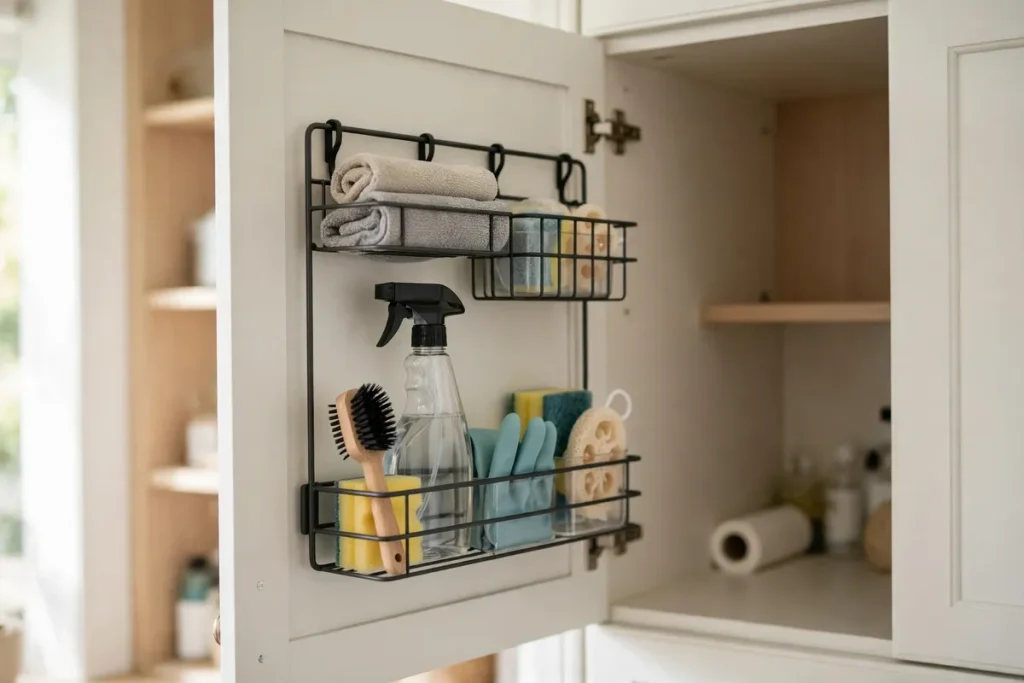
A door-mounted rack turns wasted space on the inside of a pantry or cabinet door into useful can storage. Slim wire racks hold cans in vertical rows, keeping labels facing out and freeing the shelves behind the door for larger items. This is one of the best options for a small kitchen. Most door racks hold 8 to 20 cans. Before you buy, check the rack depth against the shelf behind the door, so the door still closes without the cans hitting the shelf edge. For more ideas on using door space, read our guide to cabinet door storage. Fix the rack with screws rather than adhesive hooks when it will carry a full load of cans.
6. Lazy-Susan turntables
A lazy-Susan turntable is a round rotating tray that brings cans from the back of a shelf to the front with a simple spin. It is the best solution for a corner cabinet or a deep pantry shelf, where the back corner is otherwise almost impossible to reach. Some turntables have raised edges to stop cans sliding off as they turn. A turntable of 30 to 45 centimetres across holds about 10 to 24 cans in a single layer. Turntables do not rotate cans automatically, so put new cans at the back of the tray and move older ones forward. They also work well for mixed storage, holding cans alongside jars and sauces.
7. Pull-out can drawers
A pull-out can drawer is a sliding basket or tray that fits inside a deep cabinet or pantry and rolls out towards you on runners. It brings the entire contents of the shelf into view, so nothing is hidden at the back. That makes it the most comfortable option for a deep base cabinet, a low shelf, or anyone who finds reaching and bending difficult. Most pull-out drawers hold 12 to 30 cans, and some are divided into lanes that keep cans in neat rows. They cost more than a simple riser, usually $25 to $80, and need accurate measuring. The same pull-out idea works elsewhere too: see our guide to a drawer spice rack for a similar approach to small containers. Choose full-extension runners so the drawer opens all the way.
Choosing by pantry, cabinet or fridge
In a pantry, you usually have deep shelves, so a gravity-fed dispenser or stackable rack makes sense as your main storage, with a turntable for a corner shelf. In a kitchen cabinet, space is tighter, so a tiered riser, an under-shelf basket or a door-mounted rack usually works best, because each uses a different part of the cabinet. In a deep base cabinet, a pull-out drawer is worth the extra cost. In a fridge, only use racks made for cold, damp conditions, keep them to drink cans and small tins, and do not block air vents. Planning the whole space first helps: our guide on how to design a functional kitchen explains how to place everyday items within easy reach.
8. Measure before you buy
Most can rack disappointments come from a rack a few centimetres too wide, too deep or too tall. Measure the width, depth and height of the shelf or cabinet, then allow at least 2 centimetres at the sides, 3 centimetres at the front for loading, and enough height to lift a can out without scraping the shelf above. Also measure your cans: a standard food can is about 7.5 centimetres across and 11 centimetres tall, but soup, tuna, beans and catering cans all differ. Compare your measurements with the product dimensions, not with a photograph. If you are between sizes, choose the smaller rack.
9. Rotate, label and group your cans
Follow first-in, first-out rotation: put new cans at the back or top of the rack and take cans from the front, so the oldest cans are used first. With a gravity dispenser this happens automatically, but with a riser, turntable or drawer you need to do it by hand each time you shop. Check dates once a month and move any can close to its date to the front. Add a small label with the month and year on the top of each can as you unpack it, so you can read dates from above. Group cans by food type rather than by brand: soups together, beans and pulses together, tomatoes and sauces together, and fish together. Give every type a fixed home, keep a simple list of what you have, and put cans back in the same place after shopping.
Frequently asked questions
How many cans can a can storage rack hold?
It depends on the type. A small under-shelf basket holds 6 to 12 cans, a tiered riser holds 12 to 36, and a gravity-fed dispenser holds 24 to 54. Always check the capacity for your can size, because large catering cans take up far more room than standard 400-gram cans.
What is the best can storage rack for a pantry?
For most pantries, a gravity-fed dispenser is best because it rotates cans automatically and keeps the oldest can at the front. Add a tiered riser for jars and packets, and a turntable for a corner shelf.
What is the best can storage rack for a small cabinet?
A tiered riser, an under-shelf basket or a door-mounted rack works best in a small cabinet, because each uses a different part of the space. Measure the shelf height and depth first, and keep everyday cans at the front.
How do I stop cans from expiring in my pantry?
Use first-in, first-out rotation: put new cans behind older ones and always take from the front. Write the month and year on the top of each can, check dates once a month, and keep a simple list of what you have.
Can I use a can storage rack in the fridge?
Yes, but only with a rack made for fridge use, usually a small stackable or gravity-fed drink-can dispenser. Keep it to drink cans and small tins, do not block air vents, and leave space for cold air to circulate.
Conclusion
The best can storage rack is the one that fits your space, holds the number of cans you actually keep, and makes the oldest can the easiest one to reach. Start with a gravity-fed dispenser or a tiered riser, add a door rack or under-shelf basket if cabinet space is tight, and finish with measuring, rotation, labelling and grouping. With those nine steps, your cans will stay visible, in date order and easy to find every time you cook.