
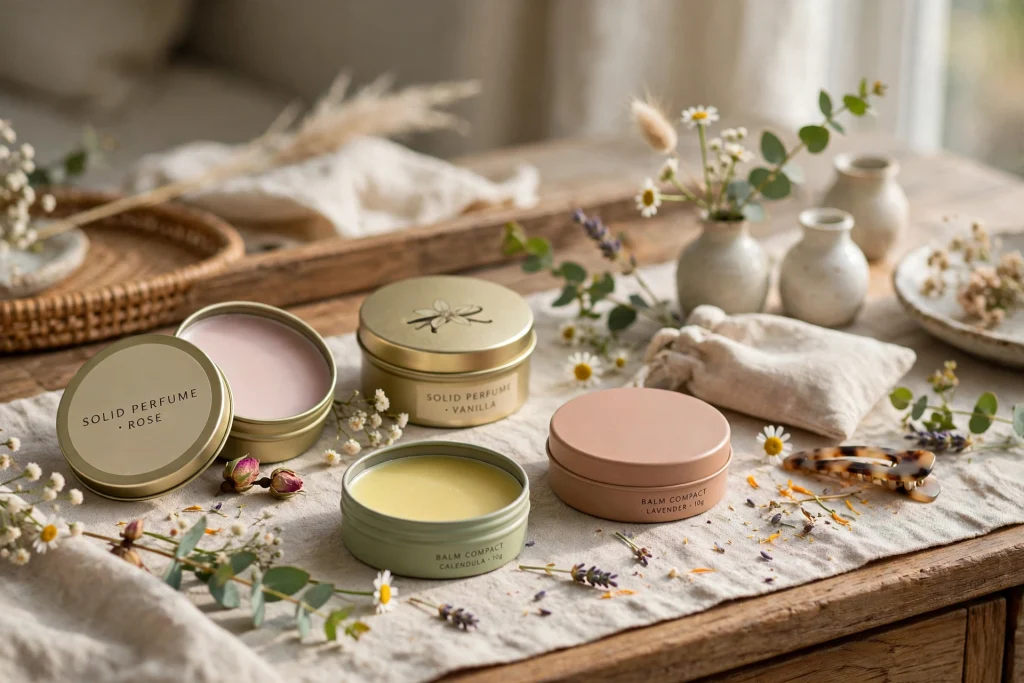

Solid perfume is a wax-based fragrance that you apply by rubbing a small amount onto your skin, usually on your wrists, neck, or behind your ears. Unlike spray perfume, it contains no alcohol, comes in a small tin or compact, and releases its scent slowly as the wax warms against your skin. If you want a fragrance that is subtle, portable, travel-friendly, and gentle on skin, solid perfume is one of the simplest options available.
Solid perfume has become popular again for good reasons. It does not spill, it cannot break in your bag, and it passes through airport security without counting toward your liquids allowance. It is also easy to apply discreetly and hard to overdo, which makes it a good choice for offices, classrooms, and anyone who finds sprays too strong. This guide explains what solid perfume is, how it is made, how to use it properly, how long it lasts, and how it compares with spray perfume.
What Is Solid Perfume?
Solid perfume is a fragrance held in a solid base of waxes and oils instead of alcohol or water. The most common bases are beeswax, shea butter, jojoba oil, and coconut oil, mixed with fragrance oils or essential oils. The result is a smooth balm that looks a little like lip balm and melts slightly when you touch it. You pick up a small amount on a fingertip, warm it between your fingers, and press or rub it onto a pulse point.
The idea is not new. Fragranced waxes and oils were used long before modern spray bottles existed, and solid perfumes were a standard way to wear scent in many cultures. What has changed is the range available today: independent makers and major brands now sell solid perfumes in scents from fresh citrus and floral to warm amber and wood, in pocket-sized tins, compacts, and refillable cases.
What is solid perfume made of?
A typical solid perfume has three parts. The base is a wax, usually beeswax or a plant-based wax, that gives the perfume its solid form. The carrier is a skin-friendly oil or butter, such as jojoba oil, shea butter, or sweet almond oil, that helps the scent spread and sink into the skin. The fragrance itself comes from essential oils, fragrance oils, or a blend of both, usually making up about 10 to 20 percent of the mixture. Some makers add vitamin E as a natural preservative, and some use only essential oils for a fully natural product.
Because solid perfume contains no alcohol, it does not evaporate the way a spray does. The scent is released gradually as your body heat warms the wax, which is why it tends to sit closer to the skin and feel more intimate than a spray. It is also why people with sensitive skin or a dislike of the sharp alcohol smell of sprays often prefer it.
Solid Perfume vs Spray Perfume
The main difference between solid and spray perfume is the carrier. Spray perfume dissolves fragrance in alcohol, which projects the scent into the air and makes it noticeable from a distance. Solid perfume holds fragrance in wax and oil, which keeps it close to the skin and releases it slowly. Neither is better in every situation, and many people keep both: a spray for occasions when they want to be noticed, and a solid for everyday wear, travel, and touch-ups.
| Feature | Solid perfume | Spray perfume |
|---|---|---|
| Base | Wax and oils, no alcohol | Alcohol and water |
| How it smells | Close to the skin, subtle, intimate | Projects further, stronger at first |
| How long it lasts | Often 4 to 8 hours on skin, fades gently | Often 6 to 12 hours, depending on concentration |
| Application | Rubbed on with a fingertip | Sprayed from a distance |
| Travel | No spill risk, not counted as a liquid | Counts as a liquid, can leak or break |
| Skin feel | Moisturizing, gentle, no alcohol sting | Can dry skin or sting after shaving |
| Cost and size | Small tins, often cheaper, easy to carry | Larger bottles, more expensive per use |
Longevity depends on the formula. A solid perfume with a high concentration of fragrance oils can last as long as an eau de parfum on skin, while a lightly scented balm may fade after a few hours. The trade-off is projection: a solid will rarely fill a room the way a spray can, and that is exactly what many of its fans like about it.
How to Use Solid Perfume
Using solid perfume is simple, but a little technique makes a big difference. Start with clean, moisturized skin, because fragrance lasts longer on hydrated skin than on dry skin. Use the pad of a finger to pick up a small amount, warm it for a second between your fingertips, and then press it onto a pulse point, such as your wrists, the sides of your neck, behind your ears, or the inside of your elbows. Do not rub your wrists together hard, as friction and heat can break down the scent faster.
Less is more. One light layer is usually enough for a subtle scent, and you can add a second thin layer after a few minutes if you want more. Because solid perfume sits close to the skin, it is best for people who will be near you, not for filling a room. Reapplying is easy: the tin fits in a pocket or purse, and a quick touch-up takes seconds. Many people reapply once in the afternoon, which is also a good moment to refresh the scent without overdoing it.
How to make solid perfume last longer
Apply it to moisturized skin, ideally right after a shower or after applying an unscented lotion. The oils in the perfume cling better to hydrated skin. Apply to warm pulse points, where blood flow is close to the surface, so your body heat releases the scent through the day. Avoid applying it over strong scented lotions, which can clash with the fragrance. Store the tin away from heat and sunlight, because heat melts the wax and can weaken the scent over time. These are the same habits that help you smell good all day, and they matter even more with a subtle fragrance such as a solid perfume.
Is Solid Perfume Good for Travel?
Yes, solid perfume is one of the best fragrance formats for travel. It cannot spill, it will not break like a glass bottle, and it does not count as a liquid at airport security. Under the TSA 3-1-1 rule for liquids, solid toiletries are generally not subject to the liquids limit, so a tin of solid perfume can go in your bag without using space in your quart-sized liquids bag. That alone makes it a favorite for carry-on-only travelers.
It is also practical in hot weather, with one caution: wax melts. Do not leave a tin in a hot car or in direct sun, and keep it in a cool pocket of your bag in summer. If it does soften, let it cool and set again at room temperature; the scent is usually unaffected, though the surface may look less smooth. For most trips, a single small tin lasts weeks of daily use, so it is easy to pack and easy to replace.
How to Choose a Solid Perfume
Choose a solid perfume the same way you would choose any fragrance: by how it smells on your skin, not just in the tin. Test it on a pulse point and give it at least 20 to 30 minutes, because the scent changes as it warms up and the top notes fade. Citrus and herbal scents feel fresh and light and work well for daytime, while amber, vanilla, musk, and wood scents feel warmer and last longer into the evening. Floral solids are a middle ground and suit most occasions.
Check the ingredients if you have sensitive skin. A product made with beeswax, jojoba oil, and essential oils is usually gentle, but anyone with a nut or seed oil allergy should read the label, and anyone with a beeswax allergy should choose a plant-wax formula. Patch test a new solid perfume on the inside of your wrist and wait a day before wearing it widely. Also consider the tin: a screw-top tin is more secure in a bag than a slide-top one, and a refillable compact is a better choice if you want to reduce waste.
Pros and Cons of Solid Perfume
Solid perfume suits people who want a subtle, personal scent, who travel often, or who prefer alcohol-free products. It is discreet, portable, moisturizing, and hard to over-apply. It is also often cheaper than a large spray bottle, and the small size makes it easy to try a new scent without committing to an expensive bottle. For gifting, a beautifully packaged solid perfume in a small tin is an easy, low-risk choice.
The downsides are real too. The scent is quieter and fades sooner than a strong spray, so it is not the best choice if you want to be noticed across a room. Applying it with a fingertip is less hygienic than spraying, especially if you share the tin, and it can be awkward in very hot weather when the wax softens. Some people also find that the scent does not last as long on their skin as a spray with the same fragrance. Trying a solid before you buy, or buying a small size first, is the sensible way to find out whether it works for you.
Frequently Asked Questions
Does solid perfume last as long as spray perfume?
It can, but it usually lasts a little less long and sits closer to the skin. A well-made solid perfume typically lasts 4 to 8 hours, while a spray eau de parfum often lasts 6 to 12 hours. Applying it to moisturized skin and reapplying once during the day helps it last.
Is solid perfume allowed on planes?
Yes. Solid perfume is a solid toiletry, not a liquid, so it is generally not counted under the TSA liquids rule and can be carried in hand luggage without a liquids bag. Keep it in a tin or compact so it stays clean and does not melt onto other items.
How do you apply solid perfume?
Warm a small amount between your fingertips, then press it onto a pulse point such as your wrists, neck, or behind your ears. Use one light layer, wait a few minutes, and add a second layer only if you want a stronger scent.
Is solid perfume good for sensitive skin?
Many people with sensitive skin prefer solid perfume because it has no alcohol, which can dry or sting skin. Check the ingredients for anything you are allergic to, such as beeswax or nut oils, and patch test it first.
Does solid perfume expire?
Yes, like all cosmetics it has a shelf life, usually about 12 months after opening. If it smells off, looks discolored, or irritates your skin, stop using it. Keep it cool, dry, and out of direct sunlight to make it last.
Conclusion
Solid perfume is a simple, old idea that fits modern life well: a wax-based fragrance you rub on your skin, carry anywhere, and reapply in seconds. It is subtler than a spray, kinder to sensitive skin, and far easier to travel with. It will not replace a strong spray for everyone, but for everyday wear, for the office, and for travel, it is hard to beat. Start with a small tin in a scent you love, apply it to moisturized pulse points, and let it warm into your skin. That is all there is to it.