
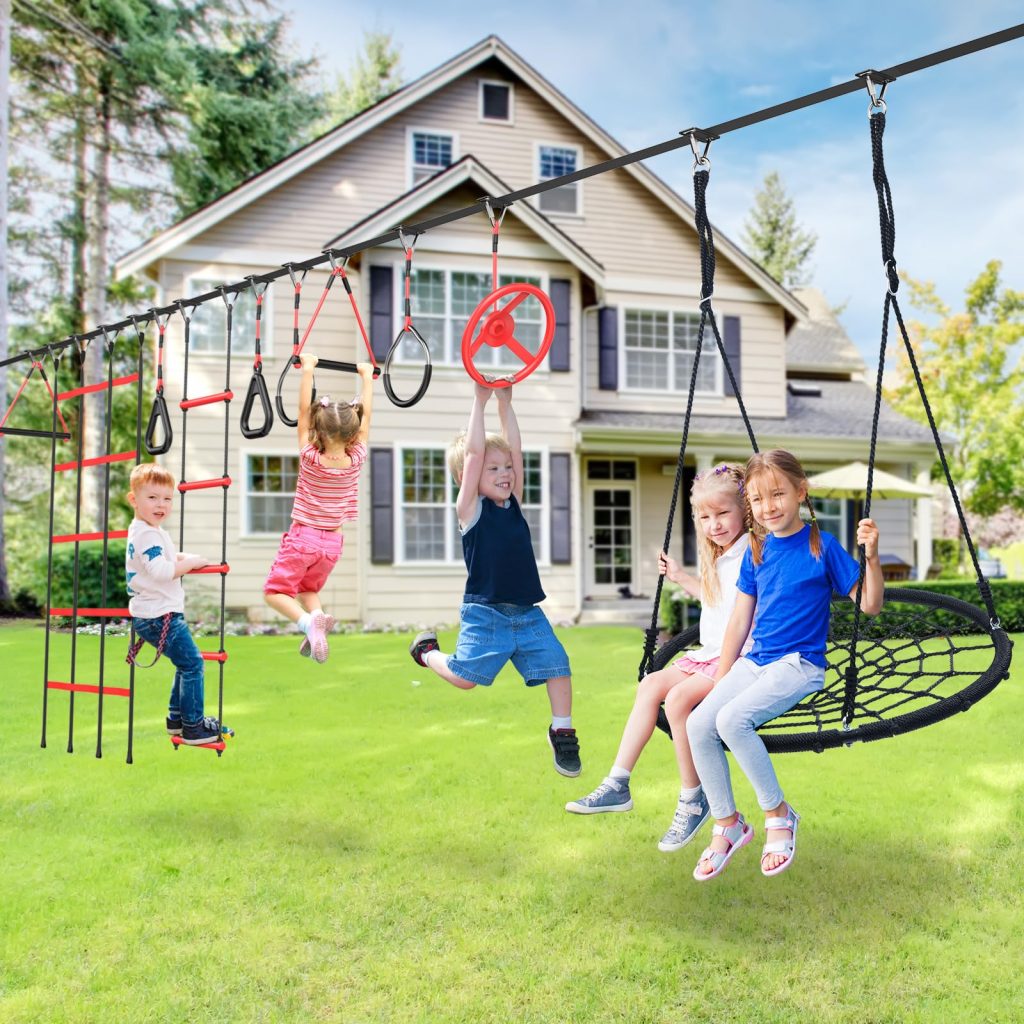

Most kids are not watching ninja competitions on TV and staying passive. They want to do it themselves. That instinct is worth paying attention to. Ninja warrior playground equipment takes the core elements of obstacle-course training and scales them for children. Warped walls, monkey bars, rope climbs, balance beams, and hanging obstacles create a full-body challenge that standard playground gear simply cannot offer. Research from the National Strength and Conditioning Association shows obstacle-based training improves upper body strength, grip endurance, and core stability faster than conventional play equipment. Kids do not notice they are training. They just know they want to beat the course.
Why Does Obstacle-Based Play Build Strength So Effectively?
Ninja-style obstacles require compound movement. That means multiple muscle groups working at the same time. When a child hangs from a bar and swings to the next one, they engage the shoulders, back, core, and grip simultaneously. No single-muscle machine does that. Functional strength training is what develops real-world athleticism. A study from the Journal of Physical Activity and Health found children aged 6 to 11 who participated in obstacle-based play three times per week gained 34% more upper body strength over 12 weeks compared to children on traditional playgrounds.
Grip strength specifically is worth flagging. Research from Keele University has linked childhood grip strength to adult cardiovascular health, cognitive function, and longevity. It is a biomarker. And ninja bars are one of the most effective ways to build it young.
How Does Ninja Equipment Support Agility Development?
Agility is not just about speed. It is about reading an environment and adjusting your body quickly. Ninja courses do this by design. Every obstacle demands a different movement pattern. A warped wall needs explosive leg drive. A balance beam needs controlled weight shifting. A rope climb needs coordinated pulling and leg locking. These are distinct motor programs the brain builds separately and then integrates.
Motor learning research from the University of Michigan shows that varied movement challenges in childhood create denser neural networks in the cerebellum, the brain region governing coordination and balance. Children who regularly practice multi-obstacle courses show faster reaction times and better spatial awareness by age 10. Agility trained young transfers directly to sports, dance, martial arts, and general physical confidence.
Is Ninja Warrior Equipment Actually Safe for Kids?
Safety is the first question every parent asks. The answer is yes, when equipment is designed and installed properly. Quality ninja warrior equipment for children uses load-tested steel frames, powder-coated finishes resistant to UV and corrosion, and impact-absorbing fall zones beneath high elements. The key metric is fall height compliance. Equipment must meet AS/NZS 4486 standards in Australia, which governs both structural integrity and critical fall height limits.
Monitored challenge is the goal. Kids should encounter obstacles that feel hard but are physically achievable. This is where good design separates from bad. Graduated difficulty levels allow younger or smaller children to find their entry point while older kids push harder. No child should be excluded. Risk calibration is built into the structure itself.
What Does It Do for a Child’s Confidence?
Confidence built through physical accomplishment is one of the most durable kinds. A child who could not make it across the monkey bars in week one and does it in week three has proof. Physical proof that effort produces results. That learning transfers. It is not abstract encouragement. It is embodied experience.
A 2020 longitudinal study tracking 600 children over three years found that those with regular access to challenge-based outdoor play reported 41% higher self-efficacy scores by age 9. Self-efficacy, the belief in your ability to do hard things, predicts academic performance, stress resilience, and career outcomes more accurately than IQ. Ninja courses are not just fun. They are shaping how children see themselves.
How Does Ninja Play Encourage Kids to Keep Moving?
Engagement is the biggest problem with children’s physical activity. Kids are not lazy. They are bored. Traditional exercise is repetitive. Ninja warrior equipment is not. Every visit to the course is a different attempt. Different sequence. Different personal goal. That novelty keeps kids coming back. Research from Sport England found that children with access to obstacle-style play equipment averaged 22 more minutes of vigorous activity per play session than those using conventional equipment.
What Makes These Installations Worth the Investment?
Durability, versatility, and usage rates. Ninja equipment built from commercial-grade materials has a minimum design life of 15 years with standard maintenance. Community playgrounds that install ninja warrior obstacles report 40 to 60% higher daily visitation rates compared to before installation. Schools with ninja zones see reductions in sedentary behaviour and improved focus during afternoon classes. The data is clear. The return on investment for quality ninja playground equipment is high in every metric that matters.