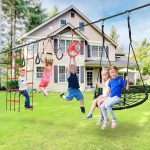
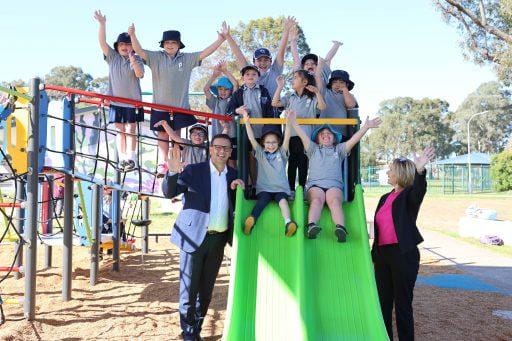

Balance is not a skill children either have or do not have. It is trained. Every time a child steps onto an unsteady surface and adjusts, the brain records the correction. Those corrections compound. Over time, the body learns to stay upright in more and more challenging conditions. Balance playground equipment creates exactly those conditions. Wobbly bridges, stepping stones, slack lines, balance beams, and net structures all challenge the postural control system continuously. Research from the Swiss Federal Institute of Sport shows that children who regularly use balance-based play equipment develop measurably superior static and dynamic balance by age 7 compared to children without access to such equipment. The gap in proprioceptive ability between the two groups is significant.
What Is Postural Control and Why Does It Start at the Playground?
Postural control is the ability to maintain or recover balance during movement and stillness. It relies on three sensory systems working together: the vestibular system, the visual system, and proprioception. All three need input to develop. Balance playground equipment delivers all three inputs simultaneously. When a child walks a wobbly beam, the eyes track the surface, the inner ear reads the tilt, and the muscles in the feet and ankles fire rapid corrections. That triangle of input is what builds real postural competence.
Children with poor postural control struggle beyond the playground. They drop things more often. They fatigue quickly when writing. They have difficulty sitting upright in class without slouching. A 2017 study from Pediatric Physical Therapy found that 68% of children referred for occupational therapy had measurable deficits in postural control. Playgrounds are one of the most accessible interventions available.
How Does Balance Equipment Build Cognitive Confidence?
Physical confidence and cognitive confidence are more connected than most people realise. When a child masters a balance challenge, the brain records a success template. I tried something hard. I failed. I adjusted. I made it. That sequence is the template for approaching difficult academic tasks, social challenges, and later, professional problems. The physical experience of recovery from imbalance becomes a mental model for recovery from failure.
Stanford psychologist Carol Dweck’s research on growth mindset identifies challenge tolerance as a foundational characteristic of high achievers. Balance play builds that tolerance in the body before the brain can conceptualise it. For young children, embodied experience always precedes conceptual understanding. Give them balance challenges early and they develop tolerance for difficulty as a default setting.
Which Types of Balance Equipment Are Most Effective?
Not all balance equipment is equal. Equipment that moves in response to the child’s weight is more effective than static beams. Dynamic surfaces force continuous neuromuscular adaptation. Net climbers and web structures are particularly effective because they respond to both the child’s movement and the movement of other children on the same structure. This unpredictability drives a higher level of balance adaptation than any single-user static element can.
Networx-style multi-level rope and cable structures are among the highest-rated balance development tools in playground research literature. They combine postural challenge with height, spatial problem-solving, and multi-sensory engagement. They also scale naturally with age and ability. A 4-year-old and a 12-year-old can both find their edge on the same structure.
How Does Balance Play Reduce Injury Risk Long Term?
This is underappreciated. Children with well-developed balance are significantly less likely to sustain injuries in sport, everyday movement, and even vehicle accidents. A meta-analysis published in the British Journal of Sports Medicine reviewed 32 studies and found that proprioceptive training, which balance playground equipment delivers, reduced sports injury rates by an average of 37% in young athletes. That effect persisted into adulthood when training began before age 10.
The cost of childhood sport injuries in Australia exceeds $300 million annually. Balance training through playground access is a low-cost, high-access prevention mechanism. Designing public spaces with balance equipment is a public health decision, not just a recreational one.
Can Balance Equipment Help Children with Developmental Differences?
Yes, meaningfully. Children with developmental coordination disorder, DCD, affect around 5 to 6% of school-age children. Their motor learning is slower and requires more repetition. Balance playground equipment provides that repetition in a natural, non-clinical context. A 2019 study in the Journal of Developmental and Behavioral Pediatrics found that children with DCD who had regular access to outdoor balance equipment showed 31% faster improvement in motor competency scores compared to those without access.
What Should Schools and Councils Prioritise When Choosing Balance Equipment?
Multi-user capacity and variability of challenge are the two key factors. Equipment that only one child can use at a time limits throughput and social interaction. Equipment with a single fixed difficulty level limits developmental range. The best balance installations offer multiple entry points across a connected network, allow group use, and present challenges across at least four difficulty levels. Maintenance matters too. Rope and cable networks require annual tension checks and UV damage assessments to remain safe and effective.