
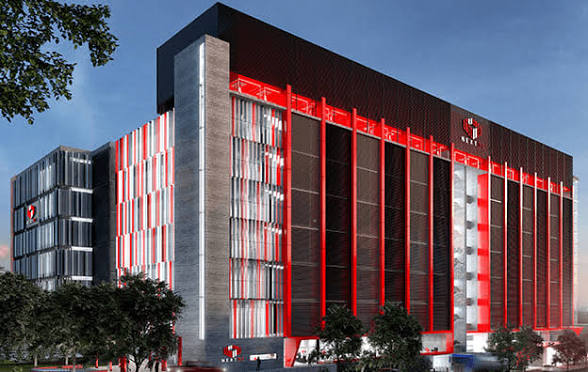

Data centre companies in Australia are not just building server rooms. They are building the backbone of a digital economy that processed over AUD 167 billion in e-commerce transactions in 2023. Every hospital record, banking transaction, and government database relies on physical infrastructure these companies design, build, and operate. Australia has over 200 commercial data centre facilities today, with capacity concentrated in Sydney, Melbourne, and increasingly in Brisbane. This article looks at how these companies actually support national digital growth, and what separates the serious operators from the rest.
Who Are the Main Players in Australia’s Data Centre Sector?
A handful of major operators dominate. NEXTDC, AirTrunk, Equinix, and Goodman are the most active in terms of capacity and new builds. NEXTDC reported 93.1MW of contracted utilisation in its FY2024 results. AirTrunk, which Blackstone acquired for USD 24 billion in 2024, operates hyperscale campuses in Western Sydney and outer Melbourne.
Beyond the big names, there is a second tier of colocation providers serving regional businesses and government agencies. Companies like Vocus, Macquarie Data Centres, and DXC Technology fill that gap. Each targets different buyer profiles, which keeps the market diverse.
How Do These Companies Actually Support Digital Growth?
The short answer is: by making reliable connectivity cheap enough to scale. A business moving workloads to the cloud does not just need compute. It needs a physical location where its internet service provider, its cloud provider, and its disaster recovery site all interconnect with minimal latency.
Data centre companies build and maintain those interconnection points. Sydney’s Equinix SY1 facility, for example, hosts over 300 network service providers and direct cloud on-ramps to AWS, Azure, and Google Cloud. Without that under one roof, enterprises would pay more and get less.
What Role Do These Companies Play in Government Infrastructure?
A significant one. The Australian government’s Secure Cloud Strategy requires agencies to store sensitive data within Australian borders. That policy directly drives demand for certified, sovereign data centre space.
Macquarie Data Centres became the first private facility to receive Certified Strategic status under the Hosting Certification Framework in 2022. That certification unlocks access to classified government workloads. Only a small number of operators can meet those standards, which makes sovereign-certified space a premium product.
How Are These Companies Handling the Energy Challenge?
Energy is the biggest operating cost and the biggest sustainability pressure at the same time. Australian data centres consumed approximately 10TWh of electricity in 2023. That is roughly 4% of national electricity consumption.
The leading operators are responding with power purchase agreements for renewable energy. NEXTDC has committed to 100% renewable electricity across its portfolio. AirTrunk signed a 295MW renewable energy deal in 2022, one of the largest corporate renewable energy agreements in Australian history. These are not green marketing moves. Renewable energy locks in long-term price certainty, which matters when power costs represent 30 to 40% of operating expenses.
What Makes a Data Centre Company Worth Working With?
Uptime track record is the first thing to check. Tier III certification from the Uptime Institute guarantees 99.982% availability. Tier IV pushes that to 99.995%. For financial services or healthcare clients, the difference between those two tiers is not theoretical. It is the difference between planned maintenance windows and unplanned outages.
Transparency matters too. Operators that publish real PUE numbers, third-party audit results, and incident reports give clients something to verify. Operators that just publish marketing claims give clients nothing but hope.
Finally, look at interconnection density. A data centre with 50 network providers on-net is fundamentally more useful than one with five, even if the physical specs look identical.