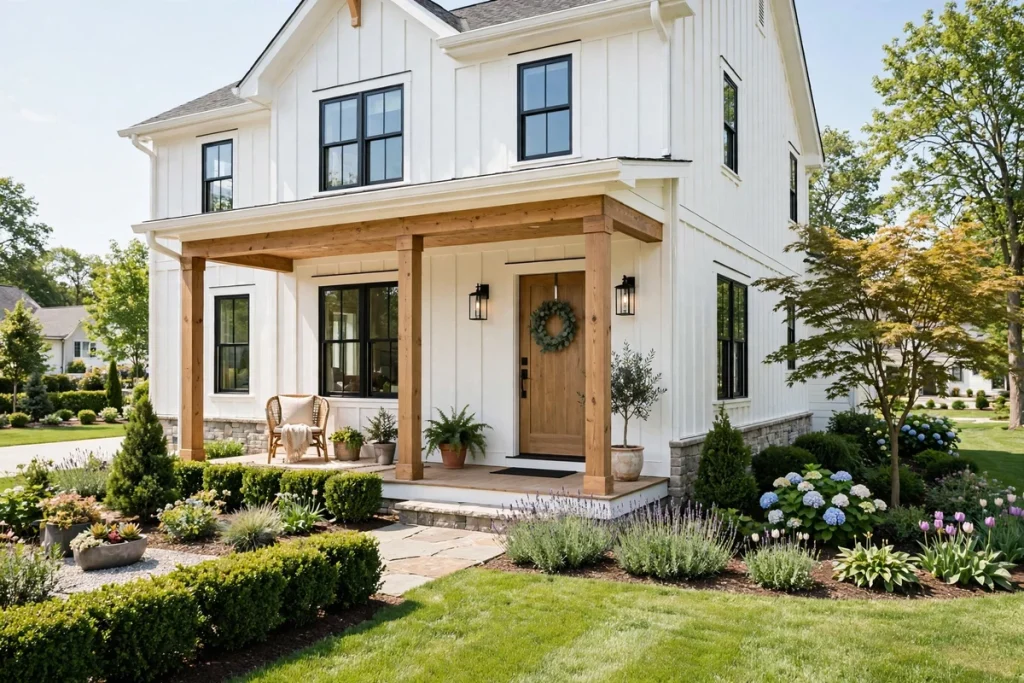

Exterior outdoor LED lights are weatherproof LED fixtures made for outside a home — for paths, porches, walls, gardens, and driveways. The best choice for most homes is a warm white (2700–3000K), IP65-rated LED light with a motion sensor for security areas and a dusk-to-dawn sensor for paths and porches. It uses far less energy than old halogen lights, lasts for years, and makes your home safer and more welcoming at night. Choose the placement first, then the brightness, then the style.
Outdoor LED lighting has become the standard for home exteriors because LEDs are efficient, durable, and available in almost any style. Top guides usually cover types and brightness, but they rarely give a placement plan for a whole home or explain IP ratings in plain language. This guide does both, with a placement planner most roundups miss, plus solar versus wired, cost, and safety advice.
What Are Exterior Outdoor LED Lights?
Exterior outdoor LED lights are lights designed to work outside in rain, wind, and temperature changes. They use LED bulbs or built-in LED chips, which use about 80 percent less energy than incandescent bulbs and last 25,000 hours or more. They come as wall lights, path lights, floodlights, string lights, deck lights, and spotlights, and they can be wired into your home, solar powered, or battery powered.
Unlike indoor lights, outdoor lights need a weatherproof rating, a suitable colour temperature for outside, and a mounting that can handle wind and rain. A light that works well in a living room will fail quickly outside if it is not rated for outdoor use.
Types of Exterior Outdoor LED Lights Compared
| Type | Best for | Notes |
|---|---|---|
| Wall lights | Porches, doors, patios | Fixed, wired, welcoming glow |
| Path lights | Walkways, driveways | Low, safe, guides visitors |
| Floodlights | Security, large areas | Bright, motion sensor, wide beam |
| Spotlights | Trees, features, house | Focused beam, highlights architecture |
| String lights | Patios, gardens, parties | Decorative, warm, easy to hang |
| Deck and step lights | Decks, stairs, pools | Low, safe, prevents trips |
| Solar lights | Paths, gardens, no wiring | Easy, no running cost, dimmer |
Wall lights and path lights are the best starting point for most homes: they cover the areas you use every day and make the house look cared for. Floodlights are best for security, spotlights are best for highlighting a tree or the house itself, and string lights are best for a patio you use in the evening.
Brightness, Colour Temperature, and IP Ratings Explained
Brightness for outdoor lights is measured in lumens, not watts. A path light needs 100 to 200 lumens, a porch light needs 400 to 800 lumens, and a security floodlight needs 1,500 to 3,000 lumens. Colour temperature is measured in Kelvin: warm white (2700–3000K) is cosy and welcoming, neutral white (3500–4000K) is clear and practical, and cool white (5000K or more) is bright and clinical — best for security, not for a patio.
IP rating tells you how weatherproof a light is. IP44 is splash-proof and suits a covered porch, IP65 is jet-proof and suits exposed walls and paths, and IP67 can handle temporary immersion and suits ground lights. For most exposed outdoor lights, choose IP65 or higher, and check that the light is rated for your climate, including frost and heat.
Placement Planner: Where to Put Exterior Outdoor LED Lights
Most guides list light types without telling you where to put them. Use this planner, which most roundups miss, to light a whole home.
| Area | Best light | Brightness | Sensor |
|---|---|---|---|
| Front door and porch | Wall light, both sides | 400–800 lumens | Dusk-to-dawn |
| Path and driveway | Path lights, 6–8 ft apart | 100–200 lumens | Dusk-to-dawn or solar |
| Back garden and patio | String lights, wall lights | 200–400 lumens | Manual or timer |
| Garage and side gate | Floodlight | 1,500+ lumens | Motion sensor |
| Steps and deck | Step lights | 50–100 lumens | Dusk-to-dawn |
| Trees and house front | Spotlights, uplights | 300–700 lumens | Timer |
Light in layers: a soft ambient light for the porch, a practical light for paths, and a bright light for security. Avoid pointing lights into neighbours’ windows or into the street, and keep the brightest lights on motion sensors so they do not stay on all night.
Solar vs Wired Outdoor LED Lights
Solar lights are easy to install, cost nothing to run, and work well for paths and gardens where the sun reaches the panel for most of the day. They are dimmer than wired lights, they fade on cloudy days, and they need a panel that is not shaded by trees or a house. Wired lights are brighter, more reliable, and better for porches, floodlights, and security, but they need an electrician if there is no existing outdoor wiring.
For most homes, a mix works best: wired lights for the porch and security, solar lights for paths and garden accents. That gives you reliable light where you need it and easy, cheap light where you do not.
How Much Do Exterior Outdoor LED Lights Cost?
A solar path light costs $10 to $30 each, a good wall light costs $40 to $120, and a motion-sensor floodlight costs $50 to $150. A full outdoor lighting plan for a typical home — porch, path, patio, and security — usually costs $300 to $900 for the lights, plus $200 to $600 for professional installation if wiring is needed. Running costs are low: an LED outdoor light that runs for 8 hours a night costs only a few dollars a year in electricity.
Safety and Installation Tips
Hire a qualified electrician for any wired outdoor lighting, especially if you need a new outdoor circuit or a light in a wet area. Use outdoor-rated cable and fittings, keep connections out of standing water, and fit a residual current device for outdoor circuits. Keep lights away from dry leaves, check them after storms, and replace a damaged fitting at once. For solar lights, clean the panel every few months so it charges properly.
Frequently Asked Questions
What IP rating do I need for outdoor LED lights?
For a covered porch, IP44 is enough. For exposed walls, paths, and gardens, choose IP65 or higher. For ground lights that may sit in water, choose IP67.
Are solar outdoor lights bright enough?
Yes, for paths and garden accents, where 100 to 200 lumens is enough. For porches and security, wired lights are brighter and more reliable, especially in winter or in shaded gardens.
What colour temperature is best for outdoor lights?
Warm white, 2700 to 3000K, is best for porches, patios, and gardens because it feels welcoming. Neutral white is best for paths and work areas, and cool white is best only for security floodlights.
How long do exterior LED lights last?
A good LED outdoor light lasts 25,000 to 50,000 hours, which is many years of evening use. Solar lights last less long, because the battery needs replacing every one to three years.
Conclusion
The best exterior outdoor LED lights are warm white, IP65-rated, and placed in layers: wall lights for the porch, path lights for walkways, and motion-sensor floodlights for security. Start with the areas you use at night, choose wired lights where reliability matters and solar where ease matters, and keep the brightest lights on sensors. Do that, and your home will be safer, more welcoming, and more beautiful after dark.
Related reading: plan the rest of your home with How to Design a Functional Kitchen, finish ceilings and outdoor soffits with How to Install Drop Ceiling, and clear space for a better exterior with the Decluttering Checklist.
Smart Outdoor LED Lights, Timers, and Sensors
Smart outdoor LED lights add convenience that is hard to give up once you try it. A dusk-to-dawn sensor turns lights on at sunset and off at sunrise without you touching a switch, a motion sensor turns a floodlight on only when someone approaches, and a timer lets you set patio lights to turn off at midnight. Smart lights can also be controlled from a phone or voice assistant, dimmed for a party, or grouped by zone — front, back, and garden — so you can light only the area you are using. If you choose smart lights, check that they work with your home system, that the Wi-Fi or hub reaches the garden, and that the lights still work manually if the network goes down. A simple timer or sensor is often enough, and it is more reliable than a complex smart system in a wet, cold garden.
Light Pollution, Neighbours, and Dark-Sky Friendly Lighting
Outdoor lights should help you, not annoy your neighbours or wash out the night sky. Choose warm white lights, shielded fixtures that point down rather than up or sideways, and motion sensors for the brightest lights so they are not on all night. Avoid very bright, cool white floodlights on a patio, which can glare into bedrooms and gardens next door. Check local rules about outdoor lighting, especially in rural or dark-sky areas, and talk to neighbours if a new light shines into their home. A well-planned outdoor lighting scheme uses the lowest brightness that does the job, lights only the areas you need, and turns off when no one is there — which is better for wildlife, for neighbours, and for your electricity bill.