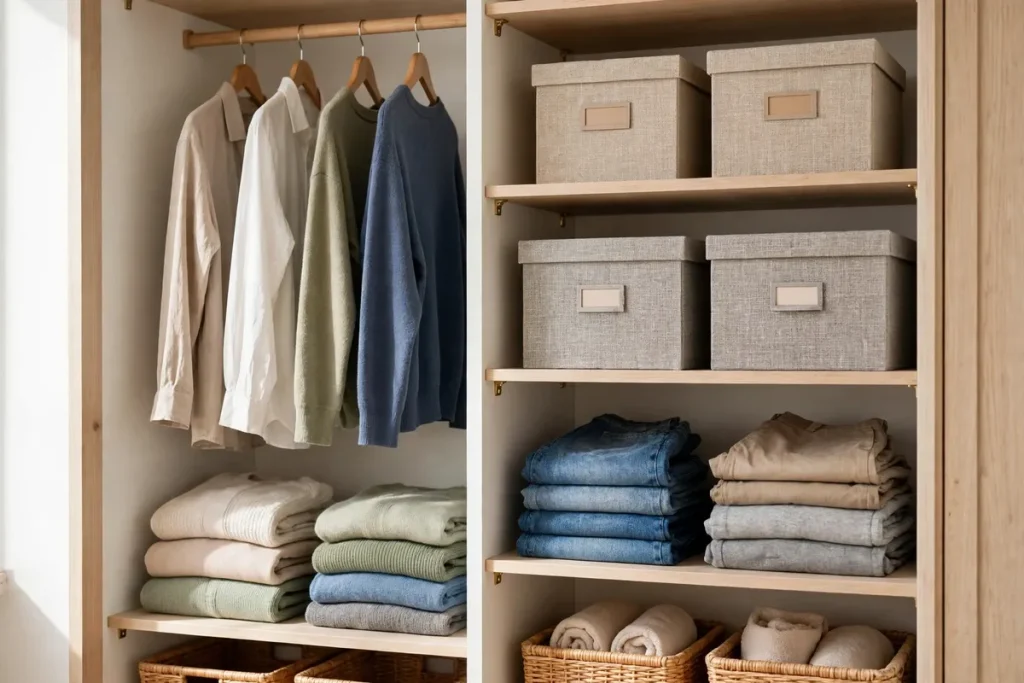

A closet organizer 2026 is a storage system — shelves, hanging rods, drawers, and baskets — that turns a cluttered closet into a space where every item has a place. The best choice for most homes in 2026 is a modular, adjustable system with double hanging rods, open shelves, and a few drawers, sized to your closet and your clothes. It costs less than a custom built-in, it can be changed as your wardrobe changes, and it usually doubles the usable storage of a standard single-rod closet.
Closet organizers are one of the most searched home storage topics because a messy closet wastes time every morning. Top guides usually list the best systems by brand, but they rarely match a system to your closet size or to what you actually own. This guide does both, with a closet-size planner most roundups miss, plus measuring, cost, and DIY advice.
What Is a Closet Organizer?
A closet organizer is any system that adds structure to a closet: shelves for folded clothes, rods for hanging clothes, drawers for small items, shoe racks, and baskets for accessories. It can be a simple wire kit, a wooden modular system, or a fully custom built-in. The goal is the same: use the vertical space, separate clothes by type, and make everything visible and easy to reach.
Most closets waste space at the top, at the bottom, and in the corners. A good organizer uses those dead zones, so a small closet can hold far more than a larger, unorganised one. It also makes it easier to see what you own, so you stop buying duplicates and you wear more of what you have.
Types of Closet Organizer Compared
| Type | Best for | Cost | Notes |
|---|---|---|---|
| Wire kit | Budget, rentals | $50–$200 | Light, easy, less polished |
| Modular wood | Most homes | $200–$800 | Adjustable, looks built-in, DIY friendly |
| Custom built-in | Walk-ins, forever homes | $1,500–$5,000+ | Best fit, most expensive, permanent |
| Freestanding wardrobe | No closet, small rooms | $200–$1,000 | Portable, needs floor space |
| Stackable cubes | Students, temporary | $30–$150 | Flexible, less durable |
Modular wood systems are the best choice for most people in 2026. They look like a built-in, they can be cut to fit, and they can be rearranged when your wardrobe changes. Wire kits are best if you rent or need a quick, cheap fix. Custom built-ins are best if you own your home, you have a walk-in closet, and you want the best possible fit.
Closet Size Planner: Which Organizer for Your Closet?
Most guides list systems without telling you which one fits your closet. Use this planner, which most roundups miss, before you shop.
| Closet size | Best system | Key features |
|---|---|---|
| Small reach-in, 4–5 ft wide | Modular kit, double hang | Double rods, shelf above, shoe rack below |
| Medium reach-in, 6–8 ft wide | Modular wood, drawers | Double hang, drawers, long hang for dresses |
| Walk-in, 5 x 7 ft | Modular or custom | Zones for clothes, shoes, accessories |
| Walk-in, 7 x 10 ft or more | Custom built-in | Island, mirror, seating, full zones |
| No closet | Freestanding wardrobe | Wardrobe + open rack, baskets |
Measure the width, depth, and height of your closet, and note the door swing, light, and any obstacles such as a water heater or a sloping ceiling. A system that is 1 inch too wide will not fit, and a system that blocks the door will frustrate you every day. Draw the closet on paper, or use a free online planner, before you order.
How to Measure and Plan Your Closet
Start by taking everything out of the closet and sorting it: keep, donate, and store. Count what you own by type — how many shirts, trousers, dresses, shoes, and bags — because that tells you how much hanging, shelf, and drawer space you need. Hang long items on one side and short items on the other, put folded clothes on shelves at eye level, and put shoes at the bottom where they are easy to reach.
Allow about 24 inches of depth for hanging clothes, 12 to 16 inches for shelves, and at least 42 inches of height for a double-hang section. Leave a clear walkway in a walk-in closet, and keep the most-used items at eye level and the least-used items at the top.
How Much Does a Closet Organizer Cost in 2026?
A wire kit costs $50 to $200, a modular wood system costs $200 to $800 for a reach-in closet and $800 to $2,000 for a walk-in, and a custom built-in costs $1,500 to $5,000 or more. Installation adds $200 to $800 for a modular system and $500 to $1,500 for a custom system, depending on size and complexity.
Budget for accessories too: matching hangers, shelf dividers, baskets, and shoe racks can add $50 to $200, but they make the system work far better. A cheap system with good accessories often works better than an expensive system with no baskets or dividers.
DIY or Professional Installation?
Most modular systems are designed for DIY installation in a day, with basic tools and a level. Follow the maker’s instructions, find the wall studs, and do not overload shelves. Hire a professional if you want a custom built-in, if your walls are uneven, or if you need electrical work for closet lighting. A professional can also help you plan the layout, which is often the hardest part.
Frequently Asked Questions
What is the best closet organizer for a small closet?
A modular kit with double hanging rods is best for a small closet. It doubles hanging space, adds a shelf above and a shoe rack below, and can be adjusted as your wardrobe changes.
Are closet organizers worth it?
Yes, if your closet is cluttered or hard to use. A good organizer usually doubles usable storage, saves time every morning, and helps you wear more of what you own. It is one of the cheapest home improvements per square foot.
How much does a custom closet cost?
A custom built-in closet usually costs $1,500 to $5,000 or more, depending on size, materials, and features. A modular system costs far less and can look almost as good in a reach-in closet.
Can I install a closet organizer myself?
Yes, most modular and wire systems are designed for DIY installation in a day. Custom built-ins are best left to a professional, especially if they need cutting, fitting, or electrical work.
Conclusion
The best closet organizer in 2026 is the one that fits your closet, your clothes, and your budget. Start by decluttering, measure carefully, choose a modular system for most closets and a custom system for a large walk-in, and add baskets, dividers, and matching hangers to make it work. Do that, and your closet will save you time every morning instead of costing you time.
Related reading: start by clearing space with the Decluttering Checklist, choose clothes worth keeping with Best Men’s Outfits for Date Night, and keep them looking good with How to Whiten Clothes.
Closet Lighting and Accessories That Make a Difference
Good lighting turns a closet organizer from a storage system into a room you enjoy using. Battery LED strips under shelves, a motion-sensor light inside the door, or a small ceiling light in a walk-in closet all help you see colours accurately in the morning, so you do not grab a navy shirt thinking it is black. Mirrors help too: a full-length mirror on the door or inside a walk-in lets you check an outfit without leaving the closet. Accessories matter as much as the main system: matching slim hangers save space and stop clothes from slipping, shelf dividers keep folded stacks tidy, baskets hide socks and accessories, and a shoe rack keeps pairs together. A valet rod — a small pull-out rod for tomorrow’s outfit — is a cheap addition that many people use every day. Spend a little on these details, and the whole system will work far better than a bare set of shelves and rods.
Keeping Your Closet Organized After the Makeover
A closet organizer only works if you keep it organized. Do a quick tidy each week: put clothes back in their zone, return shoes to the rack, and take out anything that does not belong. Do a bigger review each season: try on clothes you have not worn, donate or store what no longer fits or suits you, and rotate seasonal clothes to the front. Use the one-in, one-out rule — when you buy a new item, remove an old one — so the closet does not slowly fill up again. Keep a small donation bag in the closet, so it is easy to let go of clothes as soon as you decide you do not need them. With that simple routine, a closet organizer will stay useful for years, instead of becoming a tidy system that slowly returns to chaos.
Finally, remember that the best closet organizer is the one you will actually use. A simple system that you keep tidy is better than a complex system that overwhelms you. Start with the basics — double hanging, shelves, and a shoe rack — and add drawers and accessories only when you need them. Your closet should make mornings easier, not harder.