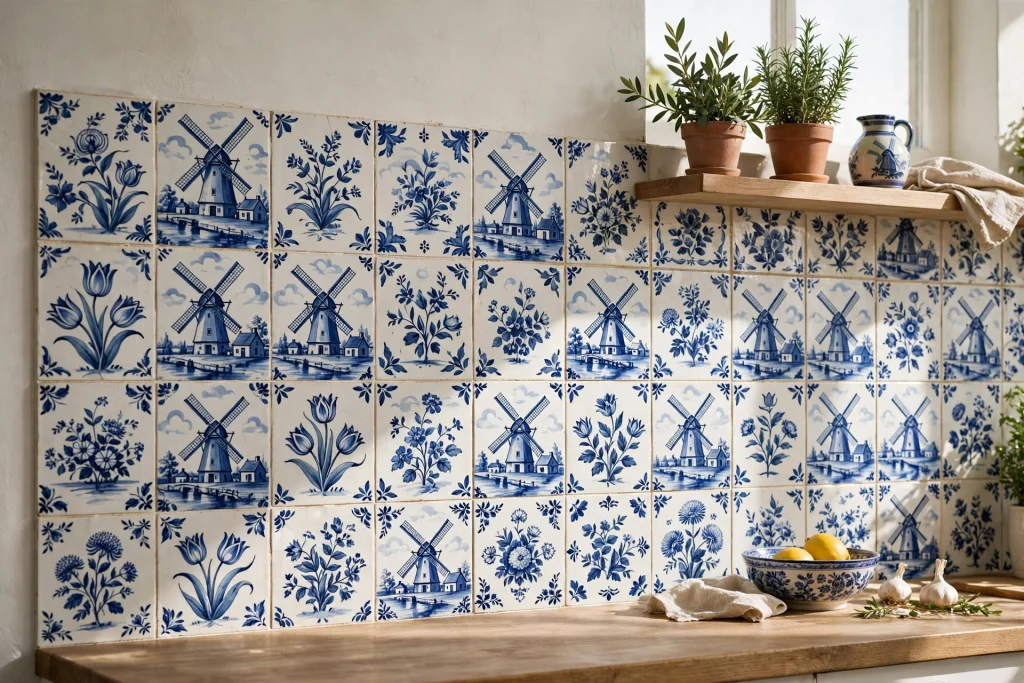

Delft tiles are hand-painted, blue-and-white ceramic tiles from the Netherlands, and they remain one of the most recognisable decorative tiles in the world. If you have ever seen a kitchen backsplash, fireplace surround, or bathroom wall covered in small white tiles painted with windmills, ships, flowers, or farm animals, you have almost certainly seen Delft tiles. They bring a calm, classic look that works in both traditional homes and modern rooms, and they have been in use for more than 400 years.
In this guide, you will learn what Delft tiles are, where they came from, how they are made, what they cost, and how to use them without making a room look like a museum. You will also find a comparison of the main types, practical advice on choosing colours and sizes, installation and care tips, and answers to the questions buyers ask most often. Whether you want a full Delft tile wall, a small accent panel, or a single row above a cooker, this article will help you decide with confidence.
What Are Delft Tiles?
Delft tiles are tin-glazed earthenware tiles, usually square, painted by hand in blue on a white background. The blue most people picture is cobalt blue, although Delft tiles were also made in other colours, including green, yellow, purple, and multi-colour designs. The classic tile is about 13 by 13 centimetres, or roughly 5 by 5 inches, although modern makers also sell larger and smaller sizes.
The name comes from the city of Delft in the Netherlands, where tile makers began producing these tiles in the 1600s. The style was inspired by Chinese blue-and-white porcelain, which Dutch traders brought home from Asia. Dutch potters could not make true porcelain, so they developed a tin glaze that gave their earthenware a white, porcelain-like surface. Painters then decorated that surface with scenes from Dutch life, landscapes, animals, flowers, and geometric patterns.
Today, the term Delft tiles is used in two ways. First, it describes genuine hand-painted tiles made in the Netherlands, often by historic factories such as Royal Delft, also known as De Porceleyne Fles. Second, it describes the wider style: blue-and-white, hand-painted or hand-look tiles made anywhere in the world, including Spain, Portugal, England, and the United States. Both can look beautiful, but they are not the same in price, durability, or collectable value, so it helps to know which one you are buying.
A Short History of Delft Tiles
Tile making in Delft began in the late 1500s, when Italian potters brought maiolica, or tin-glazed pottery, to the Netherlands. In the early 1600s, the Dutch East India Company began importing Chinese porcelain, and Dutch buyers loved its crisp white ground and deep blue painting. Local potters in Delft copied the look, and by the middle of the century Delft had become a major centre for tin-glazed pottery and tiles.
At first, Delft tiles were a luxury product. Wealthy families used them to line fireplaces, kitchens, hallways, and even whole rooms, partly because the glazed surface was easy to clean and partly because it showed off their taste and wealth. Tile pictures told stories: ships at sea, farmers at work, children playing, biblical scenes, and tulips, which were then a fashionable and expensive flower in the Netherlands. In the 1900s, interest returned, partly because collectors and designers valued the handmade quality, and partly because the blue-and-white look fitted well with coastal, country, and classic interiors.
Types of Delft Tiles
Not all Delft tiles are alike. The main differences are how they are made, how detailed the painting is, and whether they are meant for a wall, a floor, or decoration only. Knowing the types helps you match the tile to the job and avoid paying antique prices for a modern reproduction, or using a delicate decorative tile where a hard-wearing floor tile is needed.
1. Hand-Painted Dutch Delft Tiles
These are the traditional tiles, painted by hand in the Netherlands. Each tile is slightly different, which is part of the charm. The painting is done in cobalt blue on a white tin glaze, often with a small maker’s mark on the back. They are usually wall tiles, not floor tiles, because the earthenware body is softer than modern porcelain. Expect to pay the most for these, especially for antique tiles or tiles from Royal Delft.
2. Antique Delft Tiles
Antique tiles are usually 17th to 19th century tiles salvaged from old houses, fireplaces, and churches. They show wear, small chips, and uneven glazing, and collectors value those marks as proof of age. Antique tiles are best used as a framed panel, a fireplace feature, or a small accent, rather than in a wet shower or a high-traffic floor, where further damage is likely.
3. Delft-Style and Reproduction Tiles
Modern Delft-style tiles copy the blue-and-white look but are made by machine, often in Spain, Portugal, or Italy, using ceramic or porcelain bodies. The design may be printed rather than hand-painted, so tiles in a batch look identical. These tiles are usually harder, more water-resistant, and much cheaper than hand-painted Dutch tiles, which makes them a practical choice for a kitchen backsplash or bathroom wall.
4. Polychrome Delft Tiles
Polychrome means multi-coloured. These tiles use blue with green, yellow, orange, and purple, and they were popular in the 1600s and 1700s for flower and landscape scenes. They suit rooms where you want more warmth and colour than the classic blue-and-white palette gives, and they pair well with wood, brass, and warm white paint.
5. Delft Tile Panels and Murals
A panel is a set of tiles that together form one large picture, such as a harbour scene, a windmill landscape, or a set of tulips. Panels are often sold as 4, 6, 9, or 12 tiles, framed or set into a wall. They make a strong focal point above a cooker, in a hallway, or over a bath, and they are a good way to enjoy Delft art without tiling a whole room.
| Type | How it is made | Best for | Price level | Durability |
|---|---|---|---|---|
| Hand-painted Dutch | Hand-painted tin-glazed earthenware | Walls, fireplaces, panels | High | Moderate; wall use only |
| Antique | Hand-painted, 1600s-1800s | Framed panels, features | Very high | Low; handle with care |
| Delft-style reproduction | Printed ceramic or porcelain | Kitchens, bathrooms, floors | Low to medium | High |
| Polychrome | Hand-painted, several colours | Feature walls, panels | High | Moderate |
| Tile panel or mural | Several tiles, one picture | Focal points, hallways | Medium to high | Moderate to high |
Common Delft Tile Designs and What They Mean
Delft tile pictures are not random decoration. Many designs were repeated for centuries, and each group has a meaning or a story. Windmills and ships are the most famous, and they speak of Dutch trade, travel, and the low, flat landscape. Farm scenes show cows, horses, and people working in fields, while flower tiles show tulips, roses, and carnations, often one flower in the centre of each tile. Other popular designs include birds, dogs, and deer, children playing, biblical scenes, and simple geometric patterns used to frame a wall of plain tiles.
Where to Use Delft Tiles in Your Home
Delft tiles work best where you can see them up close and where their detail will not be lost. A kitchen backsplash is the classic choice: a row of Delft tiles above a cooker, or a full backsplash behind a sink, adds colour and pattern without overwhelming the room. In a bathroom, Delft tiles suit a shower wall, a bath surround, or a wainscot, especially with white sanitary ware and chrome or brass fittings. For more backsplash inspiration, see our guide to bathroom backsplash ideas.
Fireplaces are another natural home for Delft tiles. A fireplace surround in blue-and-white tiles looks warm and traditional, and the tiles are easy to wipe clean. Hallways and entryways also suit Delft tiles, either as a full wall, a dado-height band, or a framed panel that greets visitors. In a bedroom or living room, a small Delft panel can act as art. Think about scale before you commit: small 13-centimetre tiles with busy pictures can look crowded on a very large wall, so use larger tiles, a simpler pattern, or a mix of plain white tiles and picture tiles there.
How Much Do Delft Tiles Cost?
Delft tile prices vary widely, mainly because hand-painted tiles cost far more to make than printed ones. As a rough guide, modern Delft-style ceramic tiles often cost from about $5 to $25 per tile, or $30 to $150 per square foot, depending on size, material, and finish. Hand-painted Dutch tiles often cost $25 to $80 per tile, and a large panel can cost several hundred dollars. Antique tiles can cost $50 to $200 or more per tile, depending on age, condition, and rarity. Always order 10 to 15 percent extra for cuts, breakages, and spares, and keep a few spare tiles in case one is damaged later.
How to Choose Delft Tiles
Start with the room, not the tile. A kitchen with white cabinets and a marble worktop suits classic blue-and-white tiles, while a bathroom with warm wood and brass may suit polychrome tiles better. Look at the other colours in the room: the blue in Delft tiles is a cool blue, so it pairs well with white, cream, grey, and soft green. If you are planning a kitchen, our round-up of 2026 kitchen cabinet colors can help you match cabinet paint to the tile blue.
Next, decide how much pattern you want. If you love the pictures, use them as a feature and keep the rest plain. If you want a calmer look, choose tiles with a simple corner motif or a border, and use picture tiles sparingly. Check the size too: small tiles suit a small backsplash, while larger tiles suit a large wall and show the picture better. Ask for samples, and view them in daylight and in evening light, because cobalt blue can look darker in a dim room.
Check the tile body as well. For a shower or a floor, choose porcelain or a hard ceramic tile that is rated for wet areas. For a dry wall or fireplace, earthenware is fine. Ask the seller whether the tile needs sealing, what grout colour they recommend, and whether the tile can be cut cleanly. White or very light grey grout keeps the blue bright, while dark grout can make the pattern look heavy. Sintered stone is another hard-wearing surface worth comparing if you are choosing worktops to go with your tiles.
Installing Delft Tiles: What to Know
You can install Delft tiles yourself if you have tiled before, but hand-painted and antique tiles deserve extra care. Start by planning the layout on the floor or on a table. Lay out the picture tiles in order, check that the pattern lines up, and mark the centre of the wall so the design is balanced. Use a white adhesive, because a grey adhesive can show through a thin white glaze and dull the blue.
Use tile spacers to keep the joints even, usually 2 to 3 millimetres for small Delft tiles. Press each tile firmly but gently, and wipe off adhesive at once with a damp sponge. Do not use a hard brush or an abrasive cleaner on a hand-painted surface. Let the adhesive dry fully before grouting, and use a grout float at a shallow angle so you do not scratch the glaze. After grouting, clean the tiles with a soft cloth and clean water, changing the water often so grout haze does not dry on the surface. If you are tiling a wet area, make sure the wall is waterproofed first, and seal the grout if the maker advises it.
How to Clean and Care for Delft Tiles
Delft tiles are easy to care for if you treat them gently. Wipe them with a soft cloth and warm water, with a little mild soap if needed. Avoid bleach, strong acids, and abrasive pads, which can damage the glaze and fade the blue over time. In a kitchen, wipe splashes of oil and tomato sauce promptly, because they can stain grout even if they do not stain the tile. In a bathroom, dry the tiles after a shower when you can, and keep the grout sealed so mould does not grow in the joints. If a tile is chipped, replace the single tile with a spare, which is another reason to keep spares.
Frequently Asked Questions About Delft Tiles
Are Delft tiles only blue and white?
No. Blue and white is the classic look, but Delft tiles were also made in green, yellow, purple, and multi-colour polychrome designs. Modern makers also offer soft blue, navy, and other colours.
Can Delft tiles be used in a shower?
Yes, if you choose a tile rated for wet areas. Modern porcelain Delft-style tiles are a safe choice for showers. Hand-painted earthenware tiles can be used only if the maker says they are suitable and the wall is properly waterproofed.
Are Delft tiles expensive?
They can be. Printed Delft-style tiles are affordable, often $5 to $25 per tile, while hand-painted Dutch tiles cost $25 to $80 per tile and antiques can cost much more. Using picture tiles as accents keeps the cost down.
How can I tell a real hand-painted Delft tile from a printed one?
Look for slight differences between tiles, visible brush marks, and a maker’s mark on the back. Printed tiles are perfectly even and identical. Ask the seller where the tile was made.
Do Delft tiles go with modern kitchens?
Yes. A single row of Delft tiles, a small panel, or a backsplash in a simple blue-and-white pattern adds character to a modern kitchen without looking old-fashioned, especially with white cabinets, wood, and brass or black fittings.