
If you cook most nights, you already know the problem: a deep base cabinet turns into a dark cave where stockpots hide behind saucepans, lids slide to the back, and the pan you need is always underneath three others. A cabinet pull out for pots and pans fixes that by bringing the whole shelf out to you, so you can see everything and reach it without kneeling on the kitchen floor. This guide covers the four main types, how to measure your cabinet, weight capacity and soft-close slides, installation, and the mistakes to avoid.
Why a Cabinet Pull-Out for Pots and Pans Beats a Deep Cabinet
A standard base cabinet is about 24 inches deep. That depth is useful for storage but terrible for access. The front half gets used every day, while the back half becomes a graveyard for the roasting pan you use at Thanksgiving and the stockpot you bought for one recipe. Every time you need something from the back, you must move everything in front of it, crouch down, and reach into the dark. A pull-out changes the geometry: the shelf slides out on full-extension runners, so the back of the cabinet comes to you. You can see every pot at a glance and lift one straight up instead of dragging it over the others. That matters most for heavy cookware, since a cast-iron Dutch oven can weigh 15 pounds empty. Pull-outs also protect your pans, because they no longer scrape against each other, and you stop buying duplicates of pans you already own but could not find. For more storage ideas, see our guide to cabinet door storage.
The 4 Main Types of Pull-Outs for Pots and Pans
There is no single best pull-out. The right one depends on your cabinet width, how heavy your cookware is, and whether you store lids with the pans or separately.
Two-Tier Pull-Out Shelves
A two-tier pull-out has two shallow shelves stacked on one sliding frame, giving you two levels of storage in a single base cabinet. The top tier usually holds lids, small saucepans, or frying pans, while the bottom tier takes stockpots and Dutch ovens. Because each tier is shallow, nothing gets buried. Two-tier units work best in cabinets 15 to 24 inches wide. Look for a raised lip or rail on each shelf so pans do not slide off.
Pull-Out Drawers
A pull-out drawer is a full drawer box on heavy-duty slides that replaces a fixed shelf. Its solid sides stop tall stockpots tipping sideways, and it can carry more weight than a wire shelf. Deep drawers are the best choice for heavy cast iron, because the weight sits low and the drawer glides out smoothly. They also look the cleanest, since the drawer front matches the rest of your kitchen. The trade-off is cost: a drawer box needs a level cabinet floor, and good full-extension slides are not cheap.
Vertical Tray Dividers
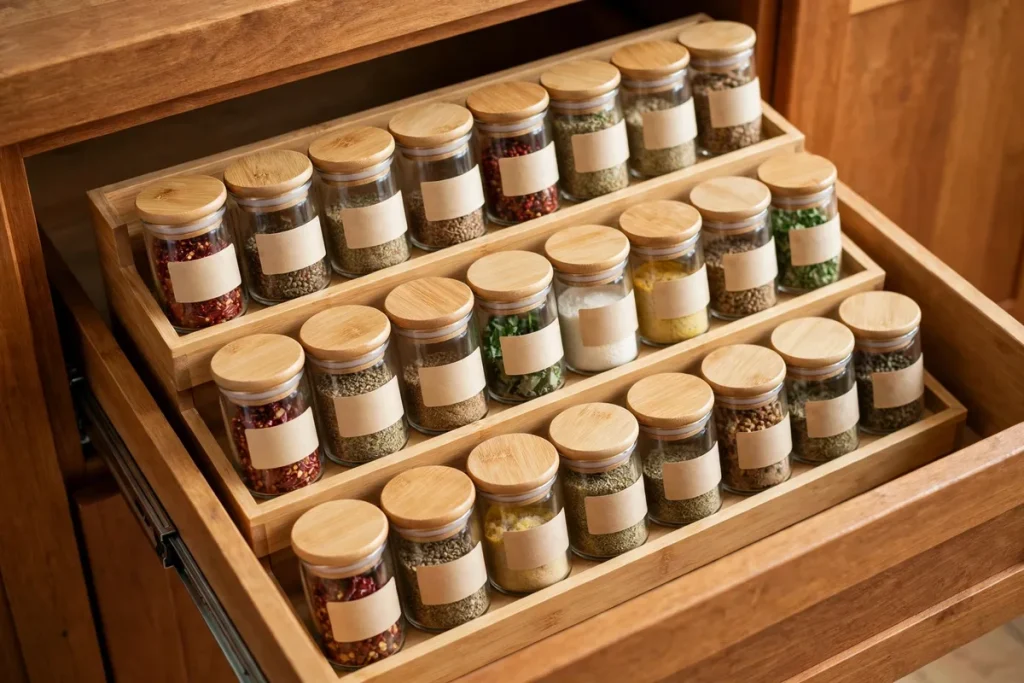
Vertical dividers turn a narrow cabinet into a filing cabinet for lids, baking sheets, cutting boards, and frying pans stored on their sides. You slide each one into its own slot, so you can pull out one lid without moving five others. Dividers work brilliantly in cabinets 9 to 12 inches wide that are too narrow for a shelf pull-out, and they are the cheapest option. They are not ideal for heavy stockpots, but for lids and flat pans they are hard to beat.
Corner Pull-Outs and Blind-Corner Units
Corner cabinets are the hardest space in any kitchen, and a blind-corner pull-out is designed for exactly that problem. Its shelves swing, pivot, or slide out in two stages, bringing the contents of the dead corner out into the open. Corner units cost more and need more clearance in front of the cabinet, so measure the swing and the aisle space before you buy.
Pull-Out Types Compared
| Type | Best for | Rough price |
|---|---|---|
| Two-tier pull-out shelves | Everyday pots, pans, and lids in a standard base cabinet | $80–$250 |
| Pull-out drawers | Heavy cast iron, stockpots, and large cookware sets | $150–$450 |
| Vertical tray dividers | Lids, baking sheets, and frying pans in narrow cabinets | $30–$120 |
| Corner pull-outs and blind-corner units | Making a corner or blind-corner cabinet usable | $200–$600 |
Prices are rough ranges for the hardware alone, before installation. Custom sizes and soft-close slides cost more.
How to Measure Your Cabinet Before You Buy
Most pull-out problems start with a tape measure, or rather with the lack of one. Pull-outs fit standard cabinet openings, but cabinets vary, especially in older homes, and a unit half an inch too wide will not fit at all. Measure twice, write the numbers down, and take them with you when you shop. If you are planning a whole kitchen, our guide on how to design a functional kitchen explains how storage fits into the wider plan.
- Measure the inside width between the cabinet sides, at the front and at the back, and use the smaller number. Allow half an inch to an inch of clearance on each side for the slides.
- Measure the inside depth from the door frame to the back panel. A standard base cabinet is about 22 to 23 inches deep inside, and most pull-outs are made in a 21-inch depth.
- Measure the inside height from the cabinet floor to the underside of the drawer or shelf above. A two-tier unit needs room for both tiers plus the pans on them.
- Check for obstructions: hinges, drawer slides, plumbing, and gas lines. A pull-out that clears the opening but hits a hinge will not slide out fully.
- Check the aisle space. Make sure the pull-out can extend fully without hitting an island, a dishwasher door, or the opposite counter.
Write down the width, depth, and height, plus what you plan to store, and bring a photo of the open cabinet when you shop. A supplier can check your numbers against the specification sheet before you order.
Weight Capacity, Slides, and Soft-Close: What to Check
Weight capacity is the number most people ignore and most regret ignoring. A pull-out full of cast iron can easily weigh 50 to 75 pounds, and a cheap unit rated for 25 pounds will sag, stick, and eventually fail. Check the rated load for the whole unit, not just for one slide, and add up the weight of the pans you plan to store. Look for at least 75 pounds of capacity, and 100 pounds or more if you own a lot of cast iron. Full-extension ball-bearing slides are worth paying for, and soft-close stops a loaded pull-out from slamming shut.
DIY Installation: A Step-by-Step Overview
Most premade pull-outs are designed for a confident DIYer with basic tools. You do not need to be a cabinetmaker, but you do need patience and a level. Plan on one to two hours for your first unit.
- Empty the cabinet, remove the existing shelf, and clean and level the cabinet floor.
- Assemble the frame and slides, and test the slide action on a flat surface first.
- Mark the slide positions with a pencil, using the specification sheet, and keep the slides level. A slide that is out of level will bind.
- Screw the slides into place, starting with one screw per slide so you can adjust, then test the pull-out. It should glide smoothly.
- Add the remaining screws, attach the shelf or drawer box, and load it gradually, starting with lighter pans.
- Adjust the slides if the shelf does not sit level or close fully. Most slides have small screws for height and side-to-side adjustment.
If the cabinet floor is uneven, there is plumbing in the way, or the unit needs cutting to fit, call a professional. A pull-out forced into a cabinet that is not square will never work properly.
Premade Inserts vs. Custom Pull-Outs
Premade inserts are ready-made units in standard sizes, usually 12, 15, 18, or 24 inches wide, and they are the right choice for most kitchens. They cost less, arrive quickly, and you can install one in an afternoon. Custom pull-outs are built to your cabinet’s exact measurements, and they make sense when your cabinet is an unusual size or you want a specific wood or finish. A premade unit plus DIY installation can cost under $200, while a custom pull-out installed by a professional can cost $500 or more. If you are weighing a pull-out against a wider remodel, our guide to kitchen remodeling costs, steps, and ideas will help you put the numbers in context.
Mistakes to Avoid
Most pull-out disappointments are avoidable. These are the mistakes we see most often:
- Buying before measuring. A pull-out that is too wide, too deep, or too tall is a return, not an upgrade. Measure the inside of the cabinet, not the outside.
- Underestimating weight. Cast iron is heavy. A unit rated for 25 pounds will not survive a shelf full of Dutch ovens.
- Choosing the wrong type. Vertical dividers will not hold a stockpot, and a deep drawer is wasted in a 9-inch cabinet.
- Skipping soft-close and full-extension slides. Cheap slides stick, sag, and slam. They are the part you touch every day.
- Overloading the top tier. Heavy pans belong on the bottom. A top-heavy two-tier unit is hard to pull out.
Frequently Asked Questions
What size cabinet pull-out do I need for pots and pans?
Measure the inside width, depth, and height first. Most base cabinets take a 15-, 18-, or 24-inch-wide pull-out, about 21 inches deep. Choose a unit at least one inch narrower than the inside width.
How much weight can a pull-out shelf hold?
Light-duty units hold 25 to 35 pounds, while heavy-duty full-extension slides hold 75 to 100 pounds or more. For pots and pans, especially cast iron, look for at least 75 pounds of rated capacity.
Can I install a cabinet pull-out myself?
Yes, most premade pull-outs are a DIY job for someone comfortable with a drill and a level. Expect one to two hours for the first unit. Measure accurately and keep the slides level.
Are pull-out drawers better than pull-out shelves for pots and pans?
Drawers are better for heavy cookware because the solid sides support the weight and stop pans tipping. Shelves are better for a mixed collection, because you can see everything at a glance.
How much does a cabinet pull-out for pots and pans cost?
A premade insert usually costs $30 to $450 for the hardware, depending on the type and size, plus installation if you hire someone. Custom pull-outs cost $500 or more installed.
A cabinet pull out for pots and pans is a small change that makes a daily difference. You stop digging through a deep cabinet and start using the cookware you already own. Start with a two-tier shelf for a mixed collection, a deep drawer for cast iron, dividers for a narrow cabinet, and a blind-corner unit for a dead corner. Measure first, buy enough weight capacity, and do not skimp on the slides.