
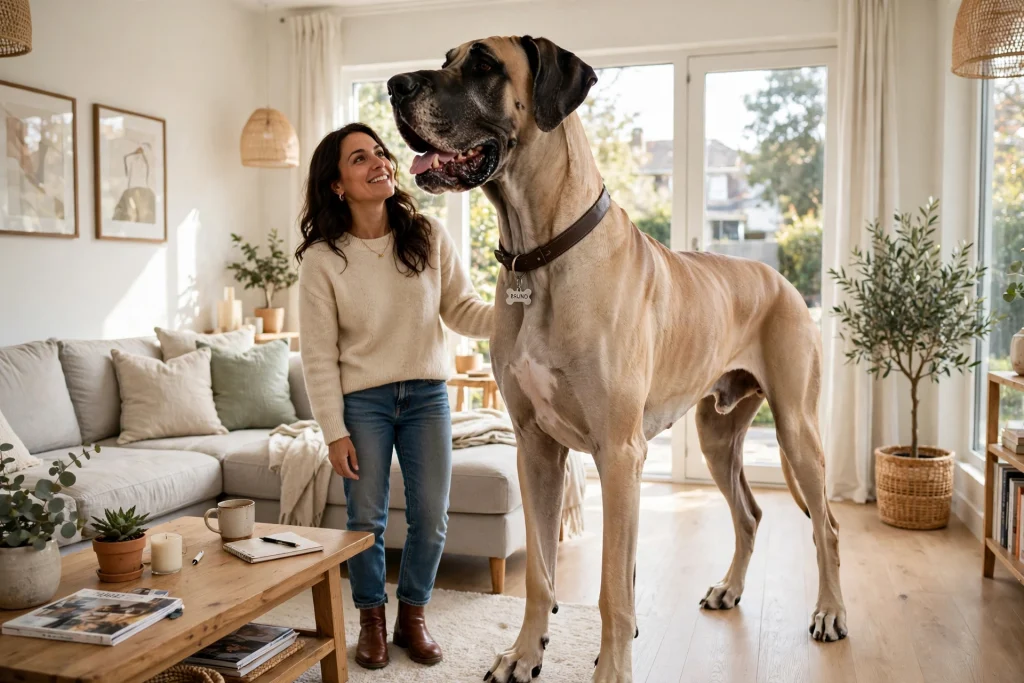

What is the largest dog breed? By height, the Great Dane is the tallest dog breed, with males often standing 30 to 34 inches at the shoulder, and by weight, the English Mastiff is the heaviest, with males commonly weighing 120 to 230 pounds. If you are asking which dog is the biggest overall, those two breeds top the list in different ways: the Great Dane wins on height, and the English Mastiff wins on sheer mass. This guide compares the biggest dog breeds in the world, explains how size is measured, and covers what it is really like to live with a giant dog.
Giant dog breeds are impressive, gentle, and demanding in equal measure. A dog that weighs more than many adults needs more space, more food, more training, and more veterinary care than a small dog, and it usually lives a shorter life. That is why the question of the largest dog breed is not just trivia. For anyone thinking about bringing home a giant breed, size affects everything from the size of your car to the size of your food bill, so it is worth understanding before you fall in love with a puppy that will grow into a 150-pound adult.
How Is the Largest Dog Breed Measured?
There is no single way to measure the largest dog, because height and weight tell different stories. Height is measured at the withers, the highest point of the shoulders, while the dog is standing. Weight is simply how heavy the dog is. A tall, lean breed such as the Irish Wolfhound can be taller than a Mastiff but weigh far less, while a Mastiff can be shorter and much heavier. Records for the tallest dog ever and the heaviest dog ever belong to different dogs for the same reason.
Most breed standards give a range rather than a single number, because size varies by sex, genetics, diet, and age. Males are usually taller and heavier than females of the same breed. The figures in this article are the typical ranges for healthy adult males, as listed in breed standards, and individual dogs can fall outside them.
The Largest Dog Breeds in the World
The table below compares the biggest recognized dog breeds by typical adult height and weight. All of these breeds are classed as giant breeds, and all of them need an owner who is ready for the space, food, and care a very large dog requires.
| Breed | Typical height | Typical weight | Known for |
|---|---|---|---|
| Great Dane | 30 to 34 inches | 110 to 175 pounds | Tallest breed; gentle and friendly |
| English Mastiff | 27 to 30 inches or more | 120 to 230 pounds | Heaviest breed; calm and loyal |
| Irish Wolfhound | 30 to 35 inches | 105 to 180 pounds | Tallest sighthound; quiet and kind |
| Saint Bernard | 26 to 30 inches | 120 to 180 pounds | Rescue heritage; patient with children |
| Newfoundland | 26 to 28 inches | 100 to 150 pounds | Swimmer; gentle water rescue dog |
| Leonberger | 25 to 31 inches | 90 to 170 pounds | Lion-like mane; playful family dog |
| Great Pyrenees | 25 to 32 inches | 85 to 160 pounds | Livestock guardian; calm and watchful |
| Tibetan Mastiff | 24 to 30 inches | 70 to 150 pounds | Ancient guardian; independent nature |
The Great Dane: the tallest dog breed
The Great Dane is widely regarded as the tallest dog breed, and the record for the tallest dog ever recorded belongs to a Great Dane. Despite their size, Great Danes are famously gentle, friendly, and people-oriented, which is why they are often called gentle giants. They are short-coated, so grooming is simple, but they need space to stretch out, a large bed, and careful exercise while they are growing, because fast growth puts strain on their joints.
The English Mastiff: the heaviest dog breed
The English Mastiff is the heaviest dog breed, with large males reaching 230 pounds or more. Mastiffs are calm, loyal, and protective, and they are usually quiet indoors, which surprises people who expect a dog of that size to be constantly active. They do drool, shed, and eat a lot, and they need a confident owner who can train a dog that outweighs them. Early socialization matters, because a Mastiff that is nervous around strangers is a serious handful.
Irish Wolfhound, Saint Bernard, and Newfoundland
The Irish Wolfhound is one of the tallest breeds of all, often standing as tall as a Great Dane, but it is lighter and more lightly built, with a rough coat and a calm, dignified manner. Wolfhounds were bred to hunt wolves, yet today they are known as quiet, affectionate companions who are happiest stretched out near their people. The Saint Bernard is a classic rescue breed from the Swiss Alps, famous for its patience with children and its enormous, shaggy frame. Saint Bernards drool and shed heavily, but they are among the most tolerant family dogs.
The Newfoundland is a powerful swimmer with a thick, water-resistant coat and webbed feet, originally bred to help fishermen in Canada. Newfoundlands are famously gentle and are often called nanny dogs because of how carefully they behave around children. They need regular grooming and plenty of space, and like all giant breeds they are happiest when they are part of family life rather than left alone in a yard.
What Is It Like to Own a Giant Dog?
Owning a giant dog is rewarding, but it is also a bigger commitment in every practical sense. A giant breed can eat several cups of food a day, and food, beds, crates, collars, and veterinary care all cost more at giant scale. A single course of medication is dosed by weight, so a 180-pound dog costs far more to treat than a 20-pound dog. Giant dogs also need a car they can fit in, a home with enough floor space for a dog bed the size of a small mattress, and a yard or nearby open space for exercise.
Training is not optional with a dog this size. A giant dog that pulls on the lead, jumps up, or has not learned to be calm around visitors is a safety issue, not just a nuisance. Start training early, socialize the puppy widely, and use positive reinforcement. Exercise needs are moderate rather than extreme: most giant breeds need one to two hours of walking a day, but puppies should not be over-exercised while their joints are still growing. Short, regular walks and play are better than long runs for a young giant breed.
Health is the hardest part of owning a giant dog. Giant breeds are prone to bloat, a dangerous stomach condition, and to joint problems such as hip dysplasia, and they tend to live shorter lives than smaller dogs, often 7 to 10 years compared with 12 to 15 years for many small breeds. Feeding a good-quality diet in measured meals, avoiding exercise right after eating, and keeping the dog at a healthy weight all help. Regular vet check-ups matter even more when the dog is large, because problems develop faster and cost more to treat.
Pet care at home scales up too, and it helps to plan for it. If you share your home with other pets, our guides to the best automatic litter box and the best kitty water fountains cover the kind of pet-care gear that makes a multi-pet household easier to manage, which is worth thinking about before a giant dog joins the family.
Giant Breeds vs Large Breeds
Large breeds, such as Labradors and German Shepherds, usually weigh 50 to 100 pounds, while giant breeds typically weigh over 100 pounds. The difference shows up in daily life: a giant breed needs a larger bed, a stronger lead, a bigger car, and a bigger food budget, and it will lean on you, step on your feet, and take up the whole sofa. In return, most giant breeds are calmer indoors than many large breeds, and they are often less demanding about exercise. If you have the space and the budget, a giant breed can be a wonderful, low-key companion. If you live in a small apartment or have a tight budget, a large breed is usually the more practical choice.
Frequently Asked Questions
What is the largest dog breed in the world?
The Great Dane is the tallest dog breed, and the English Mastiff is the heaviest dog breed. Which one counts as the largest depends on whether you measure by height or by weight.
What is the tallest dog breed?
The Great Dane is the tallest dog breed, with males often standing 30 to 34 inches at the shoulder. The Irish Wolfhound is nearly as tall and is the tallest of the sighthounds.
What is the heaviest dog breed?
The English Mastiff is the heaviest dog breed, with large males commonly weighing 120 to 230 pounds.
Are giant dogs good family pets?
Yes, most giant breeds are gentle, patient, and good with children, but they need training, space, and supervision around small children simply because of their size. A giant dog can knock a toddler over by accident, so early training and calm behavior matter.
How long do giant dogs live?
Giant breeds usually live 7 to 10 years, which is shorter than smaller dogs. Good food, a healthy weight, regular vet care, and careful exercise while they are growing can help them live longer, healthier lives.
Conclusion
The largest dog breed depends on how you measure it: the Great Dane is the tallest, and the English Mastiff is the heaviest, with the Irish Wolfhound, Saint Bernard, and Newfoundland close behind. All of them are gentle giants that make wonderful companions for owners who have the space, the budget, and the time to train and care for a very large dog. If that sounds like you, a giant breed can be one of the most rewarding dogs you will ever own. If it does not, admire them from a distance and choose a breed that fits your home and your life.