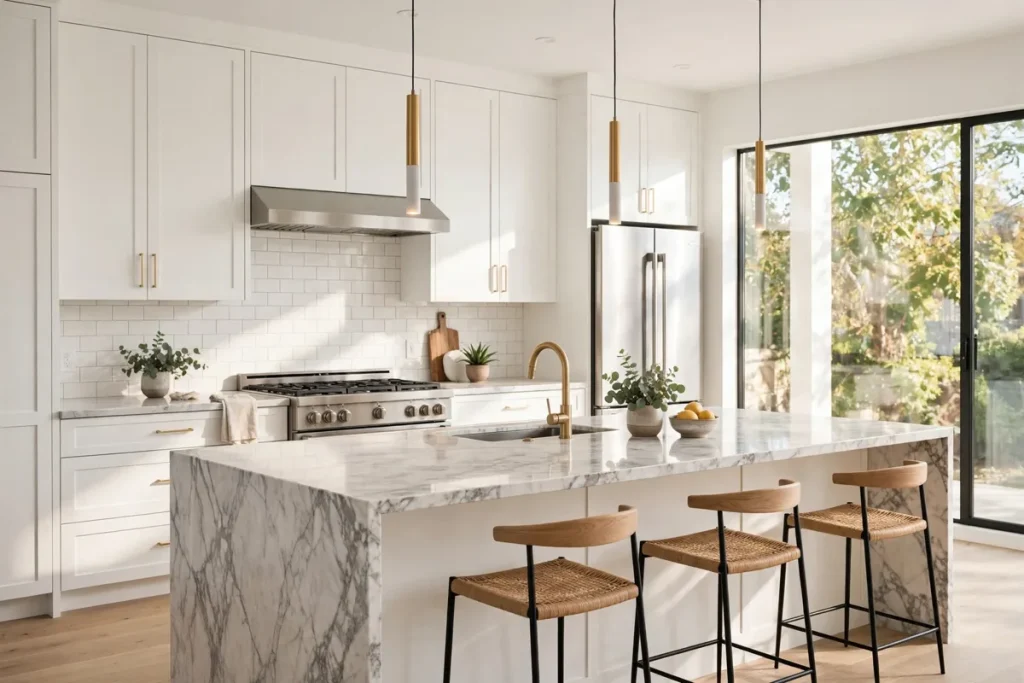

What is sintered stone? It is an engineered surface made from natural minerals — clay, feldspar, silica, and kaolin — that are ground to a powder, pressed under enormous pressure, and fired at around 1,200°C (2,200°F) until they fuse into a dense, non-porous slab. The result is a countertop material that resists heat, stains, and scratches better than almost anything else on the market, and it never needs sealing. Brands include Dekton, Neolith, Lapitec, and Laminam. It is not the cheapest option — but for busy families and outdoor kitchens, it is one of the toughest surfaces you can buy.
What Is Sintered Stone?
Sintered stone is a man-made surface that starts with natural minerals and ends with a material that behaves almost like natural stone. Unlike engineered quartz, which glues stone chips together with resin, sintered stone contains no resin at all. The minerals are fused by heat and pressure alone, a process called sintering. That is why it can take a hot pan straight from the stove, sit in full sun without fading, and shrug off red wine and lemon juice.
It is most often sold in large-format slabs, typically 126 by 63 inches (about 320 by 160 cm), in thicknesses from 6 mm for wall cladding up to 20 mm for countertops. The surface can imitate marble, limestone, concrete, metal, and wood, with veining printed through the slab. Because the pattern is printed, slabs look consistent — handy for a matching island and backsplash, less so if you love the randomness of natural stone.
How Is Sintered Stone Made?
Making sintered stone borrows from both ceramics and stone manufacturing. The process has five main steps:
- Mixing the minerals. Natural raw materials — clay, feldspar, silica, kaolin, and mineral pigments — are ground into a fine powder and blended to create the desired color.
- Pressing. The powder is pressed into large slabs under extreme pressure, compacting it into a dense, uniform sheet.
- Decorating. The pattern is printed onto the surface; in premium slabs, color runs through the body too, so edges look natural.
- Sintering. The slabs are fired in a kiln at around 1,200°C (2,200°F). The heat melts the particles at their edges so they bond together into a solid, glass-like material without fully melting the minerals. This is the step that gives sintered stone its hardness and non-porous structure.
- Cooling and finishing. The slabs cool slowly to avoid cracking, then are cut and finished matte, textured, or polished.
The whole process uses no resin, no sealers, and no synthetic binders, which is also why sintered stone can be recycled as an inert mineral material at the end of its life.
Pros and Cons of Sintered Stone
Pros
- Heat resistant. Hot pans, baking trays, and curling irons will not scorch it, unlike quartz or laminate.
- Stain resistant. The surface is almost completely non-porous, so coffee, red wine, turmeric, and oil do not leave marks.
- Scratch resistant. It is harder than granite, so knives and heavy pots rarely mark it.
- UV resistant. Sunlight does not fade or yellow it, so it is safe for outdoor kitchens and sunny window sills.
- No sealing, ever. Unlike granite or marble, it never needs a sealer or special cleaner.
- Hygienic. Because it does not absorb liquids, bacteria have nowhere to grow on the surface.
- Large slabs, thin options. Slabs are big enough for seamless islands, and slim 6 mm versions suit walls and furniture.
Cons
- Expensive. Installed, it usually costs more than quartz and granite, especially in premium brands and colors.
- Brittle edges. It is hard but not flexible: corners and thin edges can chip if hit hard, and a serious chip is difficult to repair invisibly.
- Heavy and hard to fabricate. Slabs are large and heavy, and cutting them needs diamond tooling and an experienced fabricator. It is not a DIY material.
- Limited edge profiles. Complex, rounded, or ogee edge profiles are harder to make than with granite or quartz.
- Seams can show. On very large counters, seams are sometimes more visible than in natural stone because the pattern is printed.
Sintered Stone vs Quartz vs Porcelain
These three are often confused. Quartz is resin-bound, porcelain is a thinner sintered ceramic, and sintered stone is the thickest and hardest of the three.
| Feature | Sintered stone | Quartz | Porcelain slab |
|---|---|---|---|
| What it is made of | Natural minerals, fused by heat | Stone chips in resin (about 7%) | Clay and minerals, sintered |
| Heat resistance | Excellent; hot pans safe | Fair; resin can scorch | Excellent |
| Stain resistance | Excellent | Excellent | Excellent |
| Scratch resistance | Excellent | Very good | Very good |
| UV / outdoor use | Yes, fade-proof | No; resin yellows outdoors | Yes |
| Sealing needed | No | No | No |
| Edge chips | Possible, hard to repair | Repairable | Possible; thin slabs chip more |
| Typical slab thickness | 12–20 mm | 20–30 mm | 6–12 mm |
| Installed cost per sq ft | $60–$150 | $50–$120 | $50–$120 |
The bottom line: for heat resistance and outdoor use, sintered stone and porcelain beat quartz. For the widest choice of colors and easiest buying, quartz wins. Porcelain is the budget sintered option, but its thinner slabs chip more easily on countertops.
Sintered Stone Cost
Expect to pay around $60 to $150 per square foot installed for sintered stone in the US in 2026, with premium brands and colors at the higher end. For a typical 30-square-foot kitchen countertop, that works out to roughly $1,800 to $4,500 for material and installation, before extras.
| Item | Typical cost |
|---|---|
| Material (slab only) | $40–$100 per sq ft |
| Fabrication and installation | $20–$50 per sq ft |
| Total installed | $60–$150 per sq ft |
| Typical 30 sq ft kitchen | $1,800–$4,500 |
| Cutout (sink or cooktop) | $150–$400 each |
| Waterfall edge (island sides) | $600–$1,500 extra |
What drives the price: brand, color, thickness, slab size, cutouts, and the fabricator’s experience. Thicker slabs (20 mm) cost more but look better on islands. Get three written quotes from fabricators experienced with sintered stone — it is the easiest way to avoid overpaying.
Where to Use Sintered Stone
Countertops are the most common use, but sintered stone is made for more than that. It works for kitchen islands and backsplashes, bathroom vanities and shower walls, flooring, outdoor kitchen counters, fireplace surrounds, and even dining tables. Outdoors is where it really shines: it tolerates freezing winters, hot summers, and strong sun without cracking or fading, which most other manufactured surfaces cannot do. If this is part of a bigger project, see our guide to kitchen remodeling for costs, steps, and ideas, and learn how to design a functional kitchen before you lock in the layout. Then pick your finishes — the 2026 kitchen cabinet colors roundup shows trending shades that pair well with stone-look counters.
How to Clean and Maintain Sintered Stone
Warm water and a drop of dish soap are enough for everyday messes; a non-abrasive sponge or plastic scraper handles dried-on food. Avoid harsh chemicals such as oven cleaner, and skip abrasive pads, which can dull a polished finish. You will never need to seal it, and you do not need a cutting board to protect it — though using one keeps knives sharper.
Is Sintered Stone Worth It?
The value depends on how you use your kitchen. If you cook a lot, set hot pans down without thinking, have young kids, or want an outdoor kitchen, its heat and stain resistance is genuinely useful — it forgives almost everything. If you rarely cook and want the lowest price, quartz will do the job for less. Sintered stone makes the most sense if you plan to stay for years: you are unlikely to replace it, which offsets the higher upfront cost.
Frequently Asked Questions
What is sintered stone made of?
Sintered stone is made from natural minerals — clay, feldspar, silica, and kaolin — with mineral pigments for color. The minerals are ground, pressed, and fired at around 1,200°C (2,200°F) until they fuse into a dense slab. It contains no resin or binders.
Is sintered stone the same as quartz?
No. Quartz is stone chips held together with about 7% resin, which can scorch and yellow in sunlight. Sintered stone has no resin: the minerals are fused by heat alone, so it tolerates hot pans and outdoor use.
Can sintered stone crack?
It is very hard but not unbreakable. A heavy blow to a thin edge or corner can chip it, and an unsupported span can crack. Proper support from cabinets and an experienced fabricator make cracking rare.
How much does sintered stone cost?
Installed, sintered stone typically costs $60 to $150 per square foot in the US in 2026. A typical 30-square-foot kitchen countertop runs about $1,800 to $4,500, before cutouts or extras such as waterfall edges.
Can you put hot pans on sintered stone?
Yes. Sintered stone tolerates very high heat, so a hot pan or baking tray will not scorch or crack it the way it can with quartz or laminate. A trivet is still good practice, but it is not required.
Conclusion
Sintered stone is the toughest countertop material most homeowners will ever buy: heat-proof, stain-proof, scratch resistant, fade-proof outdoors, and completely maintenance-free. Its downsides are real — it costs more than quartz, edges can chip, and it needs a specialist to install. But if you want a surface you never have to think about, and you plan to keep your kitchen for years, it is hard to beat. Compare a few brands and fabricators, choose a color you love, and let the material do the work.