
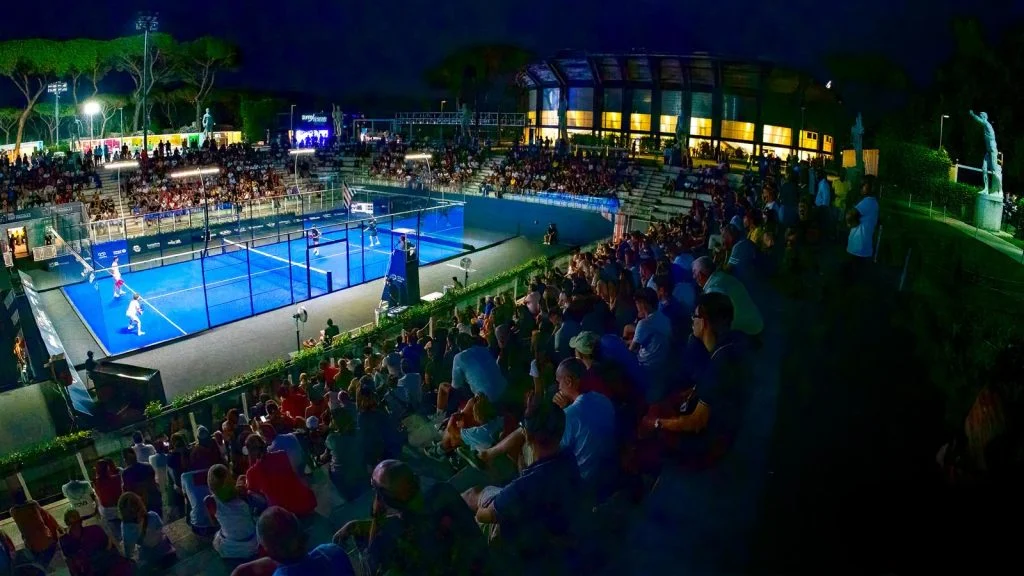

Padel, the enclosed-court racquet sport that has swept through Europe and Latin America, is rapidly establishing itself in the United States, and New Jersey is emerging as part of the next wave. With participation climbing sharply and new facilities entering the pipeline, the sport is on track to become one of the most significant additions to the American racquet-sport landscape in years.
The global numbers behind padel’s rise are staggering. A total of 7,187 new courts were built worldwide in 2024, a 26 percent increase that pushed the global total to 50,436, with the figure expected to exceed 81,000 by 2027. Industry analysts describe a pace of construction without precedent in modern sport. One report found that 3,282 new padel clubs opened worldwide in 2024 — an average of nearly nine new clubs every day.
In the United States, the sport is still young but accelerating quickly. There were fewer than 100,000 padel players across the U.S. in 2023, but by the end of 2025 that figure had surged to around 500,000. Infrastructure, however, has lagged behind enthusiasm. Despite the boom in interest, there were still only about 770 courts nationwide — fewer than in the United Kingdom. That gap has produced a clear bottleneck. Demand is so high that new clubs are booking out weeks in advance.
A hybrid of tennis and squash, padel is played on an enclosed court where the surrounding glass walls remain in play, and it is almost always contested as doubles. Its social, doubles-first format and gentle learning curve have made it especially popular among recreational players. The data bears this out: padel has a 92 percent return rate — the share of people who play again after their first try — which researchers attribute to the sport’s accessibility, social nature and addictive quality. It also draws a broader demographic than most racquet sports, with about 40 percent of players being women, one of the highest female participation rates in any racquet sport.
Growth in the U.S. has so far been concentrated in warmer, coastal markets. Florida is home to roughly 41 percent of all padel courts in the country, followed by Texas at 18 percent, California at 10 percent and New York at around 4.7 percent. But that footprint is widening. By early 2026, the U.S. had crossed 1,000 padel courts, and the sport’s presence had expanded from at least 31 states to 37. Notably, the growth is no longer limited to outdoor, sun-belt facilities: about 39 percent of courts surveyed in mid-2025 were already indoor, a sign of a more durable model taking shape in year-round climates.
That indoor shift matters for a state like New Jersey, where a temperate climate makes weather-proof facilities essential. With its dense population, proximity to the established New York market and strong racquet-sport culture, New Jersey is a natural candidate for the sport’s continued expansion. Local clubs are beginning to respond by building purpose-designed courts and launching introductory programs aimed at converting curious first-timers into regulars.
Facilities offering padel in New Jersey are part of this early movement, introducing the game to players who have never tried it and betting that padel’s accessibility and social appeal will drive repeat play. Given the sport’s exceptional return rate, that bet has strong supporting evidence.
The broader outlook suggests the U.S. market is only at the beginning of its growth curve. One industry report described padel in the U.S. not as a 10-year runway story but as a two-to-three-year breakout opportunity backed by global momentum and fast-developing infrastructure. The same report highlighted how far the country has to go to catch up: the U.S. has roughly 505,000 people per padel court, compared with ratios closer to 3,000 in Spain and 2,000 in Sweden.
For New Jersey residents, that infrastructure gap translates into opportunity. As more courts open, padel offers a low-barrier, highly social way to stay active, one that players tend to stick with once they try it. Analysts caution that the market’s rapid growth carries risks, including inexperienced operators rushing to capitalize on demand, but the underlying enthusiasm shows no sign of fading. For now, the message in New Jersey mirrors the national one: the courts are coming, and the players are already waiting.