
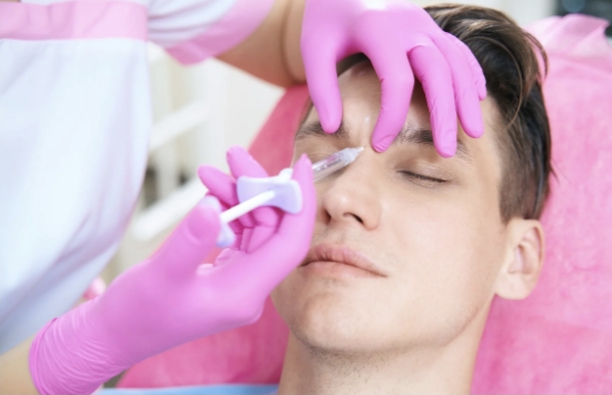

TLDR: Botox works by blocking nerve signals to targeted muscles, reducing their contraction and softening the lines those contractions create. Results appear within 3 to 7 days and last 3 to 6 months. It does not fill volume or erase deep static lines. It prevents muscle movement that creates dynamic lines.
Botox (botulinum toxin type A) works by blocking the acetylcholine release at the nerve-muscle junction of targeted facial muscles. Without the signal, the muscle cannot contract. Lines formed by repeated contraction, forehead lines, crow’s feet, and the “11s” between the brows, soften or disappear when the muscle cannot produce the movement that creates them.
The American Society of Plastic Surgeons reports that Botox is the most performed non-surgical cosmetic procedure in the United States, with over 9 million treatments administered annually.
For people in Denver considering the treatment, Botox Denver CO providers offer both Botox and Dysport (a similar neurotoxin) with comparable mechanisms and results.
What Can Botox Actually Treat?
Dynamic Lines (FDA-Approved Uses)
Dynamic lines are lines that appear during facial movement. Botox has FDA approval for:
- Forehead lines: Horizontal lines that appear when you raise your brows
- Glabellar lines (11s): Vertical lines between the brows that appear when frowning
- Crow’s feet: Lines at the outer corners of the eyes that appear when squinting or smiling
These are the lines Botox treats most reliably, because they result from muscle contraction that Botox can prevent.
Off-Label Uses
Providers use Botox off-label for:
- Brow lifting (by relaxing muscles that pull the brow down)
- Lip lines (smoker’s lines around the mouth)
- Neck bands (platysmal bands)
- Jaw slimming (masseter muscle reduction)
- Hyperhidrosis (excessive sweating)
- Migraine prevention
What Can Botox Not Do?
Botox does not fill volume. It does not lift skin laxity. It does not treat static lines, lines that are visible when the face is completely at rest and the muscles are not contracting.
Deep nasolabial folds, under-eye hollows, and volume loss in the cheeks or lips are filler indications, not Botox indications. A provider who recommends Botox for these concerns without including filler in the conversation is not giving you the full picture.
Botox also does not produce permanent results. Every treatment cycle requires re-injection. Most patients maintain results with treatments every 3 to 6 months.
How Many Units Does a Treatment Require?
Botox is dosed in units. The standard treatment amounts for common areas:
| Treatment Area | Typical Unit Range |
| Forehead | 10 to 30 units |
| Glabellar lines (11s) | 20 to 25 units |
| Crow’s feet (both sides) | 12 to 24 units |
| Brow lift | 4 to 8 units |
| Lip lines | 4 to 8 units |
| Masseter (per side) | 25 to 50 units |
The total units required vary by the strength of the targeted muscles, the patient’s facial anatomy, and the degree of relaxation desired. A first-time patient typically receives a conservative dose to assess response before the next session.
What Do Results Look Like and When Do They Appear?
Results are not immediate. The neurotoxin requires time to bind to nerve terminals.
- Days 1 to 3: No visible change
- Days 3 to 5: Muscle movement begins to reduce
- Days 7 to 14: Full effect is visible
- Months 3 to 4: Results begin to fade as nerve terminals regenerate
- Months 4 to 6: Full muscle movement returns; re-treatment is appropriate
At full effect, dynamic lines soften. The degree of softening depends on the depth of the line, the unit dose, and how long the patient has had the line. A line that has been present for 20 years has a static component that will not respond to Botox alone.
What Does Botox Cost?
Botox pricing uses two common structures:
Per unit pricing: $10 to $20 per unit. A forehead-and-11s treatment using 40 units at $15 per unit costs $600.
Per area pricing: $200 to $500 per treatment area. A three-area treatment (forehead, 11s, crow’s feet) costs $600 to $1,500.
Dysport, a comparable neurotoxin, is dosed differently (approximately 2.5 to 3 Dysport units equal 1 Botox unit) but is often priced lower per unit, making total treatment cost comparable or lower.
The American Med Spa Association reports the national average Botox treatment cost at $400 to $600 for a standard two-to-three area session.
What Questions Should You Ask Before a Botox Appointment?
- What credentials does the injector hold? Botox injections should be performed or directly supervised by a licensed medical professional (MD, DO, NP, or PA).
- How many Botox treatments does the provider perform per month? Injector volume correlates with anatomical familiarity.
- What neurotoxin brand do they use and at what concentration?
- What is the follow-up policy if the result is uneven or asymmetrical?
- Do they offer a two-week follow-up to assess results and adjust if needed?
What Are the Risks and Side Effects?
Common and temporary:
- Bruising at injection sites (resolves within 7 to 10 days)
- Mild swelling or redness at injection points (resolves within hours)
- Headache in the first 24 hours (reported in approximately 10% of patients)
Less common:
- Eyelid ptosis (drooping) if the toxin migrates to the levator muscle. Risk is minimized by the injector technique. Resolves as the toxin metabolizes.
- Brow heaviness from over-treatment of the forehead without addressing the brow depressors
Serious adverse events are rare when treatment is performed by a trained provider at standard doses.
Key Takeaways
- Botox blocks nerve-muscle signaling in targeted muscles, softening dynamic lines formed by repeated contraction
- FDA-approved treatment areas are forehead lines, glabellar lines (11s), and crow’s feet; all other uses are off-label
- Results appear within 3 to 7 days and last 3 to 6 months before re-treatment is needed
- Botox does not treat static lines, volume loss, or skin laxity. Those require filler or other modalities
- Standard dosing ranges from 10 to 30 units per area; total treatment cost averages $400 to $600 for two to three areas
- Eyelid ptosis is the most common adverse outcome and results from injector technique errors, not the product itself
Botox produces results when it is matched to the right indication, dosed correctly, and injected by someone with documented training and volume. Understanding what it can and cannot do before you book an appointment sets realistic expectations and prevents the common disappointment that comes from expecting filler results from a neurotoxin.