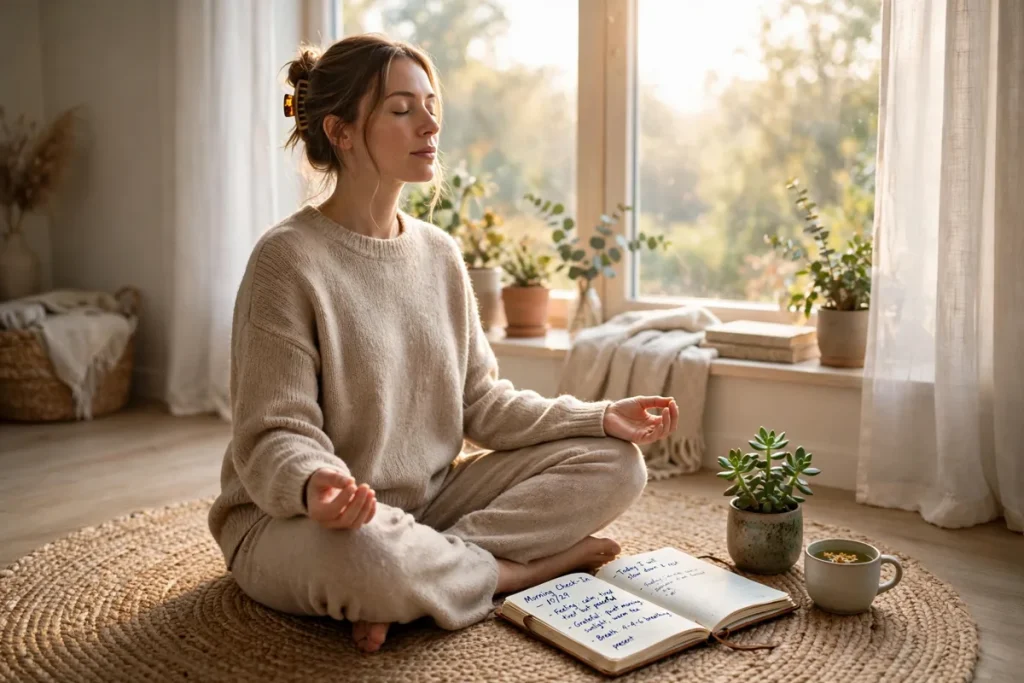

Mental health exercises are small practical habits that help you slow down and reset during a busy day.
They do not require special equipment, a gym membership, or a long stretch of free time. A few calm minutes of breathing, a short walk, or a few honest lines in a journal can make an ordinary day feel more manageable. This guide explains simple mental health exercises you can use at home, at work, or on the go, and shows how to build them into a short daily routine that is easy to keep.
Think of these practices as basic care for your mind, much like stretching is basic care for your body. They work best when they are regular and gentle. You do not need to do every exercise every day. Start with one or two, notice what helps you most, and add more only when the habit feels steady. Small steps, repeated often, are far more useful than a long routine you abandon after a week.
What Are Mental Health Exercises?
Mental health exercises are short activities that support calm, focus, and emotional balance. They may involve breathing, paying attention to your senses, moving your body gently, writing down your thoughts, or noticing things you appreciate. Unlike a workout plan with strict rules, these exercises are flexible. You can do them in the morning to start the day with a clear mind, in the middle of the afternoon when stress builds, or in the evening to wind down before bed.
The goal is not to remove every difficult feeling. Stress, worry, sadness, and frustration are normal parts of life. The goal is to give yourself a practical way to respond to those feelings instead of being carried away by them. A short pause can help you think more clearly, speak more calmly, and choose your next step with more care. Over time, these pauses can become a healthy habit, just like drinking water or taking a short break from a screen.
Breathing Exercises to Calm the Mind
Breathing is one of the easiest places to start because you can do it anywhere, and no one needs to know you are doing it. When you feel rushed or tense, your breathing often becomes fast and shallow. Slowing it down on purpose sends a simple message to your body: you can take a moment. Try to breathe through your nose, keep your shoulders relaxed, and avoid forcing the breath. If you feel dizzy or uncomfortable at any point, stop and breathe normally.
Box Breathing
Box breathing uses equal counts for each part of the breath, which makes it easy to remember. It is a good choice before a meeting, a difficult conversation, or bedtime.
- Sit comfortably with your feet flat on the floor and your hands relaxed.
- Breathe in slowly through your nose for a count of four.
- Hold the breath gently for a count of four.
- Breathe out slowly through your mouth for a count of four.
- Hold again for a count of four, then repeat the cycle three or four times.
Keep the counts comfortable. If four feels too long, use three. The exact number matters less than the steady rhythm. Focus on the count rather than on racing thoughts, and let each breath feel smooth and unhurried.
4-6 Breathing
In 4-6 breathing, your out-breath is longer than your in-breath. Many people find this pattern especially calming in the evening.
- Breathe in quietly through your nose for a count of four.
- Breathe out slowly through your mouth for a count of six.
- Repeat for four to six rounds, or for about two minutes.
- If six feels too long, try breathing in for three and out for five.
Use this exercise when you want to slow down after a busy day. You can pair it with a quiet room, soft light, or a comfortable chair. Try not to check your phone during the exercise, so your mind has a real break from messages and news.
The 5-4-3-2-1 Grounding Exercise
Grounding exercises bring your attention back to the present moment. The 5-4-3-2-1 exercise does this by asking you to notice things through your senses. It is useful when your mind is racing, when you feel overwhelmed, or when you are stuck worrying about something that has not happened yet.
- 5 things you can see, such as a window, a plant, a book, a cup, or a picture.
- 4 things you can touch, such as your chair, your clothes, a table, or your own hands.
- 3 things you can hear, such as birds, traffic, music, or the hum of a machine.
- 2 things you can smell, such as coffee, soap, fresh air, or a candle.
- 1 thing you can taste, such as water, tea, a mint, or the taste left after a meal.
Take your time with each step. Describe each item quietly to yourself in detail. For example, instead of just noticing a chair, notice its color, shape, and texture. This simple detail work gives your mind something steady to focus on. You can do the full exercise in about three minutes, or shorten it when time is short.
Gentle Movement: Walking and Stretching
Gentle movement is a powerful mental health exercise because it changes both your body and your focus. You do not need an intense workout to feel the benefit. A short walk around your neighborhood, a slow stretch at your desk, or a few minutes of easy movement in your living room can help clear your head and lift your mood.
For walking, start with ten minutes. Leave your headphones at home sometimes, so you can notice the sounds, air, and sights around you. Walk at a comfortable pace, swing your arms naturally, and breathe normally. If you walk with a friend or family member, a light conversation can add a pleasant social break to your day. If you prefer outdoor exercise spaces, this guide to outdoor fitness equipment in parks explains how public parks can support simple, free movement.
For stretching, try a simple routine that takes five minutes. Roll your shoulders slowly, reach your arms overhead, bend gently from side to side, and stretch your neck by looking slowly to each side. Move only as far as feels comfortable, and never force a stretch. The aim is to release tension, not to test your flexibility. A short stretch break between tasks can also help you return to work with fresh eyes.
Journaling Prompts for a Clearer Mind
Journaling gives busy thoughts a place to go. When worries stay only in your head, they can grow and repeat. When you write them down, you can see them more clearly, sort what matters from what does not, and decide on one small next step. You do not need perfect grammar or long entries. Five minutes and a few honest sentences are enough.
Try one prompt at a time, and write without judging yourself. If a prompt does not fit your day, skip it and choose another.
- What is on my mind right now, and what is one small thing I can do about it?
- What went well today, even in a small way?
- What am I worried about, and what do I know for sure about that worry?
- What do I need more of this week: rest, movement, quiet, or time with people?
- What would make tomorrow a little easier?
End each entry with a short note about what you will do next, if anything. Sometimes the next step is simply to rest. At other times, it may be to send a message, make a list, or take a walk. Writing the step down makes it easier to remember, and crossing it off later can give you a small sense of progress.
A Simple Gratitude Practice
Gratitude practice means pausing to notice good things in your life, even on difficult days. This does not mean ignoring problems or pretending everything is fine. It means giving your attention a balanced view, so problems are not the only thing you notice. Many people find this practice helps them feel calmer and more hopeful over time.
Each evening, write down three good things from your day. They can be very small: a warm drink, a kind message, a sunny walk, a task finished, or a comfortable bed. Add one sentence about why each one mattered to you. For example, a warm drink might have mattered because it gave you a quiet pause before work. If writing feels hard, you can simply say the three things out loud before bed.
Keep the practice short and realistic. If you miss a day, start again the next day without guilt. You can also share gratitude with others by sending a short thank-you message. Small acts of thanks often improve both your mood and your relationships, and they take less than a minute.
A Simple 10-Minute Daily Routine
Putting these exercises together into a short routine makes them easier to remember. Use the table below as a starting point, and change the order to fit your day. You can do the full routine in the morning, split it across the day, or use it in the evening to unwind.
| Time | Exercise | What to do |
|---|---|---|
| 2 minutes | Breathing | Try box breathing or 4-6 breathing in a quiet spot. |
| 2 minutes | Grounding | Use the 5-4-3-2-1 exercise to notice your surroundings. |
| 3 minutes | Gentle movement | Walk slowly or stretch your shoulders, arms, and neck. |
| 2 minutes | Journaling | Answer one prompt and note one small next step. |
| 1 minute | Gratitude | Name three good things from today, big or small. |
If ten minutes feels like too much at first, start with five. Two minutes of breathing, two minutes of movement, and one minute of gratitude is still a complete routine. The best routine is the one you will actually do, so keep it short enough to fit into real life.
Tips to Stay Consistent
Link each exercise to something you already do, such as breathing while coffee brews or journaling before bed. Keep your journal visible, track ticks on a calendar, and do not let a missed day stop you. Choose movement you enjoy, for example outdoor fitness in parks, and build other small healthy habits, such as learning how to reduce sugar intake.
These mental health exercises support general wellbeing and are not a replacement for professional help. If you are struggling, please talk to a qualified professional or a trusted support service in your area.
What are mental health exercises?
They are short, simple practices such as breathing, grounding, gentle movement, journaling, and gratitude that support calm and focus.
How do I do box breathing?
Breathe in for four counts, hold for four, breathe out for four, and hold again for four. Repeat three or four times.
What is the 5-4-3-2-1 grounding exercise?
Name five things you see, four you can touch, three you hear, two you smell, and one you taste. It helps bring your focus back to the present moment.
How long should I practice each day?
Ten minutes is enough to start. A short daily routine is easier to keep than a long one you skip.
Can mental health exercises replace professional help?
No. They support general wellbeing, but anyone who is struggling should talk to a qualified professional.