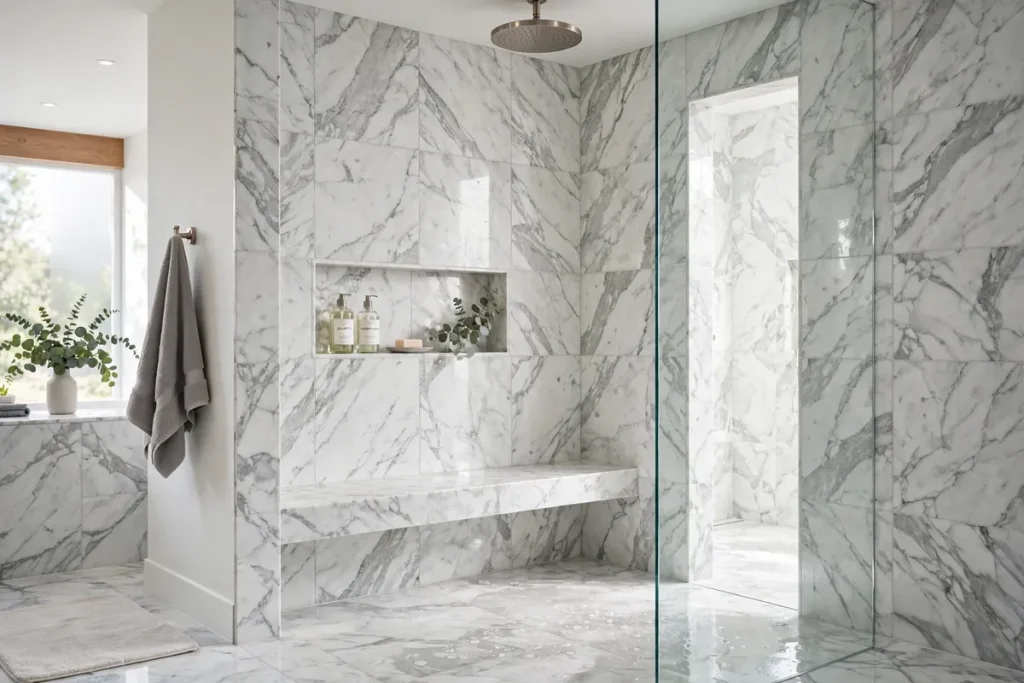

A marble shower makes a bathroom feel like a luxury hotel, and it can also buy you a maintenance job you did not expect. The veining is real, the glow is real, and so is the upkeep. Marble is a natural stone, not a sealed ceramic surface, and a shower is the wettest, most chemical-heavy room in a house. This guide gives you the honest picture: cost, care, safety, and cleaning.
What Is a Marble Shower?
A marble shower is a shower finished in natural marble, usually Carrara, Calacatta, or Statuario, on the walls, the floor, or both. Carrara is the soft grey-veined classic and usually the most affordable. Calacatta has bolder veining and a higher price. The stone can be cut into tiles, large-format slabs, or small mosaics, and left honed, with a soft matte surface, or polished to a high shine. Marble is not waterproof on its own, so it must be installed over a properly waterproofed shower.
The Honest Truth About Marble in a Shower
Here is the part many showroom photos leave out: marble is porous. It is a metamorphic limestone, and its surface is made of calcium carbonate, which reacts with acid. That is why a marble shower needs more care than porcelain or quartz, and why the most common regret is not the look, it is the maintenance.
Everyday shower products are the main problem. Shampoo, conditioner, body wash, and many soaps are mildly acidic, and hard water leaves mineral deposits that dull the surface. A stronger acid, such as vinegar, lemon-based cleaners, or a limescale remover, can etch the stone, leaving a dull spot that no amount of wiping will shine away. Fixing etching usually means professional honing and repolishing.
Sealing helps, but it does not make marble waterproof or acid-proof. A good impregnating sealer slows absorption, but it wears away in a wet shower. Expect to reseal every 6 to 12 months, more often on the floor and in hard-water homes. If water stops beading, or darkens the stone for more than a few minutes, the sealer has worn thin.
Real Marble Tile vs. Marble-Look Porcelain: The Practical Choice
Marble-look porcelain is porcelain tile printed with a photographic image of marble veining. It looks surprisingly close to the real thing from a normal standing distance. The difference is underneath: porcelain is fired clay, dense, almost non-porous, and indifferent to shampoo, soap, and hard water. It does not need sealing, it does not etch, and it costs far less to buy and to install.
That is why, for most homes, marble-look porcelain is the practical choice, particularly on the shower floor, where water, soap, and bare feet meet every day. Real marble earns its place where its depth can be seen without constant punishment: on the upper walls, in a niche, or as a feature wall. You still get the veining and the cool, solid feel of stone, but the surface doing the hardest work is the one built for it.
Choose real marble if you love natural stone for its own sake and accept the upkeep. Choose marble-look porcelain if you want the look with a normal cleaning routine and a lower bill. The mistake is choosing real marble while expecting porcelain maintenance.
How Much Does a Marble Shower Cost?
Expect to pay $20 to $65 per square foot installed for a marble shower, against $15 to $50 per square foot for porcelain, according to 2026 cost data. Marble-look porcelain tile often runs $7 to $10 per square foot for the tile, while natural marble is commonly around $16 per square foot and can rise well above that for Calacatta or book-matched slabs. Labour is higher for marble too, because it is heavier, more brittle to cut, and slower to set.
For a whole shower, those figures add up fast. A standard porcelain shower is often quoted around $7,500 for walls and pan, materials and labour, while a comparable marble shower can run $13,500 to $17,000. Large slabs, niches, benches, and a frameless glass panel push the total higher. Get an itemised quote that separates stone, labour, waterproofing, and glass, and remember resealing over ten years adds hundreds of dollars more.
Slab vs. Tile: Which Is Better for a Marble Shower?
Slabs are large, continuous pieces of marble with almost no grout lines. They look seamless and are easier to wipe down, but they are heavy, expensive, and unforgiving: a slab that cracks during transport or installation is a costly loss. Tiles are cheaper, easier to replace if one is damaged, and available in sizes from small mosaics to 12-by-24-inch rectangles. The trade-off is grout: more lines to clean and to keep sealed. For most marble showers, large-format tile on the walls and small mosaic tile on the floor is the sweet spot.
Marble vs. Porcelain-Look Tile vs. Quartz at a Glance
| Material | Cost installed per sq ft | Upkeep | Durability in a shower |
|---|---|---|---|
| Real marble tile | $20-$65 | Seal every 6-12 months; pH-neutral cleaner only | Beautiful but soft; etches and stains if unsealed |
| Marble-look porcelain tile | $15-$50 | No sealing; normal cleaning | Very durable; resists etching, staining, and water |
| Quartz panels | Higher than porcelain, often similar to marble | No sealing; wipe clean, avoid harsh chemicals | Hard and non-porous, but seams can be a weak point; rarely used for shower floors |
Slip Safety: Honed vs. Polished Marble for Shower Floors
Polished marble is beautiful and slippery. When wet, its mirror finish has very little grip, which is a real risk on a shower floor. Honed marble, the same stone with a matte, lightly textured finish, is noticeably safer underfoot, hides water spots and etching better, and still looks like marble. For a shower floor, honed is the right default, and polished belongs on the walls, if at all.
Finish is only half the story. Large, flat tiles leave long, smooth runs with few grout lines to grip, and they are hard to slope neatly toward the drain. That risk is higher in a walk-in shower without a door, where water travels further across the floor, so grip matters even more.
Small-Format Tiles for Grip and Slope
Small-format tiles, 2-by-2-inch squares, hexagons, or penny rounds, do two jobs at once. Their many grout lines add friction under bare feet, and their small size lets the installer follow the gentle slope of the shower pan to the drain without lipping or puddling. Use a honed or textured finish and keep the grout sealed.
How to Clean a Marble Shower Without Ruining It
Use a pH-neutral stone cleaner, or a few drops of mild dish soap in warm water, and a soft cloth or sponge. Rinse well, then squeegee the walls and floor after each shower. Thirty seconds of squeegeeing does more for a marble shower than any product. Wipe up shampoo or conditioner spills rather than leaving them to dry.
Never use vinegar, lemon juice, bleach, ammonia, or any bathroom cleaner labelled descaler, limescale remover, or all-purpose. Most are acidic or abrasive and will etch or dull marble. Avoid scouring pads and stiff brushes. If soap scum builds up, use a stone-safe method and a soft cloth. Our guide on how to remove soap scum without harsh acids uses the same gentle approach that protects marble, glass, and grout alike.
Who Should, and Should Not, Choose a Marble Shower?
The angle most guides skip is where marble should go, not just whether to buy it. Think in zones. The wettest zone is the floor and the lower walls, where shampoo, soap, and standing water land every day. The driest, most visible zone is the upper walls, where marble is seen, admired, and rarely splashed.
Choose a full marble shower if you love natural stone, you will squeegee and reseal on schedule, and the budget covers both installation and upkeep. Choose a mixed shower, marble walls above and porcelain-look floor below, if you want the look without the daily worry. Skip real marble if you have very hard water and no softener, or a busy family bathroom where nobody will reseal it. In that case, a full porcelain-look shower, or a bathtub remodel in a more forgiving material, will look better for longer.
Frequently Asked Questions
Is marble good for a shower?
Yes, if you accept the upkeep. Marble looks superb, but it is porous, it etches from acids in shampoo and soap, and it needs resealing every 6 to 12 months.
Is a marble shower expensive?
Yes, relative to porcelain. Expect $20 to $65 per square foot installed for marble, against $15 to $50 for porcelain, and $13,500 to $17,000 for a comparable full marble shower.
Is marble too slippery for a shower floor?
Polished marble can be, especially when wet. Choose honed marble on the floor, and use small-format tiles such as 2-by-2-inch squares or mosaics, whose grout lines add grip and help the floor slope to the drain.
How do you clean a marble shower?
Use a pH-neutral stone cleaner or mild dish soap and water, a soft cloth, and a squeegee after each shower. Never use vinegar, lemon, bleach, or limescale removers, as they etch marble. Reseal every 6 to 12 months.
Does marble in a shower need sealing?
Yes. An impregnating sealer slows water and stain absorption, but it wears away in a wet shower. Reseal every 6 to 12 months, and sooner if water stops beading or the stone darkens when wet.