
The question of whether driving modes affect range in the Cadillac Lyriq is more important than it might first appear. When you step into a modern electric SUV like the Cadillac Lyriq, you’re not just choosing how the car feels—you’re also indirectly influencing how efficiently it uses its battery.
Different driving modes don’t literally “change” the battery size or chemistry, but they absolutely influence how quickly energy is consumed. And in real-world driving, that difference can feel surprisingly noticeable.
Let’s break it down in a simple, human way without overcomplicating the tech side.
Understanding Driving Modes in the Cadillac Lyriq
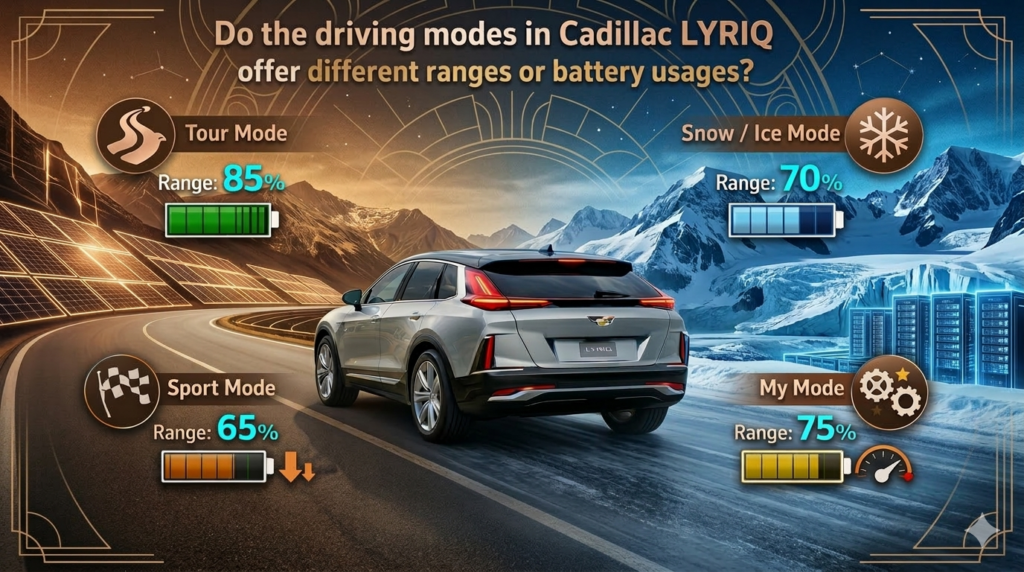
The Cadillac Lyriq typically offers several drive modes such as Tour, Sport, Snow/Ice, and My Mode. Each one adjusts throttle response, steering feel, regenerative braking behavior, and even climate system tuning in subtle ways.
Think of it like this: the battery is your fuel tank, and each mode decides how “aggressively” you tap into it.
- Tour Mode focuses on comfort and efficiency
- Sport Mode sharpens acceleration and response
- Snow/Ice Mode softens power delivery for control
- My Mode allows personalization of settings
These changes might seem like they’re just about driving feel, but underneath, energy usage is constantly being reshaped.
Do Driving Modes Actually Change Range or Battery Usage?
Yes—but not in a fixed, official “this mode gives you X miles more” way.
Instead, driving modes influence how efficiently your energy is used, which indirectly impacts range. The biggest factor is how power is delivered and how often the vehicle draws peak energy from the battery.
For example:
- Sport mode encourages faster acceleration, which uses more battery power.
- Tour mode smooths acceleration and often promotes efficiency.
- Snow/Ice limits sudden torque spikes, which can sometimes help conserve energy in slippery conditions.
However, Cadillac doesn’t assign a separate EPA range per mode because real-world usage depends heavily on driving style, terrain, temperature, and traffic.
In other words, the mode is a behavioral filter, not a separate battery profile.
Comparison of Driving Modes and Energy Impact
Here’s a simplified breakdown of how each mode can influence battery consumption:
| Driving Mode | Throttle Response | Energy Usage Pattern | Expected Range Impact |
|---|---|---|---|
| Tour Mode | Smooth & balanced | Efficient and steady | Highest potential range |
| Sport Mode | Sharp & aggressive | Higher power draw, frequent peaks | Reduced range |
| Snow/Ice | Soft & controlled | Moderate usage, limited torque spikes | Slightly reduced or neutral |
| My Mode | Customizable | Depends on settings | Variable |
This table isn’t about exact miles gained or lost—it’s about tendencies. Real-world range differences usually come down to driving behavior more than the mode itself.
Real-World Driving Scenario
Imagine you’re commuting through city traffic in stop-and-go conditions. In Tour Mode, the Lyriq gently accelerates, and regenerative braking quietly recaptures energy when you slow down. You’re likely to get a more stable and predictable range reading.
Now switch to Sport Mode on the same route. The car feels more alive—quicker off the line, more responsive at every green light. But that extra responsiveness comes at a cost: each acceleration pulls more energy from the battery, and your efficiency dips slightly.
On a highway trip, the difference becomes less dramatic. At steady speeds, all modes start to converge in efficiency, though Tour Mode still tends to be the most balanced.
A Small Personal Insight from EV Driving Experience
In my experience testing electric SUVs, the biggest surprise is how often drivers underestimate the impact of acceleration habits rather than driving modes alone. Even a small change in how aggressively you press the pedal can outweigh the difference between Tour and Sport modes.
What Really Matters More Than Driving Mode
Here’s the part many people miss: driving mode is only one layer of efficiency.
The real battery usage factors include:
- Speed consistency
- Weather (especially cold temperatures)
- Use of air conditioning or heating
- Terrain (hills vs flat roads)
- Tire pressure and road resistance
So while modes adjust the car’s personality, your driving style still dominates actual range outcomes.
One hidden advantage in the Lyriq is how well it manages regenerative braking. In city driving, this system can recover a meaningful amount of energy, especially in smoother modes like Tour.
That means even if Sport mode feels exciting, it’s not necessarily “bad”—it just prioritizes performance over efficiency.
Where Driving Modes Truly Shine
The real value of driving modes isn’t just about saving battery—it’s about matching the car to your environment.
- Long highway trips? Tour Mode feels relaxed and efficient
- Winding roads? Sport Mode enhances control and engagement
- Snowy conditions? Snow/Ice Mode improves stability and safety
- Personal preference? My Mode lets you blend everything
The Lyriq’s strength is flexibility. It doesn’t force one driving personality—it adapts to yours.
FAQs
1. Does Sport Mode significantly reduce range in the Cadillac Lyriq?
Yes, but only moderately. Sport Mode increases power demand, so range can drop slightly depending on driving habits.
2. Is Tour Mode the best for maximum range?
Generally yes. Tour Mode is designed for balanced efficiency and smooth energy use, making it the best default for range-focused driving.
3. Do driving modes change battery capacity?
No. All modes use the same battery. They only adjust how power is delivered and managed.
4. Can regenerative braking improve range in certain modes?
Yes. In smoother modes like Tour, regenerative braking can be more consistent, helping recover energy during deceleration.
5. Should I always use one mode for best efficiency?
Not necessarily. The best approach is switching modes based on conditions rather than sticking to one permanently.
Also Read: Pearl Compact Traveler 2-Piece Drum Kit Review Guide
Conclusion
Driving modes in the Cadillac Lyriq don’t directly change battery capacity or create separate range ratings—but they absolutely influence how efficiently that battery is used.
Tour Mode tends to maximize range through smoother energy delivery, while Sport Mode prioritizes performance at the cost of slightly higher consumption. Snow/Ice and My Mode add flexibility depending on road conditions and personal preference.
The real takeaway is simple: driving mode matters, but driving behavior matters more. When both are balanced well, the Lyriq delivers a refined and efficient electric driving experience that adapts naturally to everyday life.