
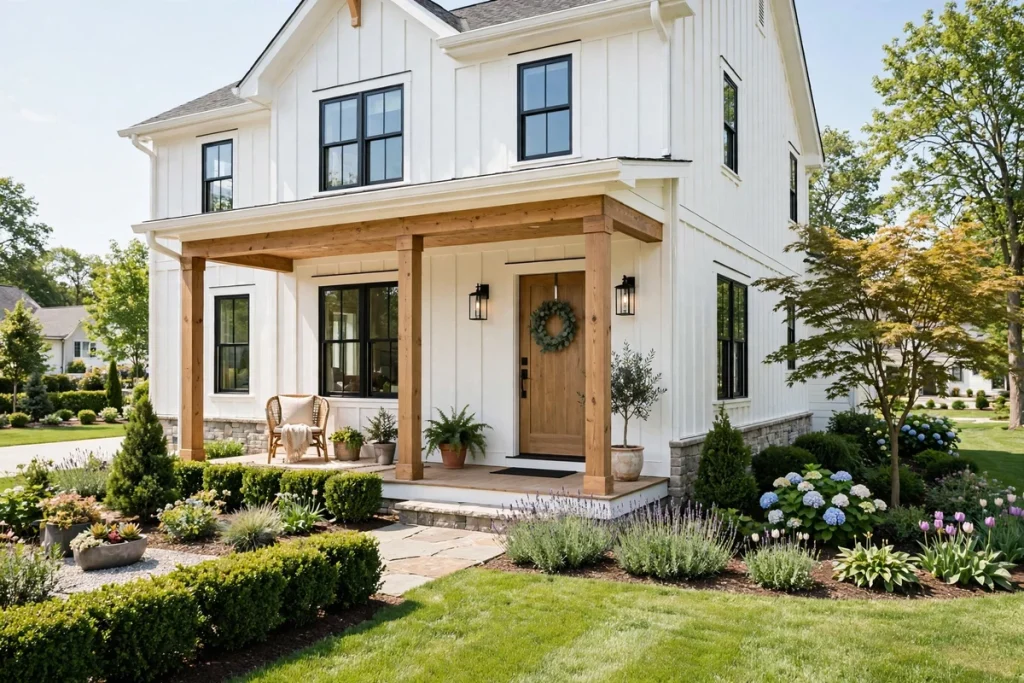

Outside light fixtures are the lights you use on the exterior of your home: by the front door, on the porch, along paths, on the garage, and in the garden. The right outside light fixtures make your home safer, easier to use after dark, and more welcoming, while the wrong ones can glare, waste energy, or leave dark spots where you need light most. In short, choose fixtures for the place they will go, pick a warm light with enough brightness for the job, and make sure they are rated for outdoor use.
This guide explains the main types of outside light fixtures, how to choose brightness and color temperature, which styles suit different homes, and how to plan, install, and maintain them. By the end, you will know exactly what to buy for your front door, porch, driveway, and garden.
What Are Outside Light Fixtures?
Outside light fixtures are light fittings designed to be used outdoors. They are built to cope with rain, dust, heat, and cold, and they are usually made from weather-resistant materials such as powder-coated metal, stainless steel, brass, or tough plastic. Inside, they hold a bulb or a built-in LED, and many have a glass or polycarbonate cover that protects the light source and spreads the light.
You will find outside light fixtures in almost every part of a home’s exterior. Wall lights sit beside doors and on garage walls, post lights stand on top of pillars, path lights mark walkways, floodlights cover driveways and back gardens, and string lights add atmosphere to patios. Each type does a different job, so a good outdoor lighting plan usually mixes two or three types rather than relying on one bright light to do everything.
Types of Outside Light Fixtures
There are more types of outside light fixtures than most people expect, and the names can be confusing. The list below covers the types you are most likely to need, and where each one works best.
Wall Lights and Porch Lights
Wall lights are the most common outside light fixtures. They mount directly on a wall, usually beside a front or back door, on a porch, or on a garage wall. A good porch light lets you see the lock, find your keys, and see who is at the door, and it also makes the entrance look cared for. Choose a wall light that is in proportion to your door: a fixture that is about one-third the height of the door usually looks right, and two matching fixtures, one on each side, suit a wide entrance.
Post Lights and Lanterns
Post lights sit on top of a post or pillar, often at the end of a driveway, beside a gate, or along a garden path. Lantern-style post lights suit traditional homes, while slim, modern post lights suit newer houses. They mark boundaries and entrances clearly, and they give a soft pool of light at about head height, which is useful for finding your way without a harsh glare.
Path and Bollard Lights
Path lights are short, low fixtures that light the ground along a walkway, driveway edge, or garden path. Bollard lights are taller versions of the same idea. They are not meant to light a whole garden; they are meant to show where to walk safely. Space them about 2 to 3 metres apart, and point the light down at the path rather than up into people’s eyes.
Floodlights and Security Lights
Floodlights give a wide, bright beam over a large area, such as a driveway, back garden, or side passage. Many have a motion sensor, so they only switch on when someone moves nearby. That saves energy and is a useful security feature. If you want a more detailed guide to choosing bright, efficient outdoor lights, see our guide to exterior outdoor LED lights.
Spotlights and Uplights
Spotlights and uplights are used to highlight a feature, such as a tree, a statue, a house number, or an attractive wall. Uplights sit at ground level and shine upwards, while spotlights can be mounted on a wall or a spike in the ground. Use them sparingly: one or two well-placed spotlights look elegant, while too many can make a garden look like a stage.
String Lights and Decorative Lights
String lights, festoon lights, and lanterns are decorative rather than practical, but they make patios and gardens feel warm and inviting in the evening. They work best over a seating area, along a fence, or across a pergola. Choose outdoor-rated string lights with warm white bulbs, and make sure the cable and plug are suitable for outdoor use.
How to Choose Outside Light Fixtures
Choosing outside light fixtures is easier if you work through four questions: where will the light go, what will it be used for, how bright should it be, and what style suits your home? Answer those first, and the choice of fixture usually follows.
| Location | Best Fixture Type | Typical Brightness | Key Feature |
|---|---|---|---|
| Front door / porch | Wall lantern | 400-800 lumens | Warm light, clear view of the lock |
| Garage / driveway | Floodlight with sensor | 1,000-2,000 lumens | Motion sensor, wide beam |
| Garden path | Path or bollard light | 100-300 lumens | Downward light, low glare |
| Patio / seating area | String lights, wall light | 200-500 lumens | Warm, dimmable light |
| Feature / tree | Spotlight or uplight | 300-600 lumens | Narrow beam, focused light |
Brightness: How Many Lumens Do You Need?
Brightness for outdoor lights is measured in lumens, not watts. For a front door, 400 to 800 lumens is usually enough. For a path, 100 to 300 lumens per light is plenty, because too much light on a path creates glare. For a driveway or a security light, 1,000 to 2,000 lumens is more appropriate. Brighter is not always better: a very bright light in a small space can dazzle you and annoy your neighbours, while a well-placed, moderate light will do the job better.
Color Temperature: Warm or Cool Light?
Color temperature is measured in Kelvins (K). Warm white light, around 2700K to 3000K, looks soft and yellow, and it suits entrances, patios, and gardens. Cool white light, around 4000K to 5000K, looks brighter and more clinical, and it suits security lights and work areas such as a garage. For most homes, warm white is the best choice for outside light fixtures, because it feels welcoming and does not make the house look harsh at night.
Weather Rating: What Does IP Mean?
Outdoor fixtures have an IP rating, which tells you how well they resist dust and water. The first digit is for solid objects, and the second is for water. For outside light fixtures, look for at least IP44, which means the fixture is protected against splashing water. For exposed locations, or for lights near the ground, IP65 is a safer choice, because it is protected against water jets and dust. Always check the rating before you buy, especially for path lights and uplights that sit low to the ground.
Style and Finish
Outside light fixtures should suit the style of your home. Traditional homes look good with lantern-style fixtures in black, bronze, or brass. Modern homes suit clean, geometric fixtures in matte black, white, or stainless steel. The finish also matters for durability: powder-coated metal and brass cope well with weather, while cheap painted metal can rust within a year. If you are planning the look of your home as a whole, our guide to residential lighting solutions has ideas for matching indoor and outdoor lighting.
LED vs. Solar vs. Mains-Powered Fixtures
Most outside light fixtures now use LEDs, because LEDs use far less energy than old halogen bulbs, last much longer, and are available in warm and cool tones. A good LED fixture can last 25,000 hours or more, which means you may never need to change the bulb.
Solar fixtures are easy to install, because they need no wiring, and they are ideal for path lights and decorative lights in sunny spots. Their weakness is that they depend on daylight to charge, so they can be dim on cloudy days or in winter, and in shaded gardens they may not work well at all.
Mains-powered fixtures are the most reliable, because they give a steady, bright light whenever you switch them on. They need proper wiring, and in most places that wiring should be installed by a qualified electrician, especially for new circuits. If you are replacing an existing mains fixture with a similar one, the job is simpler, but if you are unsure, hire a professional.
Planning Your Outdoor Lighting
Before you buy anything, walk around your home after dark and note the dark spots: the steps to the front door, the path from the gate, the side passage, and the area around the bins. Those are the places that need light first. Then think about the places where you spend time in the evening, such as a patio or a seating area, and plan softer, warmer light for those.
Layer your lighting, just as you would indoors. Start with task lighting for entrances and paths, add security lighting for driveways and dark corners, and finish with decorative lighting for patios and features. Three layers of moderate light will always look better, and work better, than one very bright light.
Think about how the lights will be controlled. A simple switch is fine for a porch light, but a timer, a dusk-to-dawn sensor, or a motion sensor can save energy and mean you never have to remember to switch the lights off. Smart outdoor lights can be controlled from a phone, and they can be dimmed or set to a schedule, but they cost more and need a reliable Wi-Fi signal outdoors.
Installation and Safety Tips
Always switch off the power at the fuse box before you work on a mains-powered fixture, and follow the manufacturer’s instructions. If the fixture needs new wiring, a new circuit, or work in a bathroom or other special location, use a qualified electrician. That is not just safer; in many areas it is also a legal requirement.
Mount wall lights at the right height. For a front door, the center of the fixture should be about 1.6 to 1.8 metres from the ground, which is roughly eye level. For a garage, mount floodlights high enough to cover the driveway, but angle them down so they do not shine into the street or into your neighbours’ windows.
Keep cables tidy and protected. Outdoor cables should be armored or run in conduit, and they should not be left where they can be tripped over or cut by a lawnmower. Use outdoor-rated junction boxes, and make sure all connections are sealed against rain.
Maintaining Outside Light Fixtures
Outside light fixtures need very little maintenance, but a little care will keep them working well and looking good. Clean the glass and the fixture a few times a year with a soft cloth and warm soapy water, because dirt and insects can block the light and make it look dull. Check the seals and gaskets each year, and replace any that are cracked or perished, because water getting inside is the most common cause of failure.
If a light stops working, check the bulb or LED first, then the fuse or circuit breaker, then the sensor if it has one. Motion sensors can be triggered by trees moving in the wind, so adjust the sensitivity and the angle if the light keeps switching on for no reason. For solar lights, clean the solar panel regularly, because a dirty panel charges much more slowly.
Frequently Asked Questions
What is the best type of outside light fixture for a front door?
A wall lantern in warm white, with 400 to 800 lumens, is usually the best choice for a front door. It gives enough light to see the lock and the step, it looks welcoming, and it suits most homes. Two matching lanterns, one on each side of a wide door, look especially good.
How bright should outside light fixtures be?
It depends on the location. Path lights need only 100 to 300 lumens, porch lights need 400 to 800 lumens, and floodlights for a driveway need 1,000 to 2,000 lumens. Brighter is not always better, because too much light can cause glare and disturb neighbours.
Are LED outside light fixtures better than solar?
LED fixtures are brighter, more reliable, and last longer, especially in winter or in shaded gardens. Solar fixtures are easier to install and cost nothing to run, but they depend on sunlight to charge and can be dim on cloudy days. Many homes use a mix: mains-powered LEDs for entrances and security, and solar lights for paths and decoration.
What IP rating do I need for outside light fixtures?
Look for at least IP44 for wall lights in a sheltered spot, and IP65 for exposed locations, path lights, and uplights near the ground. The higher the second number, the better the protection against water.
Can I install outside light fixtures myself?
You can replace an existing fixture yourself if you are confident and you switch off the power first, but new wiring, new circuits, and work in special locations should be done by a qualified electrician. Solar and battery-powered fixtures are safe to install yourself, because they need no mains wiring.
The best outside light fixtures are the ones that fit the place, the job, and your home. Start with the entrances and paths, choose warm, well-shielded light with the right brightness, and make sure every fixture is rated for outdoor use. Done well, outdoor lighting is not just practical: it makes your home safer, more welcoming, and more enjoyable after dark.