
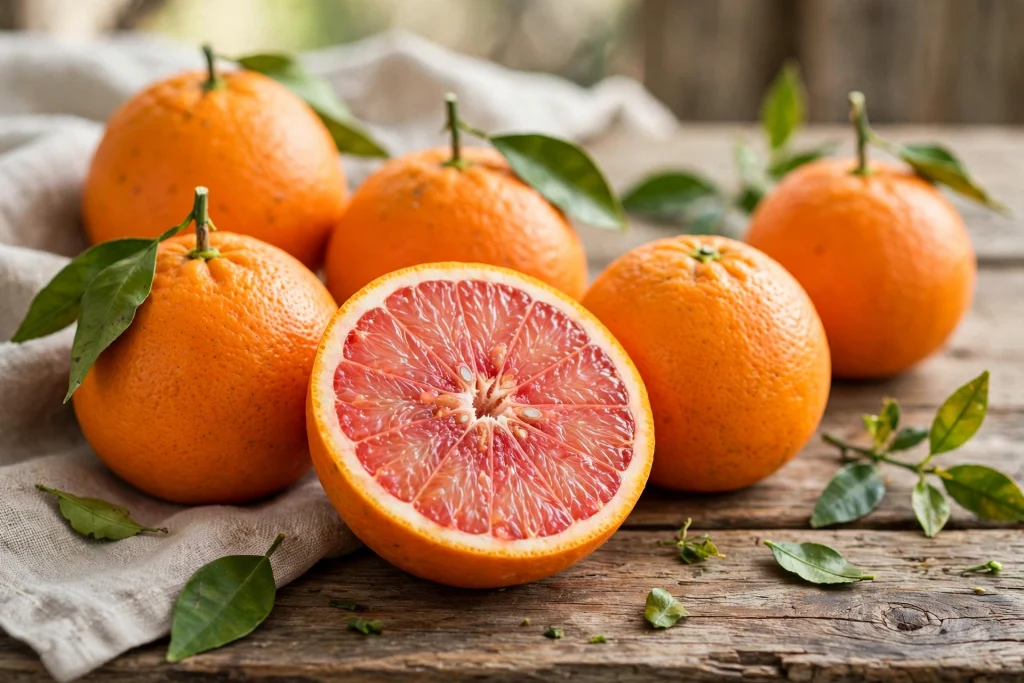

Cara navel oranges are a type of navel orange with pink-red flesh, a sweet, low-acid flavor, and almost no seeds. They look like an ordinary navel orange on the outside, but when you peel one, the flesh is a soft pink color, similar to a grapefruit, and the taste is sweeter and less sharp than a regular orange. In short, a cara navel orange is a sweet, pink-fleshed navel orange that is easy to peel, easy to eat, and good for snacking, salads, and juicing.
This guide explains what cara navel oranges are, how they taste, how they differ from regular navel oranges and blood oranges, how to choose, store, and use them, and what nutrition they provide. If you have seen them in a shop and wondered whether they are worth trying, the answer is yes, especially if you like sweet citrus with very little tartness.
What Are Cara Navel Oranges?
Cara navel oranges, also called Cara Cara navel oranges, are a variety of navel orange that was first found in Venezuela in the 1970s, on a Washington navel orange tree. The fruit is a natural mutation, not a hybrid with grapefruit, even though the pink flesh makes it look like one. The color comes from lycopene, the same natural pigment that gives tomatoes and pink grapefruit their color.
Like other navel oranges, cara navel oranges have a small, navel-like mark at one end, which is where the name comes from. They are usually round, with a bright orange rind that is easy to peel, and segments that separate cleanly. Most cara navel oranges are seedless, or nearly seedless, which makes them easy to eat out of hand and easy to use in cooking.
Cara navel oranges are in season in winter, usually from December to April in the Northern Hemisphere, with the peak in January and February. That makes them a welcome fruit in the middle of winter, when many other fresh fruits are out of season.
How Do Cara Navel Oranges Taste?
Cara navel oranges taste sweet, with very little acidity and a gentle berry-like note that regular navel oranges do not have. Many people describe the flavor as a cross between a navel orange and a pink grapefruit, but without the bitterness of grapefruit. The flesh is tender and juicy, and the juice is pink, which looks beautiful in a glass or a salad.
Because they are low in acid, cara navel oranges are a good choice for people who find regular oranges too tart, or for children who prefer sweet fruit. They are also good in dishes where you want orange flavor without a sharp citrus bite, such as a fruit salad, a green salad with orange segments, or a dessert.
| Orange Type | Flesh Color | Flavor | Seeds | Best For |
|---|---|---|---|---|
| Cara navel | Pink-red | Sweet, low acid, berry notes | Almost none | Snacking, salads, juicing |
| Regular navel | Orange | Sweet, mild, classic orange | Almost none | Snacking, cooking, juicing |
| Blood orange | Deep red | Sweet-tart, raspberry notes | Few | Salads, desserts, cocktails |
| Valencia | Orange | Sweet-tart, juicy | Some | Juicing |
Cara Navel Oranges vs. Regular Navel Oranges
The main difference between cara navel oranges and regular navel oranges is the color and flavor of the flesh. Cara navel oranges have pink-red flesh and a sweeter, less acidic taste, while regular navel oranges have orange flesh and a more classic, slightly tart orange flavor. The outside of the two fruits looks almost the same, so you need to check the label, or cut one open, to tell them apart.
In cooking, they can usually be used in the same way, but cara navel oranges are better when you want a sweeter result, a pink color, or a lower-acid fruit. Regular navel oranges are better when you want a strong, classic orange flavor, or when cara navel oranges are not in season or are more expensive.
How to Choose Cara Navel Oranges
Choose cara navel oranges that feel heavy for their size, because heavy fruit is usually juicier. The rind should be bright orange, firm, and smooth, with no soft spots, cuts, or mould. A little green on the rind is normal and does not mean the fruit is unripe, but avoid fruit that feels light, soft, or wrinkled.
Smell the fruit: a fresh orange should smell sweet and citrusy at the stem end. If you are buying a bag, check all the fruit in the bag, not just the ones on top, because one bad orange can affect the others. Cara navel oranges are often a little more expensive than regular navel oranges, so it is worth choosing carefully.
When Are They in Season?
Cara navel oranges are a winter fruit. In the United States, they are usually available from December to April, with the best quality in January and February. In other countries, the season may be a little earlier or later, depending on where the fruit is grown. Outside the season, they may be hard to find, or they may be imported and more expensive.
How to Store Cara Navel Oranges
Store cara navel oranges at room temperature for up to a week, or in the refrigerator for two to three weeks. Keep them in a cool, dry place, and do not store them in a sealed plastic bag, because they need air to stay fresh. If one orange starts to go soft or mouldy, remove it right away, so it does not affect the others.
Peeled orange segments can be stored in an airtight container in the refrigerator for three to four days. Orange juice made from cara navel oranges is best drunk fresh, but it will keep in the refrigerator for two to three days. You can also freeze orange segments or juice for smoothies and cooking, although the texture will change when it thaws.
How to Use Cara Navel Oranges
Cara navel oranges are easy to use, because they peel easily and have almost no seeds. The simplest way to enjoy them is to peel one and eat it fresh, as a snack or as part of breakfast. They are also good sliced into rounds for a fruit plate, or segmented and added to a salad.
Try cara navel oranges in a green salad with spinach, walnuts, and a light dressing, where the pink segments add color and sweetness. They are also good in a fruit salad with other winter fruit, such as apples, pears, and pomegranate seeds. For a simple dessert, serve orange segments with a little honey and yogurt.
Cara navel oranges make a beautiful pink juice, which is good on its own or mixed with other juices. Use the juice in smoothies, in a vinaigrette, or in a marinade for chicken or fish. The zest, the thin outer layer of the rind, can be used in baking, in cakes, muffins, and scones, where it adds a sweet orange flavor without the acidity of the juice.
If you like sweet fruit as a snack, cara navel oranges fit well alongside other fruit and snack ideas, and you can find more ideas in our guide to gluten-free snacks, which includes fruit and other light options. Like other seasonal fruit, cara navel oranges are at their best when they are in season, and you can learn about other seasonal fruit in our guide to blueberry season.
Nutrition of Cara Navel Oranges
One medium cara navel orange has about 60 to 70 calories, about 15 grams of natural sugar, and about 3 grams of fiber. It is a good source of vitamin C, with one orange providing most of the vitamin C you need in a day, and it also provides folate, potassium, and small amounts of vitamin A.
The pink color comes from lycopene, an antioxidant that is also found in tomatoes and watermelon. Lycopene is linked to heart health and to protecting cells from damage, although the amount in one orange is modest. Cara navel oranges are also low in fat and sodium, and they are a good choice for a healthy snack or for adding fruit to your diet.
Like all fruit, cara navel oranges contain natural sugar, so they should be eaten as part of a balanced diet, not in very large amounts at once. Eating the whole fruit, rather than drinking only the juice, is better, because the fiber in the fruit helps you feel full and slows down how quickly the sugar is absorbed.
Frequently Asked Questions
What are cara navel oranges?
Cara navel oranges, also called Cara Cara navel oranges, are a type of navel orange with pink-red flesh, a sweet, low-acid flavor, and almost no seeds. They are a natural mutation of the Washington navel orange, and the pink color comes from lycopene.
Do cara navel oranges taste like grapefruit?
No, they do not taste like grapefruit, even though the flesh is pink like grapefruit. Cara navel oranges are sweet and low in acid, with a gentle berry-like note, while grapefruit is tart and bitter. If you like oranges but find grapefruit too sharp, cara navel oranges are a good choice.
Are cara navel oranges seedless?
Yes, most cara navel oranges are seedless, or nearly seedless, like other navel oranges. You may occasionally find a small seed, but it is rare, and it does not affect the taste or the ease of eating the fruit.
When are cara navel oranges in season?
Cara navel oranges are in season in winter, usually from December to April in the Northern Hemisphere, with the peak in January and February. Outside that season, they may be hard to find or more expensive.
Can I use cara navel oranges instead of regular oranges?
Yes, you can use cara navel oranges in most recipes that call for regular navel oranges. They will give a sweeter, less acidic result and a pink color, which is good in salads, desserts, and juices. For a strong, classic orange flavor, regular navel oranges may be better.
Cara navel oranges are a sweet, pink-fleshed navel orange that is easy to peel, easy to eat, and easy to use in salads, desserts, and juices. Look for heavy, firm fruit in winter, store it in the refrigerator, and enjoy it fresh while it is in season. Once you try one, you will know it by its color and its gentle, sweet flavor.