
Teal paint is a rich blue-green colour that sits between blue and green, and it is one of the most versatile colours you can use at home. It is deep enough to feel calm and luxurious, bright enough to make a room feel alive, and flexible enough to work in a bedroom, bathroom, kitchen, or living room. If you want colour without going too bold, teal is often the answer.
In this guide, you will learn what teal paint is, how its shades differ, which teal paints are most popular, where to use teal in each room, what colours go with it, which paint finish to choose, and how to test and apply it well. You will also find a comparison of popular teal shades, practical buying tips, common mistakes to avoid, and answers to the questions buyers ask most often. By the end, you will know whether teal suits your home and exactly which shade to choose.
What Is Teal Paint?
Teal is a dark blue-green colour, named after the teal duck, which has a blue-green patch around its eyes. In paint terms, teal is made by mixing blue and green, usually with more blue than green, and often with a little grey or black to deepen it. The result is a colour that feels both cool and warm: the blue makes it calm, and the green makes it fresh and natural.
Teal is not the same as turquoise, aqua, or navy. Turquoise is lighter and brighter, with more green and more white. Aqua is paler still, like shallow tropical water. Navy is a very dark blue with almost no green. Teal sits in the middle: deeper than turquoise, greener than navy, and richer than aqua. That middle position is why teal works in so many rooms: it has the depth of a dark colour without feeling as heavy as navy or black.
Teal paint also changes with light. In a bright, south-facing room, teal can look greener and livelier. In a north-facing room with cool light, the same paint can look bluer and moodier. At night, under warm lamps, teal can look softer and more grey-green. Always test a teal paint on your own wall, in your own light, before you commit to a whole room.
Popular Teal Paint Shades
Every paint brand has its own teal, and the names can be confusing. Below are some of the most popular and most recommended teal paints, with a short note on each. Use this table as a starting point, then order samples of two or three shades and compare them on your wall.
| Paint and shade | Brand | How it looks | Best for |
|---|---|---|---|
| Teal 2053-20 | Benjamin Moore | Deep, classic teal | Accent walls, cabinets |
| Peacock Teal 2053-30 | Benjamin Moore | Rich, jewel-like teal | Bedrooms, dining rooms |
| Rainwashed SW 6211 | Sherwin-Williams | Soft, pale teal-grey | Bathrooms, small rooms |
| Oceanside SW 6496 | Sherwin-Williams | Bold, saturated teal | Front doors, furniture |
| Teal 2027 | Farrow and Ball | Deep, muted teal | Living rooms, libraries |
| Inchyra Blue 289 | Farrow and Ball | Dark blue-teal | Moody walls, cabinets |
| Real Teal | Valspar | Bright, true teal | Accents, crafts |
| Peacock Plume | Valspar | Vivid blue-green | Feature walls |
Benjamin Moore’s Teal 2053-20 is a good all-round choice if you want a true, deep teal. Sherwin-Williams Oceanside is bolder and brighter, and it was once a colour of the year, so it is widely available. Farrow and Ball’s teal shades are more muted and chalky, which suits traditional and country homes. If you are unsure, start with a mid-depth teal, not the darkest or the brightest, because it is easier to live with and easier to pair with other colours.
When you compare shades, look at the undertone. Some teals lean blue, some lean green, and some lean grey. A blue-leaning teal feels cooler and more formal. A green-leaning teal feels warmer and more natural. A grey-leaning teal feels softer and more modern. Hold the sample next to your floor, your sofa, and your worktop, because the undertone will either clash with them or blend in, and that is often the difference between a teal you love and a teal you regret.
Where to Use Teal Paint
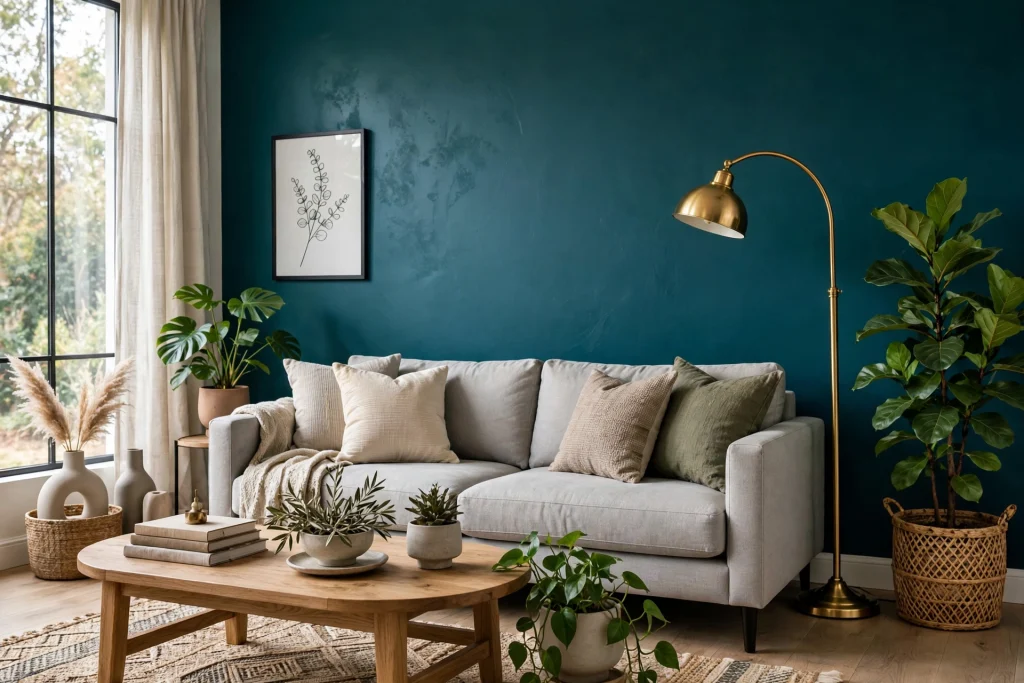
Teal works in almost every room, but it works differently in each one. In a living room, a teal accent wall behind a sofa creates a focal point without painting the whole room. In a bedroom, teal on all four walls can feel calm and cocooning, especially with white bedding, wood, and warm lamps. In a bathroom, teal on the walls or on a vanity pairs well with white tiles, marble, and brass fittings, and it hides water marks better than white paint.
In a kitchen, teal cabinets are a popular choice. They add colour without the boldness of red or yellow, and they work with white worktops, wood floors, and brass or black handles. If teal cabinets feel too bold, paint a kitchen island teal and keep the other cabinets white or cream. Our round-up of 2026 kitchen cabinet colors shows how teal fits with the other cabinet colours people are choosing this year.
Teal also suits smaller uses: a front door, a piece of furniture, a home office wall, or a hallway. A teal front door stands out against brick, white, or grey, and it is an easy way to try the colour without painting a room. A teal chest of drawers or bookcase can add colour to a neutral room, and it is easy to repaint if you change your mind.
What Colours Go With Teal Paint?
Teal is easy to pair because it works with warm and cool colours. White is the safest partner: it keeps teal fresh and stops a dark teal room from feeling heavy. Cream and warm white soften teal, while bright white makes it look crisper. Grey is another good partner, especially a warm grey, which calms teal down and suits modern rooms.
Wood tones are a natural match for teal. Light oak and pine make teal feel fresh and coastal, while dark walnut and mahogany make it feel rich and traditional. Brass and gold fittings warm teal up and suit bathrooms and kitchens, while black fittings give it a modern, graphic look. For a bolder scheme, pair teal with mustard yellow, coral, or blush pink: mustard adds warmth, coral adds energy, and blush adds softness.
Teal also works with other blues and greens, if you keep the tones close. A pale sage green, a soft sky blue, or a deep navy can sit next to teal without clashing, as long as one colour is the main colour and the others are accents. Avoid pairing teal with bright red or bright orange in large amounts, because the contrast can feel jarring, although small touches of those colours can work as accents in cushions or art.
| Partner colour | Effect | Best in |
|---|---|---|
| White | Fresh, crisp, clean | Any room, especially bathrooms |
| Warm grey | Calm, modern, soft | Living rooms, bedrooms |
| Light wood | Coastal, natural, fresh | Kitchens, living rooms |
| Dark wood | Rich, traditional, warm | Libraries, dining rooms |
| Brass and gold | Luxurious, warm | Bathrooms, kitchens |
| Mustard yellow | Bold, warm, cheerful | Accents, cushions, art |
| Blush pink | Soft, romantic, modern | Bedrooms, living rooms |
Choosing the Right Finish for Teal Paint
The finish, or sheen, changes how teal looks and how easy it is to clean. Flat or matte paint hides wall flaws and gives a soft, chalky look, which suits bedrooms and living rooms, but it is harder to clean. Eggshell is a good middle ground: it has a slight sheen, it is easy to wipe, and it suits most walls.
Satin is a good choice for kitchens, bathrooms, and hallways, because it resists moisture and wipes clean easily. Semi-gloss is best for trim, doors, and cabinets, because it is hard-wearing and shows the colour at its richest, although it also shows flaws in the surface. For teal cabinets, use a satin or semi-gloss paint made for cabinets, and prepare the surface well, because a poor finish will show on a dark colour. Our guide to Farrow and Ball paint explains how a premium paint’s finish and depth of colour can affect the final look.
How to Test Teal Paint Before You Commit
Never choose teal from a small colour chip alone. Buy a sample pot or a peel-and-stick sample of your top two or three shades, and paint a large patch, at least 60 by 60 centimetres, on the wall you plan to paint. If you can, paint two coats, because one coat is always lighter and less even than the finished colour.
Look at the sample in the morning, at midday, and in the evening, and with the lights on and off. Move the sample to different walls, because a wall opposite a window gets different light from a wall next to it. Live with the sample for at least two or three days, and look at it next to your sofa, curtains, floor, and worktop. If you still like it after three days, it is probably the right shade. If you are choosing between two shades, the lighter one is usually the safer choice for a whole room, while the darker one is better for an accent wall or a piece of furniture.
How to Paint With Teal: Tips for a Good Finish
Good preparation matters more with a dark colour like teal, because flaws show more. Clean the wall, fill any holes, sand the filler smooth, and prime the wall if it is new, stained, or a very different colour from teal. Use a primer tinted towards teal if you are painting over white, because it will help the teal cover in two coats instead of three.
Use a good quality brush for edges and a roller for large areas, and keep a wet edge so you do not get lap marks. Paint in daylight if you can, so you can see missed spots. Two coats are almost always needed for teal, and three may be needed if you are painting over a dark colour or a glossy surface. Let each coat dry fully before you apply the next, and follow the drying time on the tin. For cabinets and furniture, sand between coats, use a paint made for the surface, and let the paint cure for a few days before you use the piece heavily.
Common Teal Paint Mistakes to Avoid
The most common mistake is choosing a teal that is too dark for a small, dim room. A very dark teal can make a small room feel smaller and darker, especially if the room has only one small window. In a small room, use a lighter teal, use teal on one wall only, or add white trim and good lighting to keep the room bright.
Another mistake is pairing teal with too many other strong colours. Teal is already a strong colour, so it needs calm partners: white, wood, grey, and one accent colour are usually enough. A third mistake is skipping the sample test, especially in a north-facing room, where teal can look much bluer and colder than it did in the shop. Finally, do not use a flat finish in a kitchen or bathroom, where steam and splashes will mark it. Choose a satin or eggshell finish there, and keep a small pot of the paint for touch-ups. If you want to see how a single colour can set the tone for a whole year, read our guide to the Benjamin Moore Color of the Year 2026.
Frequently Asked Questions About Teal Paint
Is teal paint blue or green?
Teal is both: a dark blue-green colour, usually with more blue than green. Some teals lean blue and feel cooler, while others lean green and feel warmer, so check the undertone before you buy.
Does teal paint make a room look smaller?
A very dark teal can make a small, dim room feel smaller, but a lighter teal, or teal on one wall only, adds depth without shrinking the room. White trim, mirrors, and good lighting help a lot.
What colour goes best with teal paint?
White is the safest partner, followed by warm grey, light wood, and brass. For a bolder look, add mustard yellow, coral, or blush pink as accents, but keep the rest of the room calm.
Is teal paint good for kitchen cabinets?
Yes. Teal cabinets add colour without being too bold, and they work with white worktops, wood floors, and brass or black handles. Use a satin or semi-gloss cabinet paint for a hard-wearing finish.
What is the best teal paint colour?
It depends on your room and light, but Benjamin Moore Teal 2053-20, Sherwin-Williams Oceanside, and Farrow and Ball Teal are all popular choices. Test two or three samples on your own wall before you decide.