
A small dishwasher can change life in a small kitchen. It washes dishes, glasses, and cutlery while you do something else, uses less water than washing by hand, and keeps the sink clear. For apartments, studios, tiny houses, and small family kitchens, a compact dishwasher is often the difference between a tidy kitchen and a sink full of dishes.
Small dishwashers come in several types, and the best one depends on your space, your plumbing, and how many dishes you wash each day. This guide explains the main types, the sizes to measure, the features that matter, and how to use and care for a compact dishwasher. You will also find a comparison table, installation tips, and answers to the questions people ask most before buying one.
What Is a Small Dishwasher?
A small dishwasher is a compact dishwasher designed for kitchens with limited space. It is smaller than a standard full-size dishwasher, which is usually 24 inches wide, and it holds fewer place settings, usually 4 to 8, compared with 12 to 16 for a full-size model. That makes it ideal for one or two people, a small household, or a second dishwasher in a large home.
Small dishwashers are not a compromise on cleaning power. They use the same hot water, detergent, and spray arms as a full-size model, just in a smaller space. In fact, a small dishwasher can be more efficient than a large one for a small household, because you do not need to wait days to fill a large machine, and you do not waste water washing a half-empty load.
Types of Small Dishwasher
| Type | Size | Capacity | Best for | Installation |
|---|---|---|---|---|
| Countertop dishwasher | About 17-22 in wide | 4-6 place settings | Renters, studios, no plumbing changes | Connects to a tap, no permanent install |
| Portable dishwasher | About 18 in wide | 6-8 place settings | Small kitchens, movable use | Wheels, connects to a tap |
| Built-in compact dishwasher | 18 in wide | 8 place settings | Small kitchens, permanent fit | Plumbed in under a counter |
| Drawer dishwasher | 24 in wide, single drawer | 6-7 place settings | Modern kitchens, flexible use | Built in, one or two drawers |
| Tabletop mini dishwasher | About 16 in wide | 2-4 place settings | Single person, very small space | Sits on a counter, tap connection |
Countertop dishwashers are the most popular choice for renters, because they sit on a worktop and connect to a kitchen tap with an adapter. You do not need to change the plumbing, and you can take the dishwasher with you when you move. Portable dishwashers are similar, but they stand on the floor on wheels and have more capacity, so they suit a small family better.
Built-in compact dishwashers look like a slim version of a standard dishwasher and fit under a kitchen counter. They need a water supply and a drain, so they are best for owners who can install them permanently. Drawer dishwashers are a premium option. A single drawer can wash a small load, while a double drawer lets you wash two small loads at different times, which is useful for a household with different schedules.
How to Measure for a Small Dishwasher
Measure before you buy. For a countertop model, measure the depth and height of your worktop, and check that there is space to open the door fully. Leave at least a few inches above the dishwasher for steam to escape, and make sure the tap adapter fits your tap. Not all taps work with all adapters, so check the fitting before you order.
For a built-in model, measure the width, height, and depth of the space under your counter. An 18-inch dishwasher needs an 18-inch opening, but allow a small gap on each side for ventilation and for the door to open. Measure the door swing, because a dishwasher door that hits a cabinet or an island will be frustrating to use every day.
Also check the water and power supply. A countertop or portable dishwasher needs a nearby tap and a sink for drainage. A built-in model needs a hot water supply, a drain, and a power outlet. If your kitchen was not designed for a dishwasher, a plumber can usually add a connection, but get a quote first so you know the full cost.
Planning the space is part of designing a kitchen that works well in a small area. Our guide to kitchen island ideas for small kitchens shows how to make the most of a compact layout, and our guide to how to design a functional kitchen covers the layout, storage, and workflow that make a small kitchen easier to use.
What to Look for When Buying a Small Dishwasher
Capacity is the first thing to check. A place setting is a set of plates, bowls, glasses, and cutlery for one person at one meal. A 6-place-setting dishwasher will handle dinner for two people, plus breakfast dishes, but it will not fit large pots or baking trays. If you cook a lot, choose a model with adjustable racks and a cutlery tray, so you can fit larger items.
Noise level matters in a small home, especially in an open-plan apartment. Look for a dishwasher rated at 50 decibels or less, which is about the level of a quiet conversation. A noisy dishwasher can be distracting if it runs while you are working, watching television, or sleeping.
Energy and water use are also important. A small dishwasher typically uses 2 to 4 gallons of water per cycle, compared with 6 to 9 gallons for washing the same dishes by hand under a running tap. Look for an energy rating, a half-load or eco mode, and a delay start, so you can run the dishwasher at night when energy is cheaper.
Other features worth checking are the wash programmes, the drying system, and the controls. A good small dishwasher should have at least a normal, eco, and intensive cycle, plus a quick wash for lightly soiled dishes. A heated drying system dries dishes better than a simple fan, but it uses more energy. Simple, clear controls are better than a complicated panel you need a manual to use.
How to Use a Small Dishwasher Well
Load a small dishwasher carefully, because space is limited. Scrape food off plates before loading, but do not rinse them fully, because detergent needs a little food to work on. Place plates facing the centre, cups and glasses upside down on the top rack, and cutlery with handles down, except for sharp knives, which should go handle up for safety.
Do not overload the dishwasher. If spray arms cannot spin freely, or if dishes are stacked on top of each other, they will not get clean. Run the dishwasher when it is full, but not overfull. For a small household, that usually means once a day, after dinner.
Use the right detergent and the right amount. Too much detergent leaves a film on glasses, while too little leaves food behind. Use a detergent made for dishwashers, not washing-up liquid, which creates too many bubbles and can damage the machine. Add rinse aid if your glasses come out cloudy, especially in a hard-water area.
Cleaning and Maintenance
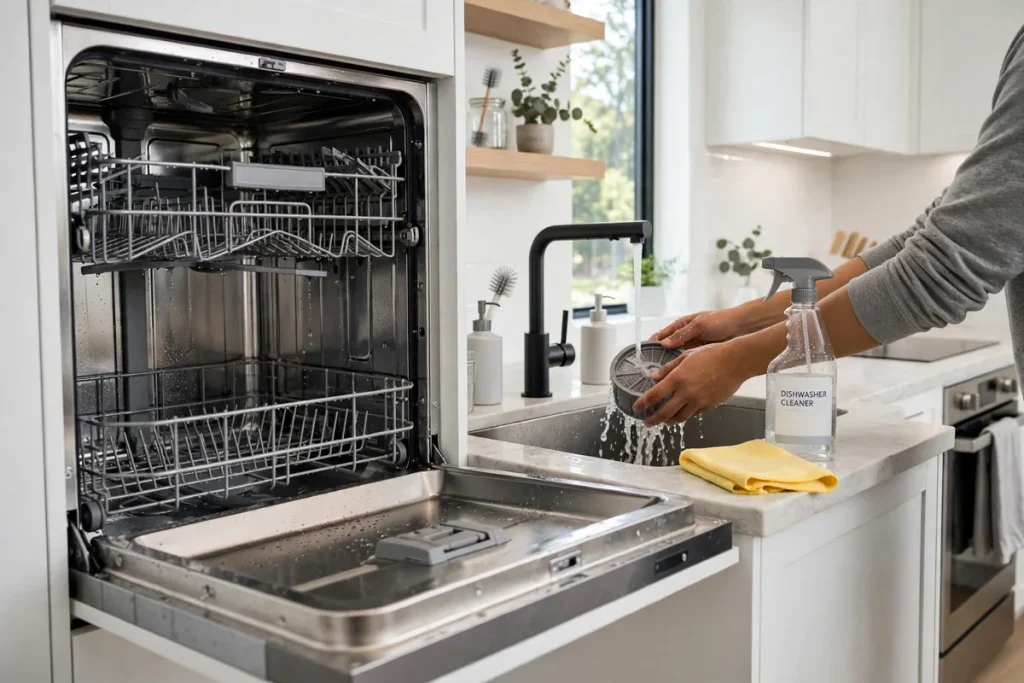
A small dishwasher needs regular cleaning to work well and to avoid smells. Clean the filter once a week, wipe the door seal, and run an empty hot cycle with a dishwasher cleaner once a month. That removes grease, limescale, and food residue that can build up inside the machine.
If your dishwasher smells, check the filter first, then the drain hose, and then run a cleaning cycle. A small dishwasher that is used daily should not smell if it is cleaned regularly. Our guide to how to clean a dishwasher explains the full routine step by step, including how to clean the spray arms and the filter.
Check the spray arms for blocked holes, and clean them with a toothpick or a small brush if needed. Descale the dishwasher if you live in a hard-water area, following the manufacturer’s instructions. A well-maintained small dishwasher can last 10 years or more.
Small Dishwasher vs Washing by Hand
A dishwasher usually uses less water than washing by hand, especially if you wash under a running tap. It also washes at a higher temperature, which kills more germs and cleans greasy dishes better. Hand washing can be faster for a single plate or cup, but for a full meal’s dishes, a dishwasher saves time and water.
The main advantage of a small dishwasher is time. Loading a dishwasher takes a few minutes, and then it does the work while you relax, work, or spend time with family. For a busy household, that time adds up to hours each week. The main disadvantage is space, because even a small dishwasher takes up counter or floor space that a small kitchen may not have. Measure carefully, and choose the type that fits your kitchen best.
Frequently Asked Questions
Can a small dishwasher wash pots and pans?
Some small dishwashers can fit a small pot or pan, especially if the racks are adjustable, but large pots and baking trays usually need to be washed by hand. Choose a model with a flexible rack if you cook with large pans often.
Do I need plumbing for a small dishwasher?
Countertop and portable dishwashers connect to a kitchen tap and drain into the sink, so they need no permanent plumbing. Built-in and drawer dishwashers need a permanent water supply and drain, like a full-size dishwasher.
How much water does a small dishwasher use?
Most small dishwashers use 2 to 4 gallons per cycle, depending on the model and programme. That is usually less than washing the same dishes by hand under a running tap.
Is a small dishwasher worth it for one person?
Yes, if you cook regularly and want to save time and water. A countertop or tabletop model is best for one person, because it holds enough for a day’s dishes without taking up too much space.
How long does a small dishwasher last?
With regular cleaning and maintenance, a small dishwasher usually lasts 8 to 10 years. Clean the filter weekly, run a cleaning cycle monthly, and descale it if you live in a hard-water area.
A small dishwasher is a practical choice for a small kitchen, a rental, or a small household. Measure your space, choose the type that fits your plumbing and your routine, and look for a quiet, efficient model with the programmes you will actually use. Used well and cleaned regularly, it will save you time, water, and a sink full of dishes.