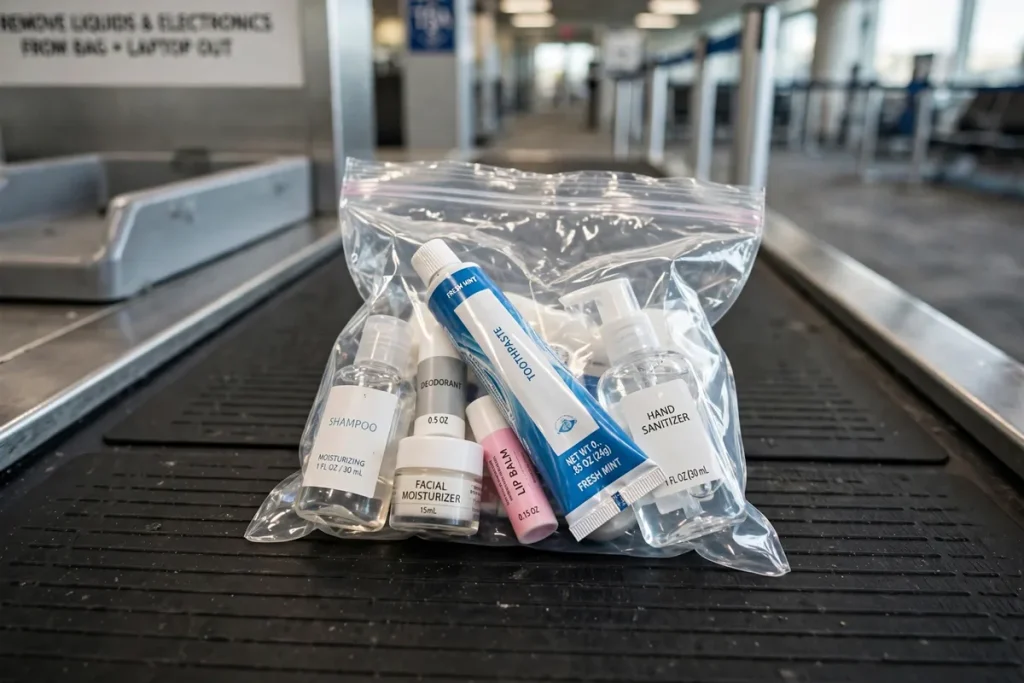

Can I take toothpaste on a plane? Yes — you can. In the United States, the Transportation Security Administration (TSA) allows toothpaste in your carry-on bag as long as each tube is 3.4 ounces (100 ml) or smaller and fits inside your single quart-size bag of liquids, gels, and pastes. In checked luggage, toothpaste is allowed with no size limit at all, so your full-size tube can travel in the bag you check in.
But most travelers want more than the short answer. Will a half-empty family-size tube survive security? Do toothpaste tablets and powders follow the same rule? What happens if an officer decides your tube is too big, and do the rules change on an international flight? Those are the details that decide whether your toothpaste makes it onto the plane or into a trash bin at the checkpoint.
The Short Answer: Yes, With One Size Rule
Toothpaste is classed as a paste, which puts it in the same group as gels, creams, and other liquids under the TSA’s liquids rule. For carry-on bags, each container of toothpaste must hold 3.4 ounces (100 ml) or less. You can bring as many travel-size tubes as you like, as long as they all fit comfortably in one quart-size, clear, resealable bag — and you are allowed one such bag per passenger.
Checked bags are a different story. Because checked luggage is screened separately and is not accessible during the flight, the TSA places no size limit on toothpaste in checked bags. Pack the travel-size tube in your carry-on for use during the journey, and put the big tube in your checked bag if you are checking one in.
Toothpaste on a Plane: Carry-On vs. Checked Bags
| Bag | Toothpaste allowed? | Size limit | Notes |
|---|---|---|---|
| Carry-on | Yes | 3.4 oz (100 ml) or smaller per tube | Must go in your quart-size clear liquids bag, one bag per passenger |
| Checked | Yes | No size limit | Full-size and family-size tubes are fine; pack upright to avoid leaks |
How the TSA 3-1-1 Rule Applies to Toothpaste
The size limit on toothpaste comes from the TSA 3-1-1 rule, which governs all liquids, aerosols, gels, creams, and pastes in carry-on bags: each container may hold no more than 3.4 ounces (100 ml), all containers must fit in one quart-size bag, and each passenger is allowed one such bag. For the full breakdown, see our guide to the TSA 3-1-1 rule.
Two details catch people out. First, the limit is measured by the size printed on the container, not the amount left inside it. Second, the quart-size bag itself matters: if your tube cannot fit in the bag alongside your other liquids, something has to move to your checked bag. Keep the bag easy to reach, because at many checkpoints you will be asked to take it out and place it in a bin on its own.
The Half-Empty Tube Trap: Container Size Is What Counts
This is the detail that costs travelers the most toothpaste. A large tube that is half empty — or even nearly empty — still counts as a large tube. Security officers judge the container by the size printed on it, not by how much paste is left inside, because there is no quick way to measure what remains in a squeezed tube at a busy checkpoint. A 6-ounce tube with one squeeze left in it is still a 6-ounce container.
Travel forums are full of stories from people who argued this point at security, and the answer is almost always the same: the tube goes in the bin or back to your checked bag. Some officers may use their discretion for a tube only slightly over the limit, but that is a favor, not a right. Buy a travel-size tube before you fly, or squeeze what you need into a small travel container of 3.4 ounces or less.
What Happens at Security If Your Tube Is Too Big?
If an officer finds a toothpaste tube larger than 3.4 ounces in your carry-on, you will usually be given a choice, but none of the options are great. You can surrender the tube and it is thrown away, step out of line to put it in your checked bag if the airline will still accept it, or hand it to someone who is not flying. You will not be fined or stopped from flying — it is a routine, low-stakes confiscation — but you will lose the toothpaste and the time it takes to sort out.
The smoothest way through is to avoid the conversation entirely. Pack only travel-size tubes in your carry-on, keep them in your quart-size bag, and take the bag out before your items go through the scanner. If you are unsure about a tube, check the size printed on its crimped end before you leave home.
Toothpaste Powder and Tablets: The Easy Workaround
Here is the extra angle most guides overlook: toothpaste does not have to be a paste at all. Toothpaste tablets and toothpaste powder are solids, not liquids, gels, or pastes, so the 3-1-1 rule does not apply to them. You can carry as many tablets as you like in your hand luggage, in any size container, without putting them in your liquids bag. For frequent flyers and light packers, they are the simplest way to stop worrying about the size rule altogether.
Tablets work exactly as you would expect: chew one until it turns into a soft paste, brush as normal, and spit. Powders work the same way — dip a damp toothbrush in the powder and brush. Both take up almost no space, weigh almost nothing, and cannot leak in your bag. The only real downside is taste and texture, which vary by brand, so try them at home before relying on them for a long trip. Solid toothpaste bars work the same way: as a solid, they are not counted as a liquid either.
International Flights: UK, EU, and Beyond
Outside the United States, the rule is the same idea with slightly different numbers: in the UK and the European Union, each container of toothpaste in hand luggage must be 100 ml or smaller, and all of your liquids must fit in a single transparent, resealable bag of up to one liter. The US limit of 3.4 ounces is 100 ml in a more familiar unit, so a US travel-size tube is fine for a flight out of London, Paris, or Amsterdam, and a European 100 ml tube is fine for a flight out of New York.
One change is worth knowing about. Some airports in the UK and the EU have installed new CT scanners that can inspect liquids inside your bag, and a few have relaxed or removed the 100 ml limit and the need to take liquids out at all. But the change is uneven: it depends on the airport and the terminal, not the country, and the old 100 ml rule still applies at most airports. The safe approach is to assume the 100 ml limit applies everywhere. Before you fly, check the rules for your departure airport specifically, not just your destination country, because the departure airport is where your bag is screened.
Other countries follow the same broad pattern: Canada’s limit is 100 ml per container, Australia’s is 100 ml, and most of Asia follows the same standard. When in doubt, the 100 ml travel-size tube is the one size that works almost everywhere in the world.
Medically Necessary Toothpaste and Special Cases
There are exceptions to the liquids rule for medically necessary items, and prescription toothpaste can fall into that category. If a dentist or doctor has prescribed a special toothpaste — for example, a high-fluoride paste for tooth decay — you can usually bring a larger amount in your carry-on, but declare it at the checkpoint and be ready to show the prescription or a doctor’s note. Children’s toothpaste follows the standard rule: 3.4 ounces or 100 ml per tube in a carry-on.
How to Pack Toothpaste for a Flight
- Choose a tube of 3.4 ounces (100 ml) or smaller for your carry-on, and check the printed size on the tube.
- Put the tube in your quart-size clear liquids bag and keep that bag at the top of your carry-on.
- Pack full-size tubes in checked luggage, inside a sealed plastic bag in case the tube leaks.
- Consider toothpaste tablets or powder if you want to skip the liquids bag entirely.
- If unsure about the size, buy a travel-size tube at the airport after security.
The same sizing logic applies to the rest of your toiletries bag. Our guide to travel-size shampoo sizes explains which bottles are safe for carry-on, and our guide to whether you can take cigarettes on a plane covers tobacco and lighters, which follow very different rules from liquids.
Frequently Asked Questions
Can I take toothpaste on a plane in my carry-on?
Yes — each tube must be 3.4 ounces (100 ml) or smaller, in your quart-size liquids bag.
Can I bring a full-size tube of toothpaste in checked luggage?
Yes — checked bags have no size limit for toothpaste.
Can I take a half-empty large tube of toothpaste on a plane?
No. Officers judge the printed tube size, not how much paste is left.
Do toothpaste tablets and powder count as liquids?
No. They are solids, so the 3-1-1 rule does not apply and they need no liquids bag.
What size toothpaste can I take on an international flight?
100 ml per container in the UK, EU, Canada, and Australia.
Keep your carry-on tube at 3.4 ounces (100 ml) or smaller, and security will be smooth.