
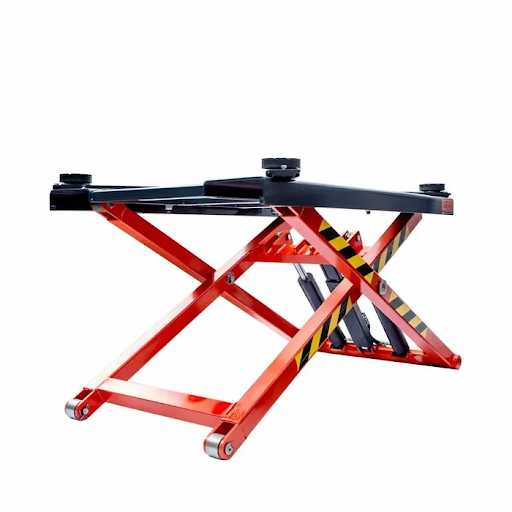

Most home mechanics work on the ground because the ceiling is too low
Through a Canadian summer of catching up on vehicle jobs, the thing that limits a home garage is rarely skill or tools. It is headroom, since a full two-post hoist needs a ceiling most attached garages simply do not have, and that is the gap a mid-rise scissor lift is built to fill.
The choice being made is a height rather than a machine. A full hoist lifts a vehicle to standing height and asks for a tall bay and a bolted installation, while a jack and stands cost almost nothing and leave the owner lying on concrete. The mid-rise option sits deliberately between the two.
Waist height is what changes about the work
Raising a car to roughly waist level does not sound dramatic until the work starts. A wheel comes off at chest height rather than at the floor, brake components sit where hands and eyes naturally go, and the whole job stops being an exercise in lying down and reaching upward.
That is the practical return on a scissor lift of this class. It does not turn a garage into a professional shop, but it removes the crouching and the creeper from the jobs a home mechanic actually does most weekends, which is where the fatigue and the mistakes come from.
The height suits some jobs and rules out others
Wheels, brakes, suspension components, rocker panels, and bodywork along the sides all fall comfortably within reach at mid-rise height. Those account for the large majority of the work a private owner takes on at home during a working season. That is the range of work a scissor lift of this height is genuinely aimed at.
What the height does not allow is standing underneath. Exhaust work along the full length of a vehicle, transmission removal, and anything that means moving freely beneath the car still belong on a full hoist, and no amount of optimism changes that.
It replaces jack stands rather than competing with a hoist
The honest comparison is not with a professional installation but with the jack and stands sitting in the corner of most garages. A vehicle raised on stands rests on four separate points that were each positioned by hand and judged by eye.
A scissor lift takes the whole vehicle up on one engineered structure with a mechanical lock holding it there. The load path is designed rather than improvised, which is a meaningful difference when someone is working beside a car that weighs two tons.
Portability is what keeps a small garage usable
A garage that holds a car, a bench, and storage cannot give up its floor permanently. Because this class of lift rolls on its own wheels, it is pushed into the middle of the bay for a job and moved back against the wall afterward.
That single trait is what makes it viable in a home shop rather than a dedicated one. An owner outside Sherbrooke keeps his standing on end along the garage wall and rolls it out perhaps twenty times a year. Storage is part of the specification on a domestic scissor lift rather than an afterthought.
The floor decides whether any of it is safe
Everything above rests on the assumption of a flat, sound concrete floor. A lift standing on a slope, on a cracked slab, or on an asphalt driveway can shift as the load comes on, and that is precisely when nobody wants movement.
The routine that keeps a raised vehicle predictable
• Level concrete only: never asphalt or a slope
• Use the lift points: match the vehicle manual
• Engage the lock: before anything goes underneath
• Clear the path: nothing under a descending lift
Where the mid-rise class fits and where it stops
• Strength: waist-height access without a tall bay
• Strength: rolls away when the bay is needed
• Limit: no standing room underneath the vehicle
• Limit: demands a sound, level concrete floor
Weighed against a two-post hoist, this format gives up full standing access and the permanence that comes with it, and returns a lift that fits a normal garage ceiling and can be stored against a wall between jobs. For a garage with an eight foot ceiling, that trade is not really a choice at all.
Home garages keep taking on work the shops used to do
As labor rates climb, more owners handle their own brakes, tires, and seasonal changeovers, and the equipment market has responded with formats sized for a domestic bay rather than scaled down from commercial machines. Equipment sized for a domestic bay is now a category rather than a compromise.
That shift is why the automotive equipment that TMG Industrial supplies includes lifts built around the ceiling height a house actually has.