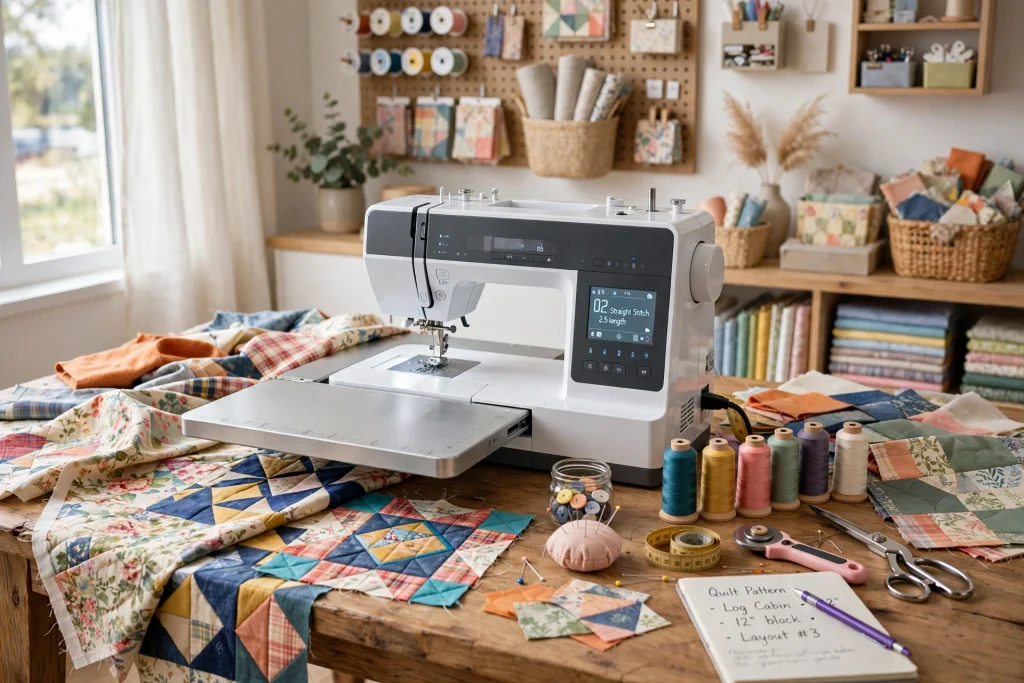

Quilting sewing machines are not the same as ordinary sewing machines, even though they look similar at first glance. A regular machine can sew a seam, but quilting asks far more of it: it must feed three thick layers at once, stitch through batting without puckering, handle a large quilt in a small throat space, and keep a steady stitch length while you move the fabric by hand. The wrong machine will fight you on every quilt, while the right one will make quilting feel calm and controlled.
This guide explains what makes quilting sewing machines different, how to choose between domestic, longarm, and mid-arm machines, which features actually matter, and how much you should pay at each level. It includes comparison tables for throat space, stitch types, and budgets, a checklist for buying a used machine, and maintenance advice that will keep your machine running well for years. Whether you are a beginner making your first lap quilt, or an experienced quilter ready to upgrade, the principles below will help you choose quilting sewing machines that suit your quilts, your space, and your budget.
What Makes Quilting Sewing Machines Different?
Quilting is different from dressmaking because of the sandwich: a quilt top, a layer of batting, and a backing fabric, all stitched together. That sandwich is thick, heavy, and hard to move, and it puts extra strain on the feed, the needle, and the motor. Quilting sewing machines are designed for that job.
The most important difference is throat space, which is the distance between the needle and the body of the machine. A larger throat gives you more room to roll and move a quilt while you stitch. The second difference is the feed system: many quilting sewing machines have a walking foot, or an even-feed foot, that moves the top layer at the same speed as the bottom layer, so the layers do not shift. The third difference is stitch control: quilting needs a consistent stitch length, a good free-motion mode, and a motor that does not slow down when it meets thick seams. A machine that is excellent for sewing clothes may still be a poor choice for quilting if it has a small throat and no walking foot.
Types of Quilting Sewing Machines
| Type | Throat space | Best for | Typical price |
|---|---|---|---|
| Domestic quilting machine | 7 to 12 inches | Beginners, lap and twin quilts | 300 to 1,500 dollars |
| High-end domestic | 11 to 13 inches | Serious quilters, large quilts | 1,500 to 4,000 dollars |
| Mid-arm machine | 16 to 20 inches | Large quilts, faster quilting | 4,000 to 8,000 dollars |
| Longarm machine | 18 to 26 inches | Professional quilting, business | 8,000 to 20,000 dollars or more |
| Hand-guided longarm on frame | 18 to 26 inches | Free-motion quilting at scale | Frame and machine combined |
Domestic Quilting Sewing Machines
Domestic quilting sewing machines are standard sewing machines with quilting features, and they are the right choice for most beginners. They sit on a table, they can also sew clothes and do general sewing, and they are the cheapest way to start quilting. Look for a throat space of at least 8 inches if you plan to quilt anything larger than a baby quilt, a walking foot included in the box, a free-motion foot, and a needle-up and needle-down function. A domestic machine will handle lap, twin, and even queen quilts, but you will need to roll the quilt tightly and work in sections.
Mid-Arm and Longarm Quilting Sewing Machines
Mid-arm and longarm quilting sewing machines are larger machines mounted on a frame, with the quilt loaded on rollers. You move the machine, not the quilt, which makes it far easier to quilt a large quilt evenly. A mid-arm machine is a good step up if you quilt often and want more space without the cost of a full longarm. A longarm machine is a professional tool, and it is usually only worth the cost if you quilt for other people, run a quilting business, or make many large quilts each year. Before you buy a longarm, check that you have the floor space for the frame, which can be 10 to 12 feet long, and that you can afford the maintenance and the learning time.
Throat Space: The Feature That Matters Most
If you remember only one number when you shop for quilting sewing machines, remember the throat space. It is measured in inches, from the needle to the right-hand side of the machine, and it decides how much quilt you can fit under the machine at once.
A throat of 5 to 6 inches, which is common on basic sewing machines, is too small for quilting anything larger than a placemat. A throat of 7 to 9 inches is workable for lap and baby quilts. A throat of 10 to 12 inches is comfortable for twin and queen quilts, and it is the sweet spot for most serious home quilters. A throat of more than 12 inches is usually found only on high-end domestic machines and on mid-arm machines. When you test a machine, bring a rolled-up quilt or a thick towel, and try to move it under the needle. That will tell you more than any specification sheet.
Essential Features in Quilting Sewing Machines
| Feature | Why it matters for quilting | Must-have? |
|---|---|---|
| Walking foot / even feed | Feeds all layers evenly, prevents shifting | Yes |
| Free-motion foot | Lets you move fabric in any direction | Yes |
| Needle up / down | Stops with needle in fabric, for pivoting | Yes |
| Stitch regulator | Keeps stitch length even in free motion | Very useful |
| Extension table | Supports a heavy quilt, reduces drag | Very useful |
| Speed control | Slows the machine for detailed work | Useful |
| Automatic thread cutter | Saves time, but not essential | Nice to have |
| Large bobbin | Fewer bobbin changes on large quilts | Useful |
A walking foot is the single most useful accessory for quilting sewing machines, and it should be included with the machine or available as an official accessory. It is essential for straight-line quilting, for stitching in the ditch, and for attaching binding. A free-motion foot, also called a darning foot, is essential for free-motion quilting, where you lower the feed dogs and move the fabric by hand. A stitch regulator, which is found on higher-end quilting sewing machines, keeps your stitch length even even if your hand speed changes, and it makes free-motion quilting far easier for beginners.
Do not pay extra for hundreds of decorative stitches if you plan mainly to quilt. Most quilters use only a few stitches: a straight stitch, a zigzag, and a blanket stitch for applique. Spend the money on throat space, a good motor, and a walking foot instead.
Free-Motion Quilting vs Walking-Foot Quilting
There are two main ways to quilt on quilting sewing machines, and most quilters use both. Walking-foot quilting is for straight lines, grids, and gentle curves. You use the walking foot, you keep the feed dogs up, and the machine feeds the quilt for you. It is the best way to start, because it is controlled and predictable, and it is ideal for modern, geometric quilts.
Free-motion quilting is for curves, feathers, stippling, and flowing designs. You lower the feed dogs, attach a free-motion foot, and move the quilt by hand while the needle stitches. It takes practice, and your first attempts will be uneven, but it gives you complete freedom. Start with a small practice sandwich, use a speed that feels comfortable, and keep your hands close to the needle. A stitch regulator will help, but practice matters more than any feature.
How Much Should You Pay for Quilting Sewing Machines?
| Budget | What you get | Who it suits |
|---|---|---|
| Under 500 dollars | Basic domestic machine, small throat, walking foot may be extra | Beginners testing quilting |
| 500 to 1,500 dollars | Good domestic quilting machine, 8 to 10 inch throat, walking foot included | Regular quilters, most home use |
| 1,500 to 4,000 dollars | High-end domestic, 11 to 13 inch throat, stitch regulator, large bobbin | Serious quilters, large quilts |
| 4,000 to 8,000 dollars | Mid-arm machine, frame, large throat | Frequent quilters, large quilts |
| 8,000 dollars or more | Longarm machine, frame, computerised options | Professional and business use |
Do not buy the cheapest machine you can find if you plan to quilt regularly. A machine with a small throat and a weak motor will frustrate you, and you will upgrade within a year. It is better to buy a good mid-range machine and keep it for five or ten years. Also budget for accessories: a walking foot, a free-motion foot, an extension table, quilting needles, and good thread will add 100 to 300 dollars to the cost, and they are not optional.
Buying Used Quilting Sewing Machines: A Checklist
Used quilting sewing machines can be excellent value, but only if you test them properly. A used machine that has been serviced regularly can last for decades, while a used machine that has been neglected can cost more to repair than it is worth.
- Test the machine with a real quilt sandwich, not just a single layer of cotton.
- Check that the walking foot and free-motion foot are included, or budget to buy them.
- Listen for grinding, clicking, or uneven motor sounds.
- Check that the stitch length is even, and that the tension is balanced on both sides.
- Ask when it was last serviced, and by whom.
- Check that the bobbin case, the feed dogs, and the needle plate are not damaged.
- Ask for the manual, the power cord, and any extra feet that came with the machine.
- Buy from a dealer if you can, because you will get a service and a warranty.
If the seller will not let you test the machine, or if the machine has been stored in a damp garage, walk away. A good used machine from a reputable dealer is a far safer buy than a cheap machine from an unknown seller.
Fabric, Thread, and Needles for Quilting
The machine is only part of quilting. Fabric, thread, and needles matter just as much. Use 100 percent cotton fabric for most quilts, because it is stable, easy to sew, and easy to press. Use a quilting needle, which has a tapered point that goes through layers without damaging the fabric, and change it after every project, or after about eight hours of sewing. Use a good-quality cotton or polyester thread, and do not use old thread that breaks easily.
When you finish a quilt, you will need to wash it carefully, and the care labels on the fabric will guide you. Our guide to clothing wash care symbols explains the symbols you will see on fabric and on finished quilts, and our guide to comfortable women’s clothing covers fabric comfort and fit in a different context, but many of the same cotton and blend principles apply to quilt fabrics. Sewing technology is also changing, and our article on seamless technology in comfort clothing shows how new sewing methods are changing the way fabrics are joined, which is relevant to anyone interested in how machines and fabric work together.
Maintaining Your Quilting Sewing Machine
Quilting creates a lot of lint, because batting sheds fibres, and that lint will clog your machine if you do not clean it. Clean the bobbin area after every project, using a small brush, not compressed air, which can push lint deeper into the machine. Oil the machine only if the manual says to, and only with the oil recommended for that model. Many modern quilting sewing machines are designed not to need oiling, and the wrong oil can damage them.
Have your machine serviced once a year if you quilt regularly, and more often if you quilt every day. A service will check the timing, the tension, and the motor, and it will catch problems before they become expensive. Store the machine in a dry place, cover it when you are not using it, and do not leave it in a cold garage, because condensation can cause rust.
Common Mistakes When Choosing Quilting Sewing Machines
- Choosing a machine with a small throat, and then finding you cannot fit a quilt under it.
- Buying a machine without a walking foot, and then paying extra for one later.
- Paying for hundreds of decorative stitches you will never use for quilting.
- Buying a longarm machine before you have the space, the time, and the quilts to justify it.
- Skipping a test sew, and finding the machine does not handle thick seams well.
- Using the wrong needle, and then blaming the machine for skipped stitches.
- Forgetting to budget for an extension table, feet, and good thread.
Frequently Asked Questions
Can I quilt on a regular sewing machine?
Yes, you can quilt on a regular sewing machine, especially for small quilts, if it has a walking foot and a free-motion foot. For larger quilts, quilting sewing machines with a larger throat space will make the work far easier, and they are worth the upgrade if you quilt regularly.
What is the best throat space for quilting?
For most home quilters, a throat space of 10 to 12 inches is ideal. It is large enough for twin and queen quilts, but the machine is still small enough to sit on a table. A throat of 7 to 9 inches is workable for lap quilts, while a throat of more than 12 inches is found on high-end and mid-arm machines.
Do I need a longarm machine to quilt?
No. Most quilters never need a longarm machine. Domestic quilting sewing machines can quilt lap, twin, and queen quilts, and a mid-arm machine is a good middle step if you quilt very often. A longarm machine is mainly for professional quilters and quilting businesses.
What is the difference between a walking foot and a free-motion foot?
A walking foot feeds all the layers of a quilt evenly, and it is used for straight-line quilting. A free-motion foot lets you move the fabric in any direction by hand, and it is used for free-motion quilting, curves, and decorative designs.
How often should I service my quilting machine?
Have it serviced once a year if you quilt regularly, and clean the bobbin area after every project. Change the needle after every quilt, and use good-quality thread to reduce lint and breakage.
Is it worth buying a used quilting sewing machine?
Yes, if you test it with a real quilt sandwich, check that the feet are included, and buy from a dealer who will service it. A well-maintained used machine can be excellent value, and many older machines are very durable.
The Bottom Line
The best quilting sewing machines are not the most expensive ones, and they are not the ones with the most stitches. They are the machines whose throat space fits your quilts, whose walking foot feeds the layers evenly, whose motor handles thick seams without slowing down, and whose controls feel comfortable in your hands. Start by deciding what size quilts you will make, then choose a throat space that fits them, then check the walking foot, the free-motion foot, and the stitch regulator. Test the machine with a real quilt sandwich before you buy it, budget for the accessories you will need, and have it serviced regularly. Get those basics right, and your quilting sewing machine will make quilting easier, not harder, for years to come.