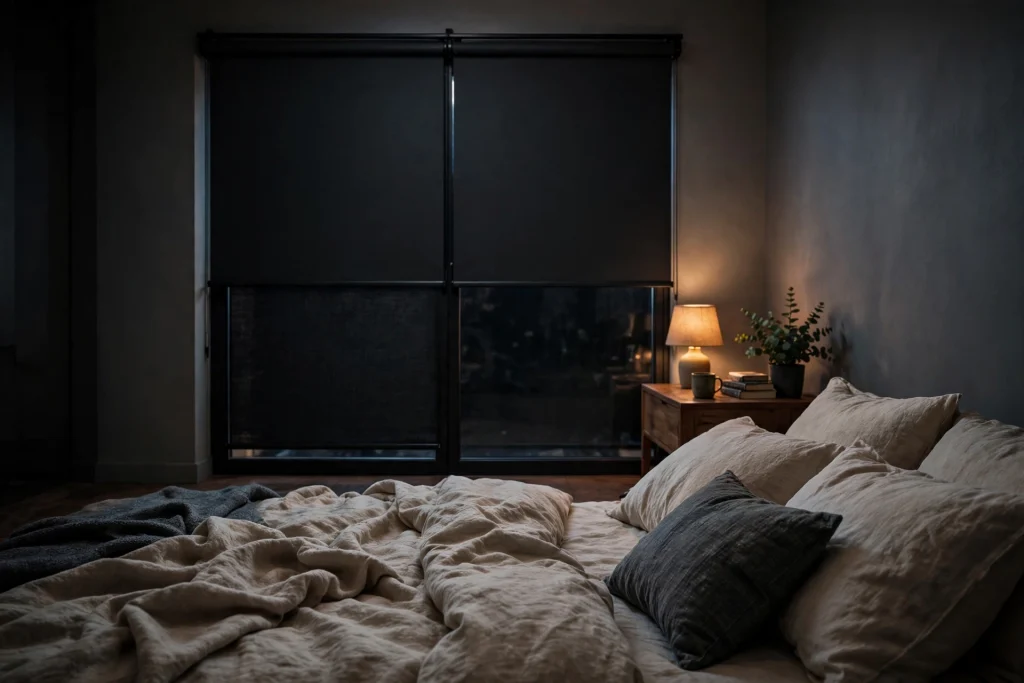

Blackout roller blinds are the simplest way to make a room properly dark, and they are also one of the most misunderstood window coverings you can buy. Many people buy a set labelled blackout, fit it inside the window frame, and then wonder why a bright line of light still leaks in around the edges at 6 a.m. The blind itself may be genuinely blackout, but the way it was measured, mounted, and sized decides whether your room is dark or merely dim.
This guide explains how blackout roller blinds work, how they differ from dim-out and room-darkening blinds, how to measure for inside and outside mounts, how to fix light gaps, and how to choose between cordless, chain, and motorised operation. It also includes cost tables, a measuring checklist, and cleaning advice, so you can buy once and get the darkness you actually want. Blackout roller blinds are a practical choice for bedrooms, nurseries, shift workers, home cinemas, and anyone whose sleep is disturbed by street lights or early sun.
What Are Blackout Roller Blinds?
Blackout roller blinds are roller blinds made from a fabric with a light-blocking coating, usually a layer of acrylic or a laminated backing, that stops almost all light from passing through the fabric itself. When the blind is down, the fabric is opaque. That is different from a standard roller blind, which may be sheer or light-filtering, and different from a dim-out blind, which reduces light but still lets a noticeable amount through.
Blackout roller blinds do not make a room completely dark on their own. Light can still leak around the sides, top, and bottom of the blind, through gaps between the blind and the window frame, and under a door. True darkness comes from the combination of a blackout fabric and a good fit. That is why measuring and mounting matter as much as the fabric, and why the cheapest blind, badly fitted, can be worse than a mid-priced blind fitted well.
Blackout Roller Blinds vs Dim-Out, Sheer, and Curtains
| Window covering | Light blocked | Privacy at night | Best for |
|---|---|---|---|
| Blackout roller blinds | 99 to 100% through fabric | Full | Bedrooms, nurseries, shift work |
| Dim-out roller blinds | 80 to 95% | Full | Living rooms, offices |
| Light-filtering roller blinds | 30 to 70% | Daytime only | Kitchens, living rooms |
| Sheer roller blinds | 10 to 30% | Daytime only | Privacy in daylight |
| Blackout curtains | 95 to 100% through fabric | Full | Bedrooms, large windows |
| Blackout roller blinds + curtains | Near total, gaps covered | Full | Best darkness, insulation |
Blackout roller blinds are neater and easier to clean than curtains, they take up less space, and they are usually cheaper. Curtains, on the other hand, can cover the sides of a window and reduce light gaps, and they add insulation and softness to a room. Many people get the best result by combining the two: blackout roller blinds for the main light block, and curtains, or side channels, to cover the edges. If you are choosing between blinds and curtains for a large or awkward window, our guide to curtains for sliding glass doors explains how to choose style, size, and fabric for wide openings, and many of the same measuring principles apply.
How to Measure Blackout Roller Blinds: Inside vs Outside Mount
Measuring is the step that decides whether your blackout roller blinds work. Measure twice, write the numbers down, and check them again before you order. Use a metal tape measure, measure in millimetres or centimetres, and do not round up or down.
Inside mount: fitting inside the window recess
An inside mount fits the blind inside the window frame. It looks neat, it leaves the window sill clear, and it is the most common choice. Measure the width of the recess at the top, middle, and bottom, and use the smallest measurement. Measure the height at the left, middle, and right, and use the longest measurement. The blind will be made slightly narrower than the recess so it can move freely, and that gap is where light leaks in. Expect a gap of about 10 to 20 millimetres on each side, depending on the brackets and the fabric roll.
Outside mount: fitting on the wall or frame
An outside mount fits the blind on the wall above the window, or on the window frame, so the fabric overlaps the opening. It blocks far more light, because the fabric covers the edges of the window, and it is the best choice if you want maximum darkness. Measure the width of the window opening, then add at least 50 to 75 millimetres on each side, and add at least 75 to 100 millimetres above the top of the window. That overlap is what stops the light leaking around the sides. Outside mounts also work better on windows that are not square, or on windows with handles that would obstruct an inside blind.
| Mount type | Darkness | Look | Best when |
|---|---|---|---|
| Inside mount | Good, with side gaps | Neat, recessed | You want a tidy fit and some light is OK |
| Outside mount | Best, gaps covered | Bolder, covers frame | You want maximum darkness |
| Inside + side channels | Near total | Neat, modern | Shift work, nurseries, home cinema |
| Inside + curtains | Near total | Soft, layered | Bedrooms, insulation matters |
Always check the depth of your window recess before you order an inside mount. You need enough depth for the brackets and the rolled fabric, usually at least 60 to 75 millimetres. If the recess is too shallow, the blind will stick out, or you will need an outside mount instead.
How to Fix Light Gaps Around Blackout Roller Blinds
Light gaps are the most common complaint about blackout roller blinds, and they are almost always fixable. The first step is to find where the light is coming from. Check the sides first, then the top, then the bottom. The side gaps are usually the largest, because the fabric is narrower than the recess.
- Choose an outside mount, so the fabric overlaps the window opening on all sides.
- Add side channels, which are slim tracks that the blind runs in and that block light at the edges.
- Add a pelmet or a cassette at the top, which covers the roll and blocks light from above.
- Use a bottom bar that sits flat against the sill, so light does not leak underneath.
- Layer curtains over the blind, which will cover the sides and add insulation.
- Check that the blind is level. A blind that is not level will leave a larger gap on one side.
If you already have blackout roller blinds with gaps, you do not need to replace them. Side channels and a pelmet can often be added, and curtains are the simplest fix. Do not expect a single blind, fitted inside a recess, to give you total darkness on its own.
Motorised, Cordless, and Chain Operation: Which Is Best?
Blackout roller blinds come with three main types of operation, and the right choice depends on who will use them, how high the window is, and your budget.
Chain operation is the cheapest and most common. A continuous chain loop raises and lowers the blind. It is reliable and easy to repair, but the chain can be a safety risk for small children and pets, and it can look untidy. Always use a chain safety device, and keep the chain out of reach of a cot or bed.
Cordless operation uses a spring mechanism, so you push the blind up or pull it down by hand. It is safer for children, it looks cleaner, and it is a good choice for bedrooms and nurseries. It can be harder to use on very large or heavy blinds, and the spring may need adjusting over time.
Motorised blackout roller blinds are operated by a remote, a wall switch, or a smart home system. They are the easiest to use, they are the safest for children, because there is no cord or chain, and they are ideal for high windows, large blinds, and people with limited mobility. They cost more, they need power, either a battery or a mains connection, and the motor may need replacing after several years. If you want to open and close your blinds on a schedule, or control them from bed, motorised blinds are worth the extra cost.
How Much Do Blackout Roller Blinds Cost?
| Type | Typical price per blind | What affects the price |
|---|---|---|
| Ready-made, chain | 20 to 60 dollars | Size, fabric, shop |
| Made-to-measure, chain | 60 to 150 dollars | Size, fabric, finish |
| Made-to-measure, cordless | 80 to 180 dollars | Size, spring mechanism |
| Motorised, made-to-measure | 150 to 400 dollars | Motor, remote, smart control |
| Side channels and pelmet | 30 to 100 dollars extra | Length, material |
| Professional fitting | 30 to 80 dollars per blind | Location, number of blinds |
Prices vary by size, fabric, and retailer, and large windows cost far more than small ones. Ready-made blinds are cheaper, but they come in standard sizes and may not fit your window exactly, which means more light gaps. Made-to-measure blinds cost more, but they fit better and block more light. For a bedroom where darkness matters, made-to-measure is usually worth the extra cost. Get at least two quotes, check what is included in the price, and ask whether fitting is included.
Blackout Roller Blinds for Bedrooms, Nurseries, and Shift Workers
Darkness is not just about comfort, it is about sleep. Light, even a small amount, can suppress melatonin, the hormone that helps you fall asleep, and it can wake you earlier than you want. That is why blackout roller blinds are so useful in bedrooms, and why they matter even more for people who sleep during the day.
For a bedroom, choose an outside mount if you can, add side channels or curtains if you need total darkness, and choose a cordless or motorised blind if you have children. For a nursery, safety is the first priority: choose a cordless or motorised blind, keep all cords out of reach, and do not place a cot under a window with a chain blind. For shift workers, combine blackout roller blinds with curtains, a sleep mask as a backup, and a cool, quiet room. Our guide to a healthy home bedroom covers light, air, and temperature together, and our best bedtime routine for adults explains how darkness fits into a regular sleep schedule.
Cleaning and Maintaining Blackout Roller Blinds
Blackout roller blinds are easy to maintain, but the coating that blocks light can be damaged by harsh cleaning. Dust them regularly with a soft cloth, a feather duster, or a vacuum cleaner with a brush attachment on a low setting. For marks, wipe gently with a damp cloth and a small amount of mild soap, then wipe with clean water and let the blind dry fully before you roll it up. Do not use bleach, do not use abrasive cleaners, and do not put a blackout blind in a washing machine.
If the blind starts to roll unevenly, check that it is level, check that the fabric is not catching on the brackets, and check that the chain or spring is working smoothly. A blind that rolls to one side usually needs the brackets to be levelled, not a new blind. If the motor in a motorised blind stops working, check the battery or power supply first, then the remote, before you call a repairer.
Mistakes to Avoid With Blackout Roller Blinds
- Measuring only once, or measuring only the width at the top of the window.
- Choosing an inside mount when you need maximum darkness, and then being surprised by side gaps.
- Buying a dim-out blind by mistake, because the label said room darkening rather than blackout.
- Choosing a chain blind for a nursery or a child’s bedroom.
- Ordering a ready-made blind that is slightly too small, to save money, and then living with light leaks.
- Cleaning a blackout blind with bleach or a harsh cleaner, and damaging the coating.
- Forgetting to check the recess depth, and finding the blind will not fit inside the frame.
Frequently Asked Questions
Do blackout roller blinds block all light?
Blackout roller blinds block almost all light through the fabric itself, but light can still leak around the sides, top, and bottom. An outside mount, side channels, or curtains will reduce those gaps and give you near-total darkness.
Are blackout roller blinds good for bedrooms?
Yes, blackout roller blinds are one of the best choices for bedrooms, especially for light sleepers, shift workers, and people who are woken by street lights or early sun. Choose an outside mount and a cordless or motorised blind for the best result.
What is the difference between blackout and dim-out blinds?
Blackout blinds block 99 to 100 percent of light through the fabric. Dim-out blinds block 80 to 95 percent, and still let a noticeable amount of light through. If you need a dark room for sleep, choose blackout, not dim-out.
Can I fit blackout roller blinds myself?
Yes, most blackout roller blinds are designed for DIY fitting, and you need only a drill, a level, and a tape measure. Measure carefully, check that the brackets are level, and follow the instructions. For large, heavy, or motorised blinds, professional fitting is worth considering.
Do blackout roller blinds help with heat?
Yes, blackout roller blinds can help to keep a room cooler in summer by blocking sunlight, and they can add a small amount of insulation in winter. They are not a substitute for proper insulation, but they do reduce heat gain through a window.
How do I clean blackout roller blinds?
Dust them regularly, wipe marks with a damp cloth and mild soap, and let them dry fully before rolling them up. Do not use bleach or abrasive cleaners, and do not machine wash them.
The Bottom Line
Blackout roller blinds work best when you treat them as a system, not just a fabric. Choose a true blackout fabric, measure carefully, choose an outside mount if you want maximum darkness, and add side channels or curtains to cover the gaps. Choose cordless or motorised operation if you have children, or if the window is high or large. And buy made-to-measure if darkness really matters to you, because a blind that fits properly will block far more light than a cheaper blind that does not. Get the fit right, and blackout roller blinds will give you the dark, quiet room that makes good sleep much easier.