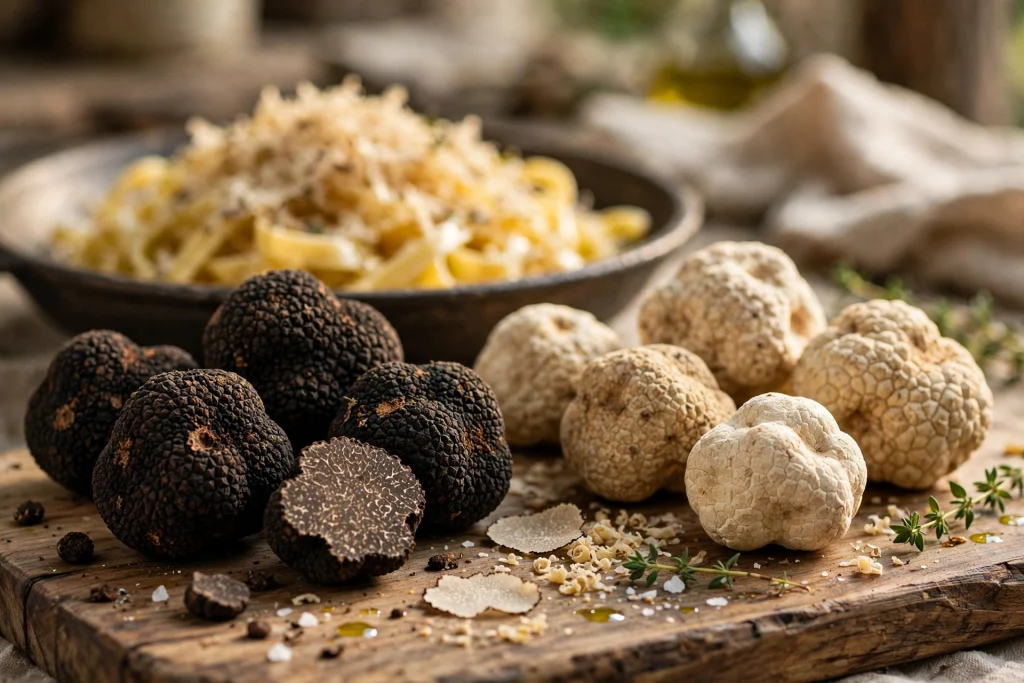

A truffle mushroom is not quite a mushroom and not quite a plant. It is the fruiting body of a fungus that grows underground, attached to the roots of trees such as oak, hazelnut, and beech. Unlike the mushrooms you see in a supermarket, a truffle never breaks the surface. It is found with the help of trained dogs or pigs, dug up by hand, and sold fresh within days. That rarity, and its powerful aroma, is why truffles are among the most expensive foods in the world.
Truffles have been prized since Roman times, when they were served at feasts and believed to have special powers. Today they are a symbol of fine dining, but they are also used in everyday cooking in truffle oil, truffle butter, and truffle salt. This guide explains what a truffle mushroom is, the main types, what it tastes like, how to use it, and how to store it so you get the most from every gram.
What Is a Truffle Mushroom?
A truffle is a type of fungus, like a mushroom, but it grows completely underground. It forms a symbiotic relationship with the roots of a host tree. The fungus helps the tree absorb water and minerals, and the tree gives the fungus sugars made through photosynthesis. This partnership, called mycorrhiza, is essential. Without the right tree, soil, and climate, truffles will not grow.
Truffles are found in specific regions, including France, Italy, Spain, and parts of Australia and the United States. Black truffles, often called Perigord truffles, come mainly from France and Spain. White truffles, the most expensive kind, come mainly from Alba in Italy. Summer truffles are more common and more affordable, while winter truffles are stronger and more prized.
Because truffles grow underground, they cannot be farmed in the same way as button mushrooms. Farmers plant orchards of inoculated trees and wait years, sometimes seven to ten years, for the first truffles to appear. Even then, the harvest is uncertain. A dry summer, a cold winter, or the wrong soil pH can mean no truffles at all. That long wait and high risk help explain the price.
Types of Truffle Mushroom
| Type | Colour and appearance | Flavour | Season | Price level |
|---|---|---|---|---|
| White truffle (Tuber magnatum) | Pale cream, smooth skin | Intense, garlicky, musky | Autumn | Very high |
| Black Perigord truffle (Tuber melanosporum) | Black, rough skin, dark flesh | Earthy, chocolatey, rich | Winter | High |
| Summer truffle (Tuber aestivum) | Black, rough skin, pale flesh | Mild, nutty, delicate | Summer | Moderate |
| Burgundy truffle (Tuber uncinatum) | Black skin, brown flesh | Nutty, earthy, hazelnut notes | Autumn | Moderate to high |
| Oregon white truffle | Pale, irregular shape | Garlicky, floral, spicy | Winter | Moderate |
White truffles are usually eaten raw, shaved thinly over a finished dish. Heat destroys much of their delicate aroma, so they are never cooked for long. Black truffles are more robust and can be gently warmed in butter, cream, or a sauce, which helps release their flavour. Summer truffles are milder, so you need more of them to make an impact, but they are a good starting point if you are trying truffle for the first time.
There are also many products made with truffle, including truffle oil, truffle butter, truffle salt, and truffle paste. These are more affordable and easier to use, but their quality varies widely. Some truffle oils are made with real truffle, while others use a synthetic compound called 2,4-dithiapentane to mimic the aroma. Read the label and choose products that list real truffle as an ingredient if you want the genuine flavour.
What Does Truffle Taste Like?
Truffle is difficult to describe because its flavour is unlike anything else. People often use words such as earthy, musky, garlicky, nutty, and umami. A white truffle smells strongly of garlic, cheese, and damp earth, with a hint of honey. A black truffle is deeper and more chocolatey, with notes of forest floor and dried fruit.
The aroma is as important as the taste. Much of what you experience when you eat truffle comes through your nose, not your tongue. That is why truffles are usually shaved over hot food, so the steam carries the aroma up. A small amount goes a long way. Ten grams, about the size of a walnut, is enough to flavour a dish for two people.
If you have never tried truffle, start with a simple dish where the truffle is the star, such as fresh pasta with butter and Parmesan, scrambled eggs, or risotto. Rich, fatty foods carry the flavour well, because many of the aromatic compounds in truffle dissolve in fat. A plain dish lets you taste the truffle itself, rather than a dozen competing flavours.
How to Use Truffle Mushroom in Cooking
Use fresh truffle as a finishing ingredient, not as a main ingredient to be cooked for a long time. Shave it thinly with a truffle slicer, a mandoline, or a sharp knife, and add it at the very end. For white truffle, shave it directly onto the plate. For black truffle, you can warm it briefly in butter or fold it into a sauce just before serving.
Classic pairings include eggs, pasta, risotto, potatoes, cheese, and mushrooms. Truffle and eggs are a particularly good match, because the richness of the egg yolk carries the truffle aroma beautifully. Try shaving truffle over a simple egg dish, such as our baked eggs recipe with cheese, spinach, and tomatoes, for a luxurious weekend breakfast. Truffle also works well with creamy sauces, mashed potatoes, and mild cheeses such as Brie or burrata.
For everyday cooking, truffle oil and truffle butter are easier to use. Add a few drops of truffle oil to fries, popcorn, pasta, or a salad dressing just before serving, and do not heat it strongly. Stir truffle butter into mashed potatoes, melt it over steak, or spread it on warm bread. A little is enough, and too much can overwhelm the dish and taste artificial.
When you are planning a meal around truffle, keep the rest of the menu simple. A truffle pasta or risotto pairs well with a simple side, and our guide to side dishes for ham shows how a few fresh, simple sides can support a rich main dish without competing with it. For a quick weeknight version, a truffle butter pasta can be ready in the time it takes to cook the pasta, as with many of the ideas in our collection of fast and easy dinner recipes.
How Much Truffle Do You Need?
For a fresh truffle, plan on 5 to 10 grams per person for a main dish, and 3 to 5 grams per person for a starter or garnish. That is roughly one small truffle per two people. For truffle oil, start with half a teaspoon per serving and add more to taste. For truffle butter, a tablespoon per serving is usually enough.
Buy the smallest amount you need and use it quickly. Fresh truffles lose aroma every day after they are dug up, so a large truffle bought for a single meal is a waste if half of it sits in the fridge. If you want to try truffle without a large cost, look for a summer truffle, a small black truffle, or a good truffle butter made with real truffle.
How to Store Truffle Mushroom
Fresh truffles should be used within five to seven days. Wrap each truffle individually in a paper towel, place it in a sealed glass jar or airtight container, and store it in the fridge. Change the paper towel every day, because moisture is the enemy. A damp truffle will go soft and lose its aroma faster.
Do not store truffles in rice, as is sometimes suggested, unless you plan to use the rice as well. Rice draws moisture from the truffle and can dry it out, although the rice itself will pick up a little truffle aroma and can be used for risotto. Do not wash a truffle until just before you use it. Brush off any soil with a soft brush or a damp cloth, and trim away any damaged parts.
For longer storage, you can freeze a black truffle, although the texture will change. Wrap it tightly, freeze it whole, and grate it while still frozen into hot dishes. White truffles do not freeze well and are best eaten fresh. Truffle butter and truffle oil keep longer, usually several weeks in the fridge for butter and several months in a cool, dark place for oil, but check the label for the best-before date.
A useful trick is to store eggs in the same container as a fresh truffle for a day or two. The porous eggshells absorb the truffle aroma, so the eggs themselves will taste faintly of truffle when you cook them. It is a simple way to get extra value from a single truffle.
Nutrition and Health Notes
Truffles are low in calories and fat, and they contain fibre, vitamin C, iron, and antioxidants. Because you eat so little at a time, they are not a significant source of nutrition on their own, but they add a lot of flavour without adding many calories, salt, or sugar. That makes them a useful way to make simple, healthy foods feel special.
People with a mushroom allergy should be careful with truffles, because they are fungi. If you have never eaten truffle before, try a small amount first. Truffle oil and other products may also contain allergens, so read the label, especially if the product is made in a factory that handles nuts, milk, or gluten.
Frequently Asked Questions
Is a truffle mushroom a real mushroom?
Yes, in the sense that it is a fungus, but it is not a typical mushroom. It grows underground, never forms a cap or stem above the soil, and is harvested by hand with the help of trained dogs.
Why are truffles so expensive?
Truffles are rare, hard to find, slow to grow, and have a short season. They cannot be farmed like ordinary mushrooms, they lose aroma quickly after harvest, and demand from restaurants is high. All of that pushes the price up.
Can you eat truffle mushroom raw?
Yes, white truffles are usually eaten raw, shaved thinly over a finished dish. Black truffles can be eaten raw or gently warmed. Wash and brush the truffle just before use, and do not cook it for a long time.
What is the best substitute for truffle?
There is no perfect substitute, but truffle oil, truffle butter, or truffle salt made with real truffle can give a similar aroma at a lower cost. Mushrooms with a little garlic and Parmesan can give an earthy, savoury flavour, but they will not taste like truffle.
How long does a fresh truffle last?
Five to seven days in the fridge if wrapped in a paper towel and stored in an airtight container, with the paper changed daily. Use it as soon as you can, because the aroma fades every day.
A truffle mushroom is a small luxury, but it does not have to be intimidating. Choose a type that fits your budget, use it simply, shave it thinly, and let its aroma do the work. Start with eggs, pasta, or risotto, store it carefully, and enjoy it while it is fresh. Once you have tasted a real truffle, you will understand why cooks have prized it for centuries.