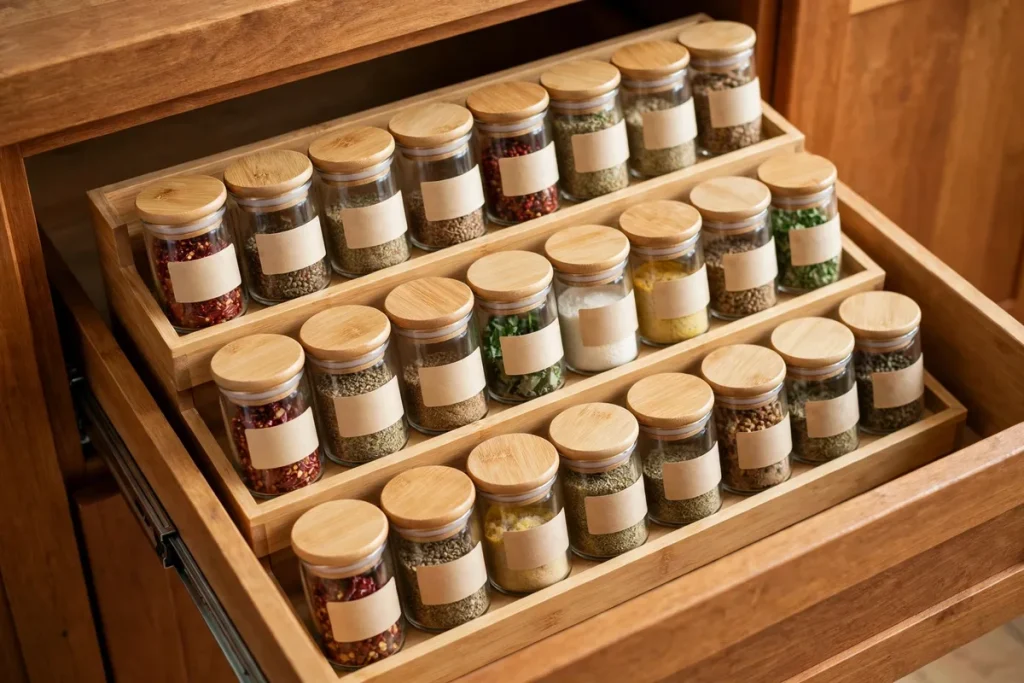

A drawer spice rack turns a messy kitchen drawer into a system you can actually use. Instead of digging through a jumble of jars in a cabinet, you open one drawer and see every spice at a glance. With the right insert, matching jars, and a sensible layout, cooking gets faster and your counters stay clear.
What Is a Drawer Spice Rack?
A drawer spice rack is any insert, tray, or set of jars designed to store spices inside a kitchen drawer rather than on a shelf or in a cabinet. Some inserts hold jars at a tilt so the labels face up; others are tiered steps that raise each row above the one in front. The idea is the same either way: every spice should be visible and reachable without moving half a dozen jars out of the way.
Drawer storage suits most kitchens because drawers are usually easier to reach than high cabinet shelves, and a shallow drawer is often the perfect depth for spice jars. If you are planning a bigger update, our guide to kitchen remodeling explains how to plan storage before you commit to new cabinets.
Tiered Inserts: The Key to Seeing Every Jar
Tiered inserts are the most popular choice for a drawer spice rack, and for good reason. Each row sits slightly higher than the row in front of it, like steps, so the labels on the back rows stay visible. Without tiers, jars at the back of a drawer disappear behind the jars in front, which defeats the purpose.
Choose an insert that fits your drawer rather than forcing a standard size into it. Many inserts expand sideways to fill wider drawers, and some can be trimmed to length. A snug fit matters: an insert that slides around every time you open the drawer will frustrate you and chip your jars.
If your drawer is very shallow, a flat tray with rows of jars lying on their sides may work better than a tiered insert. Flat trays keep jars low, but you will need to label the lids so you can read them from above.
Uniform Jars and Labels
Uniform jars are the second secret of a tidy drawer spice rack. When every jar is the same size and shape, rows line up neatly, inserts fit properly, and you can use the full width of the drawer. Mixed jars from different brands leave awkward gaps and waste space.
Glass jars with airtight lids are a good default: they keep spices fresh, they do not absorb odors, and you can see how much is left. Pick a jar size that matches how much you cook. A standard 4-ounce jar suits most households, while keen cooks may prefer larger jars for everyday spices like cumin, paprika, and black pepper.
Labels matter as much as the jars. Label the part of the jar you see when the drawer opens: the lid for flat trays, the side for tilted or tiered inserts. Include the spice name, and consider adding the purchase date so you know when a spice is past its best. Ground spices usually lose their punch after about a year, while whole spices last longer.
Measure Your Drawer Before You Buy
Measuring takes five minutes and saves a return trip. Empty the drawer, then measure three things:
- The inside width, from one side wall to the other.
- The inside depth, from front to back.
- The inside height, from the drawer floor to the top edge, so you know how tall a jar plus insert can be before the drawer stops closing.
Write the numbers down and compare them with the insert dimensions before ordering. Remember to leave a little clearance above the tallest jar so the drawer closes smoothly even when it is full. If you have a very deep drawer, consider a two-part insert or a tray at the front with bulk items stored behind it.
Layout Tips That Keep Spices Easy to Find
Once the insert and jars are ready, arrange the drawer so the spices you reach for most often are easiest to grab. A few layout rules help:
- Group spices by how you cook: everyday cooking spices together, baking spices together, and chili and heat in one section.
- Put your most-used spices at the front of the drawer, closest to your hand when it opens.
- Arrange alphabetically within each group if you have a large collection, so you can find an unusual spice without scanning every jar.
- Keep duplicates and rarely used spices at the back, or move them to a second drawer or pantry shelf.
- Leave one small gap at the end of a row for new jars, so adding a spice does not mean rearranging the whole drawer.
The same organization ideas work beyond the drawer, too. If you want to tidy the rest of your kitchen, see how to use storage shelves for better home and workplace organisation.
Keeping Your Drawer Spice Rack Working
A drawer spice rack only stays useful if you maintain it. When you finish a jar, wash it before refilling so old residue does not dull the flavor of the new spice. Check dates once or twice a year and replace ground spices that have lost their aroma. And when you buy a new spice, give it a jar and a label right away, before it ends up loose in the drawer and the system starts to slip.
Done well, a drawer spice rack is one of the cheapest kitchen upgrades you can make. It costs little, takes an afternoon at most, and pays off every time you cook.
Frequently Asked Questions
What is a drawer spice rack?
A drawer spice rack is an insert or set of jars that lets you store spices flat or tilted inside a kitchen drawer, so you can see every label at a glance instead of digging through a cabinet.
How do I measure a drawer for a spice insert?
Measure the inside width, depth, and height of the drawer, then check the jar height plus the insert thickness so the drawer still closes easily.
Are tiered inserts better than flat trays?
Tiered inserts are usually better because each row sits higher than the one in front, so labels stay visible; flat trays work well in shallow drawers.
Should all my spice jars match?
Matching jars are not required, but uniform jars make the drawer look tidier and make it easier to fit rows evenly, so most people standardize on one jar size.
How should I label spice jars?
Label the lids or the sides you see when you open the drawer, and include the spice name and, if you like, the purchase date so you know when to replace old spices.